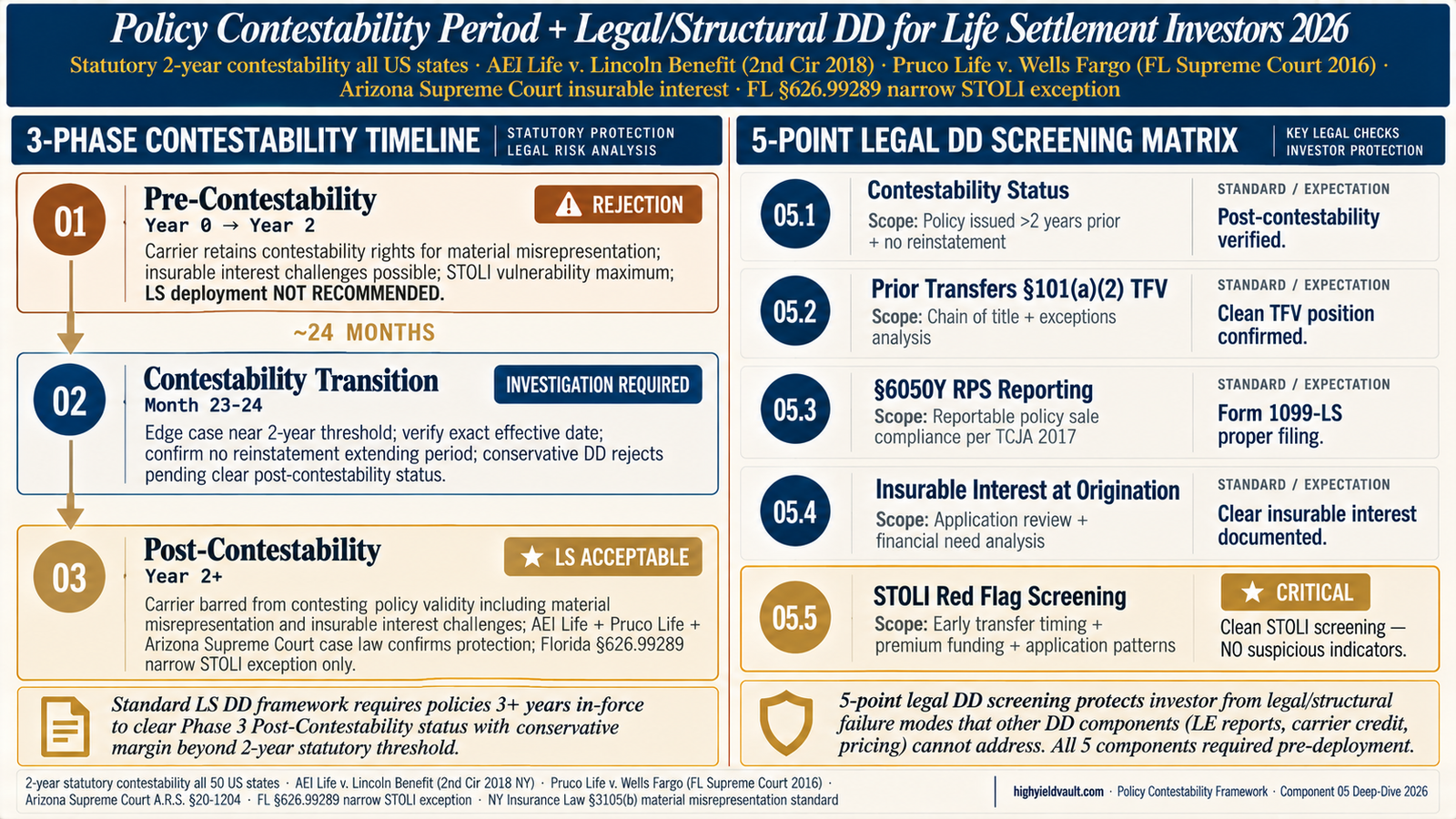
Policy contestability period and legal/structural DD represent Component 05 of the 7-component DD framework and require systematic 3-phase timeline analysis (Pre-Contestability Year 0-2 DD rejection / Contestability Transition Months 23-24 investigation required / Post-Contestability Year 2+ LS acceptable) PLUS 5-point legal DD screening (contestability status / prior transfers IRC §101(a)(2) TFV / §6050Y RPS compliance / insurable interest at origination / STOLI red flag screening). The 2-year statutory contestability period applies in all 50 US states with carrier rights to contest policy validity for material misrepresentation barred after 2 years from policy effective date (or last reinstatement). Landmark case law confirms broad incontestability protection: AEI Life LLC v. Lincoln Benefit Life Co. (2nd Circuit 2018) applied NY incontestability to bar STOLI challenges; Pruco Life v. Wells Fargo (Florida Supreme Court 2016) held FL incontestability applies even to STOLI; Arizona Supreme Court confirmed A.R.S. §20-1204 bars insurable interest challenges after 2 years. Sole significant exception: Florida STOLI exception statute §626.99289 added by legislature post-Pruco creates narrow STOLI-specific carve-out for FL policies only.
The 5-point legal DD screening: Component 05.1 Contestability Status (verify >2 years in-force with no reinstatement extending period); Component 05.2 Prior Transfers IRC §101(a)(2) TFV (chain of title + §101(a)(2) exceptions analysis per Day 103 cornerstone); Component 05.3 §6050Y RPS Compliance (reportable policy sale Form 1099-LS proper filing per TCJA 2017); Component 05.4 Insurable Interest at Origination (application review + financial need analysis documenting valid insurable interest); Component 05.5 STOLI Red Flag Screening GOLD-HIGHLIGHTED CRITICAL (early transfer timing + premium funding source + application pattern analysis identifying stranger-origination indicators). All 5 components required pre-deployment; failure of any single component typically triggers DD rejection or elevated scrutiny.
See LS policies with Component 05 verification ready for your DD
Every HYV listing includes contestability status documentation, chain of title review summary, and legal/structural compliance verification prepared for your Component 05 DD execution. Our internal legal/structural assessment precedes platform listing; your independent attorney-coordinated verification completes your position-specific DD.
Browse available policiesWhy contestability is the foundational legal shield for LS investors
Component 05 Legal/Structural Compliance is positioned alongside Component 03 Carrier Credit Quality as foundational framework because legal/structural failures cannot be mitigated through other DD components if a policy with contestability or STOLI vulnerabilities is accepted. A policy with perfect LE reports, excellent A+ carrier credit, optimal pricing, and clean escrow structure becomes investor loss scenario if the carrier successfully contests policy validity during the hold period for material misrepresentation or insurable interest challenges. The 2-year statutory contestability period provides broad investor protection once cleared — but policies acquired within the 2-year window carry residual carrier contestability risk that no other framework component addresses.
The landmark case law establishes the strength of post-contestability investor protection across multiple US jurisdictions. In AEI Life LLC v. Lincoln Benefit Life Co. (2nd Circuit 2018), the court applied NY's 2-year incontestability framework to bar Lincoln Benefit's challenge to a STOLI-pattern policy, holding that NY Insurance Law incontestability provisions apply even to policies with alleged STOLI characteristics once the 2-year period lapses. The court declined to recognize a judicial fraud exception to NY's statutory incontestability, instead holding that any STOLI-specific carve-out would require legislative action. In Pruco Life Insurance Co. v. Wells Fargo (Florida Supreme Court 2016), the court held that Florida's §627.455 2-year contestability period precludes challenge to policy validity based on lack of insurable interest even for STOLI-pattern policies — the court noted a STOLI exception might be wise public policy but left that decision to the Florida legislature. Florida subsequently acted: the Florida Viatical Settlement Act was amended to add §626.99289 defining STOLI practices and §626.99291 creating a narrow STOLI exception to the 2-year contestability period — the only such legislative STOLI exception in US state insurance law. The Arizona Supreme Court similarly held that A.R.S. §20-1204 incontestability provisions bar insurable interest challenges after 2 years with only nonpayment of premiums as statutory exception.
For LS investor DD purposes, these cases establish that policies acquired post-contestability (Year 2+ in-force) provide broad protection against carrier contestability challenges across the vast majority of US jurisdictions. The practical implication: HYV internal screening and institutional LS DD best practice typically requires policies 3+ years in-force to clear Component 05.1 Contestability Status with conservative margin beyond the 2-year statutory threshold, eliminating edge-case ambiguity about exact effective date, potential reinstatement extending contestability, or state-specific interpretation variance.
The 3-phase contestability timeline framework
The timeline below provides visual framework for policy contestability status assessment during Component 05.1 DD screening. Phase 01 Pre-Contestability is warning-flagged as DD rejection; Phase 02 Transition requires investigation; Phase 03 Post-Contestability is gold-highlighted as acceptable for LS deployment.
Pre-contestability red flag
Year 0 → Year 2⚠ DD rejection — LS deployment NOT RECOMMENDED. Carrier retains full contestability rights for material misrepresentation under NY Insurance Law §3105(b) and equivalent state statutes; insurable interest challenges possible; STOLI vulnerability maximum. Residual carrier contestability risk cannot be mitigated through other DD components. Standard institutional LS DD rejects policies in this phase regardless of other factor quality.
Contestability transition
Months 23-24Investigation required. Edge case near 2-year threshold requires verification of exact policy effective date, confirmation of no reinstatement extending contestability period, review of any policy amendments affecting effective date, and jurisdiction-specific statutory interpretation. Conservative DD typically rejects pending clear post-contestability status; aggressive DD may proceed with elevated attorney engagement and risk-adjusted pricing.
Post-contestability protected
Year 2+★ LS acceptable per statutory framework. Carrier barred from contesting policy validity including material misrepresentation and insurable interest challenges across all 50 US states. AEI Life + Pruco Life + Arizona Supreme Court landmark case law confirms broad protection extends even to STOLI-pattern policies in most jurisdictions. Sole exception: Florida STOLI exception §626.99289 creates narrow carve-out for FL-domiciled policies only. Standard LS DD practice: require 3+ years in-force for conservative margin beyond 2-year statutory threshold.
Standard LS DD framework requires policies 3+ years in-force to clear Phase 3 Post-Contestability status with conservative margin beyond 2-year statutory threshold.
How does contestability + 5-point legal DD apply to your position?
Schedule a 20-minute consultation. We'll walk through the 3-phase contestability timeline + 5-point legal DD screening framework application to your deployment candidates, including chain of title review, §101(a)(2) TFV analysis coordination, and STOLI red flag screening methodology.
Or call (833) 250-9677The 5-point legal DD screening matrix
The screening below provides systematic 5-component framework for Component 05 Legal/Structural Compliance DD. Component 05.5 STOLI Red Flag Screening is gold-highlighted as critical component because STOLI vulnerabilities represent the highest-impact legal/structural failure mode even for policies past the 2-year contestability threshold in states where STOLI claims may extend beyond standard incontestability (Florida being the sole state with explicit statutory STOLI exception).
Contestability status verification
Scope: Policy issued >2 years prior per statutory framework; confirm no reinstatement extending period; verify exact effective date; jurisdiction-specific statutory interpretation
Standard: Post-contestability verified with 3+ year conservative margin preferred
Prior transfers IRC §101(a)(2) TFV
Scope: Chain of title documentation for all prior ownership transfers; IRC §101(a)(2) transfer-for-value exception analysis per Day 103 cornerstone framework; verification of clean TFV position for current acquisition
Standard: Clean TFV position confirmed through documented exception qualification
§6050Y RPS reporting compliance
Scope: Reportable policy sale compliance per TCJA 2017 §6050Y framework; Form 1099-LS proper filing for prior transfers; carrier §6050Y acknowledgment review; buyer §6050Y filing readiness confirmation
Standard: Form 1099-LS proper filing documented across chain of title
Insurable interest at origination
Scope: Original application review for financial need documentation; relationship-based or financial-interest-based insurable interest analysis; carrier underwriting file review where accessible; state-specific insurable interest statutory compliance
Standard: Clear insurable interest documented at policy origination
STOLI red flag screening
Scope: Early transfer timing analysis (transfers within first 2-3 years of policy issuance); premium funding source review (non-recourse premium financing patterns); application pattern analysis (high face amount relative to insured financial need); third-party involvement indicators
★ Critical standard: Clean STOLI screening — NO suspicious indicators; even post-contestability STOLI vulnerabilities require elevated scrutiny particularly for Florida-domiciled policies
5-point legal DD screening protects investor from legal/structural failure modes that other DD components (LE reports, carrier credit, pricing) cannot address. All 5 components required pre-deployment.
Real walkthrough: Jennifer's edge-case 23-month policy evaluation
Here's how the 3-phase contestability timeline + 5-point legal DD screening framework applies in practice, illustrated through a composite scenario based on standard accredited investor Component 05 DD execution for an edge-case policy near the 2-year contestability threshold.
61-year-old accredited investor · edge-case 23-month policy legal DD + STOLI screening evaluation
Starting position: Jennifer, a 61-year-old family office principal in Chicago IL, is evaluating a specific $600K LS position offered through HYV. The policy summary shows: insured male age 78 Florida resident, carrier Mutual of Omaha AM Best A+, universal life policy with $1.5M face amount, policy issued approximately 23 months prior (near 2-year contestability threshold), asking price $600K, target base case IRR 11.5-13%. Jennifer initiates Component 05 Legal/Structural Compliance assessment with Morrison & Foerster insurance litigation counsel coordinating 5-point legal DD screening per the HYV framework, with elevated attention to contestability status given edge-case timing and Florida-domiciled policy requiring §626.99289 STOLI exception analysis.
Component 05.1 Contestability Status Verification: Morrison & Foerster team reviews policy documents to determine exact effective date. Policy declaration page shows issue date: specific date 23 months prior to current date. However, policy history review reveals premium lapse at month 8 followed by reinstatement at month 11 with reinstatement application and reunderwriting. Critical finding: Under Florida Insurance Code §627.455, the 2-year contestability period restarts from reinstatement date, not original issue date. Effective contestability clock: 23 months − 11 months reinstatement timing = 12 months post-reinstatement = Phase 01 Pre-Contestability warning status. Policy does NOT clear Phase 03 Post-Contestability — would require 12 additional months in-force to reach 2-year post-reinstatement threshold. Jennifer's team flags this as potential DD rejection pending further analysis.
Component 05.2 Prior Transfers §101(a)(2) TFV: Chain of title documentation reviewed. Original policy owner: insured's revocable trust. First transfer: insured's revocable trust to insured's wholly-owned business entity (business succession planning context). Second transfer: business entity to current seller (life settlement intermediary) at month 15. §101(a)(2) analysis: First transfer qualifies for carryover basis exception (transfer to entity in which insured holds substantial interest). Second transfer to unrelated intermediary potentially triggers TFV without clear exception — adverse tax consequence if acquired by Jennifer without exception qualification. §101(a)(2) analysis finds mixed status per Day 103 cornerstone framework; tax counsel coordination required to confirm exception qualification for Jennifer's acquisition structure.
Component 05.3 §6050Y RPS Reporting: Chain of title §6050Y filing review. First transfer (insured's trust to business entity): §6050Y treatment uncertain due to related-party nature; Form 1099-LS filing not documented in available records. Second transfer (business entity to intermediary at month 15): clear reportable policy sale per §6050Y; Form 1099-LS filing documented by selling business entity. Current contemplated acquisition by Jennifer: would require §6050Y Form 1099-LS filing by Jennifer as buyer. §6050Y chain of title shows gap at first transfer potentially creating prior-period compliance exposure for selling parties — reviewed with specialized tax attorney and determined to not affect Jennifer's acquisition compliance.
Component 05.4 Insurable Interest at Origination: Original policy application reviewed. Insured was 76 years old at policy issuance with documented $8M net worth and active business operations. Face amount $1.5M approximately 19% of documented net worth — within reasonable insurable interest parameters for business succession and family wealth transfer planning. Original beneficiary structure: insured's revocable trust. Clear insurable interest documented at origination; application appears bona fide. Clean Component 05.4 verification.
Component 05.5 STOLI Red Flag Screening (Critical): Early transfer timing: first transfer at month 11 (coincident with reinstatement — potentially suspicious timing coincidence); second transfer at month 15 to intermediary. Premium funding source review: initial premiums funded from insured's personal accounts; post-reinstatement premium funding source unclear — potential premium financing involvement not conclusively verified. Application pattern: face amount reasonable relative to insured financial need; no obvious high-face-amount red flags. Third-party involvement: intermediary acquisition at month 15 (approximately 4 months post-reinstatement) represents relatively early transfer timing that elevates STOLI scrutiny particularly for Florida-domiciled policy subject to §626.99289 exception. Multi-point STOLI indicators present: unclear reinstatement premium funding source + early transfer timing post-reinstatement + Florida domicile + edge-case contestability status creates concerning STOLI red flag pattern.
Decision: Combined analysis across Components 05.1 Pre-Contestability + 05.2 Mixed TFV status + 05.5 STOLI red flag pattern = DD REJECTION. Jennifer's team determines combined legal/structural failure modes exceed acceptable deployment thresholds despite other DD factors (Mutual of Omaha A+ carrier, acceptable LE reports from 3 industry-standard underwriters, attractive pricing). Position passed to seller with respectful decline noting legal/structural concerns. Jennifer continues DD execution on alternative candidates with clearer Component 05 profiles. Decision cost: $4,800 Morrison & Foerster legal review + opportunity cost of alternative deployment during review period = acceptable cost of avoiding potential multi-year legal entanglement from accepting problematic position.
Jennifer's walkthrough reflects systematic accredited investor Component 05 DD execution for edge-case policy near contestability threshold with multiple complicating factors (reinstatement extending contestability period, mixed §101(a)(2) TFV status across chain of title, Florida-domiciled policy subject to §626.99289 STOLI exception, multi-point STOLI red flag indicators). The framework: 5-point legal DD screening protects investor from accepting legal/structural failure modes that other DD components cannot address; combined failures across multiple components typically triggers DD rejection even when individual components might not; conservative DD execution favors rejection when combined red flags create meaningful uncertainty. Standard institutional practice treats legal DD cost ($3K-$8K typical attorney engagement) as acceptable screening investment to avoid multi-year legal entanglement from accepting problematic positions.
Get matched with clean Component 05 policies for your DD
Tell us your contestability conservative margin preferences, state concentration limits (particularly Florida STOLI exception policies), and position size preferences. We'll show you 2-3 vetted life settlement policies with clean Component 05 verification ready for your independent 5-point legal DD screening.
When legal DD requires specialized attorney engagement beyond standard framework
The 3-phase contestability timeline and 5-point legal DD screening framework provide operational guidance for standard Component 05 DD execution. However, certain scenarios involve complexity requiring expanded specialized attorney engagement beyond standard framework application.
Four scenarios requiring expanded specialized attorney engagement beyond standard legal DD
1. Pre-contestability edge cases with reinstatement history complexity. Policies with lapse/reinstatement history during the first 2 years create contestability analysis complexity because many states reset the 2-year clock from reinstatement date rather than original issue date. Multiple reinstatements, partial reinstatements, or reunderwriting events can extend effective contestability period well beyond nominal policy age. Specialized attorney engagement with jurisdiction-specific expertise required to determine accurate contestability status. Standard framework application alone can produce incorrect contestability conclusions in these edge cases.
2. STOLI red flag patterns requiring expanded investigation. STOLI screening indicators like non-recourse premium financing, early policy transfers, high face amounts relative to insured financial need, or third-party intermediary involvement at policy origination warrant expanded investigation beyond standard DD screening. Specialized attorney engagement with STOLI litigation experience required to assess likelihood of successful STOLI challenge, particularly for Florida-domiciled policies subject to narrow STOLI exception §626.99289. Even post-contestability policies with meaningful STOLI patterns may warrant DD rejection or substantial pricing discount to compensate for residual STOLI challenge risk.
3. Florida-domiciled policies subject to §626.99289 STOLI exception. Florida is the sole US state with explicit statutory STOLI exception extending beyond standard 2-year contestability framework. The §626.99289 statutory STOLI definition is broad and §626.99291 exception allows carrier STOLI challenges without time limitation if STOLI practice is established. Florida-domiciled policies require specialized attorney engagement with Florida insurance law expertise to assess STOLI exposure under the state-specific framework. HYV internal practice typically applies elevated screening thresholds for Florida-domiciled policies with any STOLI pattern indicators.
4. Chain of title gaps or §101(a)(2) TFV complexity across multiple transfers. Policies with multiple ownership transfers before current acquisition create §101(a)(2) TFV analysis complexity requiring specialized tax attorney coordination per Day 103 cornerstone framework. Each prior transfer potentially carries TFV implications affecting current acquisition tax treatment. Chain of title gaps where documentation is incomplete or ambiguous require expanded investigation to establish TFV compliance. §6050Y RPS compliance across chain of title must also be verified to ensure no prior-period non-compliance affects current acquisition. These scenarios may require coordinated attorney + CPA engagement with specialized life settlement tax expertise beyond standard legal/structural DD framework scope.
For investors in these four specialized scenarios, standard 3-phase timeline + 5-point screening framework provides starting point but requires expanded specialized attorney engagement. HYV coordinates specialized attorney referrals with jurisdiction-specific expertise for Component 05 DD execution when standard framework identifies elevated complexity warranting expanded analysis.
See Component 05 verified policies ready for legal DD
Every listing includes contestability status documentation, chain of title summary, and legal/structural compliance verification prepared for your Component 05 DD execution. Our internal legal/structural assessment precedes platform listing; your independent attorney-coordinated verification using the 5-point framework completes your position-specific assessment.
Or call (833) 250-9677Frequently asked questions about policy contestability + legal DD
What exactly is the 2-year contestability period and what does it protect investors from?
The 2-year contestability period is a statutory framework applying in all 50 US states that limits insurance carriers' rights to contest policy validity to the first 2 years from policy effective date (or last reinstatement if applicable). The framework operates on these core principles: Statutory basis: Each state has an incontestability statute (e.g., NY Insurance Law §3203, Florida §627.455, Arizona A.R.S. §20-1204, California Insurance Code §10113.5) establishing the 2-year framework with narrow variations. Only exception in most states: nonpayment of premiums (which allows carrier to lapse policy for failure to pay but not to contest validity). Carrier contestability rights within 2 years: carrier can contest policy for material misrepresentation (NY §3105(b) standard requires actual proof of materiality), insurable interest challenges (lack of insurable interest at policy origination), STOLI claims (stranger-originated life insurance patterns), or other validity challenges. Rescission consequence: if carrier successfully contests within 2 years, policy is void ab initio and death benefit is not payable. Carrier contestability rights after 2 years: carrier is barred from contesting policy validity on material misrepresentation grounds; most states extend this to bar insurable interest challenges and STOLI challenges post-contestability. For LS investor protection: post-contestability status provides broad protection against carrier contestation of policy during the multi-year hold period before death benefit payment at natural maturity. Policies acquired within the 2-year window carry residual carrier contestability risk; standard institutional LS DD rejects pre-contestability policies regardless of other factor quality. Investor action implication: Component 05.1 Contestability Status Verification is first-line screening in Component 05 Legal/Structural DD; policies must achieve clear post-contestability status (typically 3+ years in-force for conservative margin) before clearing legal DD screening.
What were the AEI Life, Pruco Life, and Arizona Supreme Court cases and why do they matter for LS investors?
These three landmark cases established broad post-contestability investor protection across multiple US jurisdictions by rejecting carrier attempts to extend contestability rights beyond the 2-year statutory window. AEI Life LLC v. Lincoln Benefit Life Co. (2nd Circuit 2018): The Second Circuit affirmed summary judgment for the LS investor (AEI Life) against Lincoln Benefit's challenge to a STOLI-pattern policy. The court applied NY's 2-year incontestability framework to bar Lincoln Benefit's STOLI challenge after the 2-year period lapsed. Significance: declined to recognize a judicial fraud exception to NY statutory incontestability; established that NY law applies incontestability even to policies with alleged STOLI characteristics. Pruco Life Insurance Co. v. Wells Fargo (Florida Supreme Court 2016): The Florida Supreme Court held that Florida's §627.455 2-year contestability period precludes carrier challenge to policy validity based on lack of insurable interest even for STOLI-pattern policies. Significance: established broad incontestability protection in Florida initially; however, the court noted a STOLI exception might be wise public policy and left that decision to the Florida legislature. Florida subsequently acted: §626.99289 (STOLI definition) and §626.99291 (STOLI exception) were enacted to create a narrow STOLI-specific carve-out to the 2-year contestability period — the only such state legislative STOLI exception in US insurance law. Arizona Supreme Court case: Confirmed A.R.S. §20-1204 incontestability provisions bar insurable interest challenges after 2 years with only nonpayment of premiums as statutory exception; LS investor successfully defended against carrier insurable interest challenge post-contestability. Significance: established that Arizona statutory framework operates similarly to NY framework in barring insurable interest challenges post-contestability. For LS investor significance: these cases collectively establish that policies acquired post-contestability (Year 2+) provide broad protection against carrier contestability challenges across the vast majority of US jurisdictions. The practical implication: HYV internal screening and institutional LS DD typically require policies 3+ years in-force to clear Component 05.1 Contestability Status with conservative margin beyond the 2-year statutory threshold. Florida-domiciled policies require specialized screening due to §626.99289 narrow STOLI exception creating state-specific risk framework.
What is STOLI and how do investors screen for STOLI red flags?
STOLI (Stranger Originated Life Insurance) refers to life insurance policies originated with the intent that the policy be transferred to an unrelated third-party investor shortly after issuance, rather than for legitimate insurable interest purposes benefiting the insured's family or business succession needs. STOLI arrangements typically involve: Third-party investor funding or arranging policy issuance (often through non-recourse premium financing structures). Insured agreeing to policy origination with understanding of eventual transfer, often in exchange for financial incentive. Early transfer to third-party investor within first 2-3 years after policy issuance. Face amounts substantially exceeding insured's legitimate financial need or insurable interest. STOLI legal significance: Most states consider STOLI arrangements void for lack of valid insurable interest at origination; however, as the Pruco Life and AEI Life cases established, 2-year statutory incontestability typically bars carrier STOLI challenges in most jurisdictions post-contestability. Sole significant exception: Florida §626.99289/§626.99291 creates narrow statutory STOLI exception extending challenge rights beyond standard 2-year framework for FL-domiciled policies. STOLI red flag screening (Component 05.5 Critical): Early transfer timing within 2-3 years of policy issuance; non-recourse premium financing patterns (financing arrangements where insured has no personal recourse obligation to repay premiums); unusual face amounts relative to insured financial need (standard rule-of-thumb: face amount >25-30% of documented net worth warrants investigation); third-party involvement at policy origination (brokers, settlement intermediaries, or investor representatives participating in application process); senior-insured focus (STOLI arrangements particularly common for insureds age 70+ at issuance); documented stranger relationships between insured and intended beneficiaries at origination. Standard DD approach: STOLI red flag screening required for every policy regardless of apparent cleanliness; multi-point red flag patterns typically trigger DD rejection even for post-contestability policies; specialized STOLI litigation attorney engagement warranted for policies with significant red flag indicators particularly Florida-domiciled. HYV internal practice: elevated screening thresholds for Florida-domiciled policies, policies with any premium financing history, and policies with transfers within first 3 years of issuance.
How does policy reinstatement affect contestability period calculation?
Policy reinstatement typically restarts the 2-year contestability clock from reinstatement date rather than original policy issue date, creating substantial legal DD implications for policies with lapse/reinstatement history. Statutory basis: Most state insurance codes include reinstatement provisions explicitly extending the contestability period from the date of reinstatement (e.g., NY Insurance Law §3203(a)(3), Florida §627.455 reinstatement provisions). The rationale: reinstatement typically involves new underwriting including updated health declarations by insured, creating fresh opportunity for material misrepresentation that justifies renewed carrier contestability rights. Practical implications for LS investor DD: Policy aged 23 months from original issue but reinstated 12 months ago has effective contestability clock running only 12 months from reinstatement date, placing policy in Phase 01 Pre-Contestability regardless of nominal 23-month age. Multiple reinstatements can further extend effective contestability period. Partial reinstatements or reinstatements without reunderwriting may have different contestability treatment under specific state frameworks. Component 05.1 verification requires: Review of all policy historical documents including lapse notices, reinstatement applications, and reinstatement effective date documentation. Verification of specific carrier reinstatement provisions in policy contract (some policies have specific reinstatement contestability provisions that may differ from statutory default). Jurisdiction-specific attorney analysis for policies with complex reinstatement history. State-specific contestability calculation (some states have narrower reinstatement contestability extensions than others). Standard LS DD practice: Policies with reinstatement history receive elevated Component 05.1 scrutiny; conservative DD typically requires 3+ years post-reinstatement rather than 3+ years post-original-issue; policies with multiple reinstatements or complex reinstatement history may warrant DD rejection due to contestability analysis complexity even when effective contestability period appears cleared.
Why is Florida treated differently and what does §626.99289 STOLI exception mean?
Florida is the sole US state with explicit statutory STOLI exception extending carrier challenge rights beyond standard 2-year contestability framework, creating state-specific risk framework for Florida-domiciled LS investments. Historical context: The Florida Supreme Court in Pruco Life Insurance Co. v. Wells Fargo (2016) held that Florida's §627.455 2-year contestability period applied even to STOLI-pattern policies, barring post-contestability STOLI challenges. The court noted a STOLI exception might be wise public policy but declined to create one judicially, leaving the decision to the Florida legislature. Florida legislative response: The Florida Viatical Settlement Act was subsequently amended to add two STOLI-specific provisions: §626.99289 establishing broad statutory STOLI definition covering patterns including non-recourse premium financing, early transfer intent, and third-party involvement at origination; §626.99291 creating carrier right to challenge policies as STOLI without time limitation if STOLI practice is established. Practical significance: Florida-domiciled policies subject to §626.99289/§626.99291 framework carry residual STOLI challenge risk even post-2-year contestability period. The exception does NOT eliminate 2-year contestability for standard material misrepresentation challenges — only for STOLI-specific challenges. Burden of proof: Carrier bears burden of proving STOLI practice per statutory definition; broad statutory definition may make this burden achievable for carriers in specific fact patterns. Statute of limitations: Specific statute of limitations analysis for STOLI challenges under §626.99291 may apply but the framework specifically does not include standard 2-year contestability bar. Investor DD implications: Florida-domiciled policies (policies issued in Florida or where insured resides in Florida at origination) require specialized Component 05.5 STOLI screening with Florida insurance law expertise; HYV internal practice applies elevated screening thresholds for Florida-domiciled policies with any STOLI pattern indicators; some institutional LS investors avoid Florida-domiciled policies entirely to eliminate §626.99289 exposure; others apply discounted pricing to Florida positions to compensate for residual STOLI challenge risk. The Florida STOLI exception represents the single most significant state-level deviation from the broad 2-year contestability framework applying across the other 49 US states.
What's the typical cost and timeline for Component 05 legal DD execution?
Component 05 Legal/Structural Compliance DD execution costs and timeline vary by policy complexity but typical standard framework application involves these parameters: Timeline: Phase 03 of the overall 5-phase DD execution sequence per Day 111 cornerstone framework; typically completes in 2-3 weeks for standard-complexity policies; may extend to 4-6 weeks for policies with chain of title complexity, Florida STOLI exception analysis, or reinstatement history requiring expanded investigation. Cost structure (standard-complexity policies): Attorney engagement for 5-point legal DD screening typically $3,000-$8,000 depending on policy complexity and attorney hourly rates ($400-$800/hour typical for specialized insurance attorneys); specialized Florida STOLI exception analysis adds $2,000-$5,000 for FL-domiciled policies; expanded chain of title investigation adds $1,500-$4,000 for policies with multiple prior transfers; §101(a)(2) TFV coordination with tax attorney adds $1,500-$3,000 for complex chain of title TFV analysis. Total Component 05 cost: Standard policy $3,000-$8,000; complex policy with multiple expansion scenarios $8,000-$20,000. As percentage of position size: 0.5-1.5% of typical $500K-$1M LS position for standard complexity; up to 2-4% for complex scenarios. Documentation deliverables: Component 05 opinion letter covering contestability status verification, chain of title and §101(a)(2) TFV analysis, §6050Y RPS compliance review, insurable interest at origination assessment, STOLI red flag screening findings, and recommended risk mitigation measures (pricing discount, additional representations and warranties, insurance coverage, or DD rejection recommendation). Investor action implications: Legal DD cost should be budgeted as mandatory DD component expense rather than optional supplementary analysis; attorney engagement should precede acquisition commitment with ability to reject position based on legal DD findings; standard institutional practice treats $3K-$8K legal DD cost as acceptable screening investment to avoid multi-year legal entanglement from accepting problematic positions. HYV coordinates attorney referrals with jurisdiction-specific expertise for Component 05 DD execution.
Start with Component 05 verified policies
Two paths to begin: browse currently available life settlement policies with pre-verified contestability status + clean legal/structural compliance documentation, or schedule a consultation to walk through 5-point legal DD screening framework application to your deployment strategy and attorney engagement coordination.
Or call (833) 250-9677