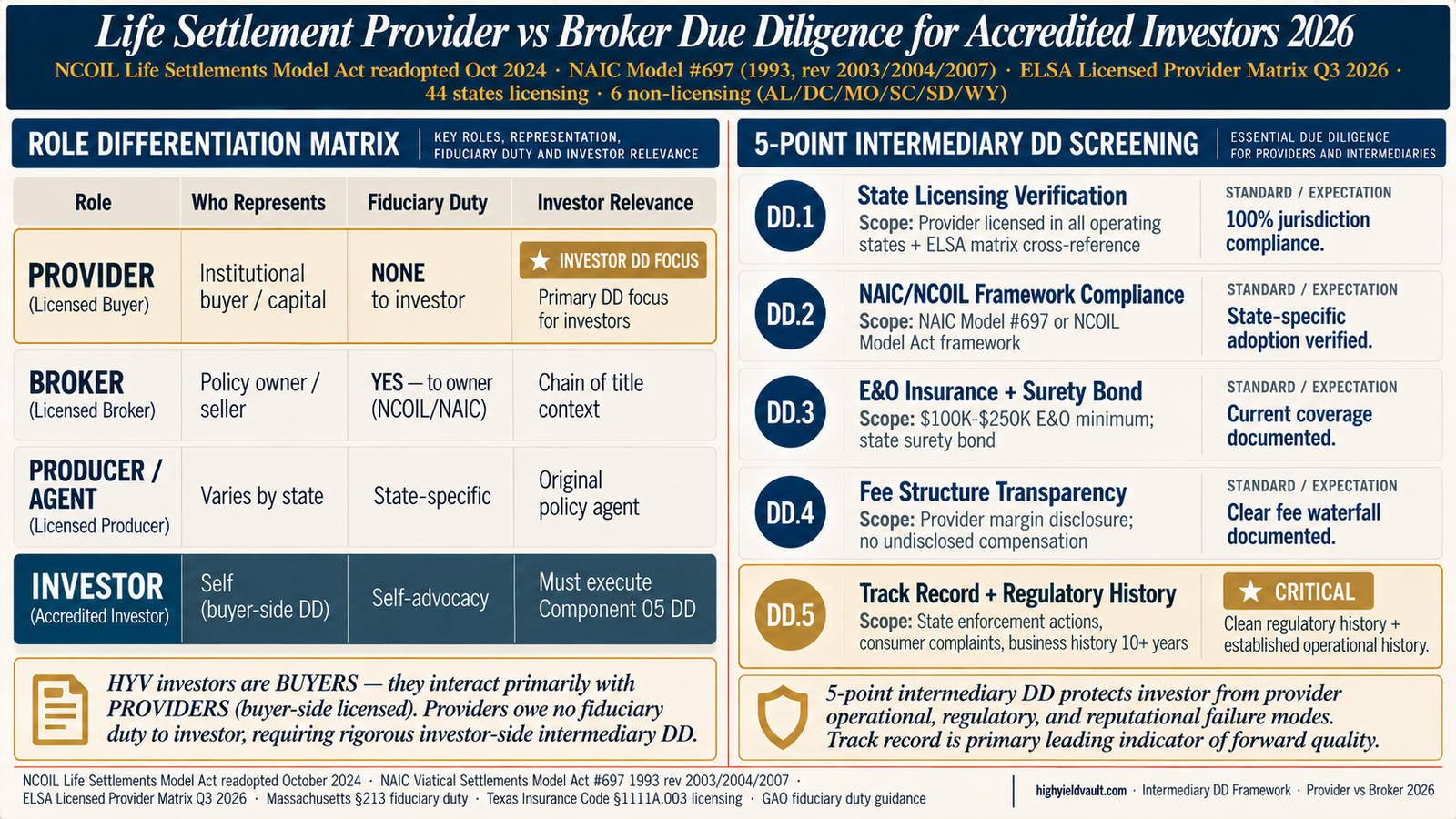
Life settlement provider vs broker due diligence requires understanding the role asymmetry: PROVIDER is buyer-side institutional capital that purchases policies from owners and resells to accredited investors — the provider owes NO fiduciary duty to the investor despite being the investor's direct counterparty. BROKER is seller-side intermediary that markets policies to multiple providers on behalf of policy owner and OWES statutory fiduciary duty to the owner per NCOIL Life Settlements Model Act readopted October 2024 and NAIC Viatical Settlements Model Act #697 as adopted in most state insurance codes. Investor-side DD must focus primarily on provider verification since providers interact directly with investors but offer no statutory protection; broker quality affects investor indirectly through chain-of-title documentation but is primarily the policy owner's concern. The 5-point intermediary DD screening: Component DD.1 State Licensing Verification (ELSA Licensed Provider Matrix Q3 2026 cross-reference); Component DD.2 NAIC/NCOIL Model Act Compliance; Component DD.3 E&O Insurance + Surety Bond Coverage; Component DD.4 Fee Structure Transparency; Component DD.5 Track Record + Regulatory History GOLD-HIGHLIGHTED CRITICAL.
44 US states require life settlement provider licensing per NCOIL or NAIC Model Act framework; 6 states (Alabama, District of Columbia, Missouri, South Carolina, South Dakota, Wyoming) do not currently require provider licensing per ELSA Q3 2026 Licensed Provider Matrix. Provider operating in multiple states requires separate licensing per state (not a single federal license). Investor verification: provider must demonstrate current valid licensing in every state where (a) policy was issued, (b) insured resides, and (c) provider operates. Framework divergence note: NCOIL Model Act and NAIC Model Act #697 differ in material respects — NCOIL permits sale 2 years after policy issuance; NAIC #697 requires 5-year holding period before standard sale eligibility. State adoption determines applicable framework for specific policy.
See LS policies with provider DD verification ready for your deployment
Every HYV listing includes provider licensing documentation across all operating jurisdictions, ELSA matrix cross-reference verification, and intermediary compliance review prepared for your independent intermediary DD execution. Our internal provider verification precedes platform listing; your independent review completes buyer-side intermediary DD.
Browse available policiesWhy provider vs broker distinction matters critically for investor-side DD
The fiduciary duty asymmetry between brokers (statutory fiduciary duty to policy owners) and providers (no fiduciary duty to investors) is the single most important legal/structural concept for accredited investor buyer-side intermediary DD. Policy owners selling their policies through life settlement transactions are protected by their broker's statutory fiduciary duty — the broker must act in the owner's best interest regardless of compensation structure per Massachusetts General Laws Chapter 175 §213(7) and equivalent state statutes. Accredited investors buying policies through providers receive NO equivalent statutory protection — the provider is a counterparty, not a fiduciary, and the investor must execute independent intermediary DD to protect buyer-side interests.
This asymmetry is deliberate and reflects the regulatory architecture of life settlements as consumer-protective transactions. State legislatures and insurance regulators designed the broker fiduciary duty framework to protect typically unsophisticated policy owners (often elderly individuals with limited financial literacy) from exploitative transaction terms. Accredited investors are presumed to have the financial sophistication and resources to execute independent DD and do not require equivalent statutory protection. The practical implication: investors cannot rely on provider statutory duties and must execute independent 5-point intermediary DD to verify provider licensing, compliance, operational quality, and track record before deployment.
The intermediary chain in a typical life settlement transaction flows: (1) policy owner engages broker to market policy to multiple providers; (2) broker executes market canvass, often soliciting bids from 5-15 licensed providers; (3) winning provider executes purchase of policy from owner at agreed price; (4) provider aggregates portfolio or packages policy for individual investor sale; (5) accredited investor acquires policy or fractional interest from provider through platform or direct relationship. HYV investors enter this chain at step 5 — meaning the broker fiduciary duty operated at step 2 to protect the original owner, but by step 5 that protection is historical rather than ongoing. Investor-side intermediary DD at step 5 focuses on the provider counterparty quality, not the broker's prior fiduciary performance.
The 4-row role differentiation matrix
The matrix below provides systematic role framework distinguishing the four intermediary roles in life settlement market structure. Provider role is gold-highlighted as the primary investor DD focus because providers are the investor's direct counterparty despite owing no fiduciary duty — making independent intermediary DD paramount.
HYV investors are BUYERS — they interact primarily with PROVIDERS (buyer-side licensed). Providers owe no fiduciary duty to investor, requiring rigorous investor-side intermediary DD.
How does 5-point intermediary DD apply to your deployment?
Schedule a 20-minute consultation. We'll walk through the 5-point intermediary DD screening framework applied to specific provider counterparties for your deployment candidates, including ELSA matrix cross-reference, NCOIL vs NAIC framework analysis, and E&O coverage verification.
Or call (833) 250-9677The 5-point intermediary DD screening matrix
The screening below provides systematic 5-component intermediary DD framework for accredited investor buyer-side verification. Component DD.5 Track Record + Regulatory History is gold-highlighted as critical component because operational and regulatory track record is the strongest leading indicator of forward provider counterparty quality.
State licensing verification
Scope: Provider licensed in all operating jurisdictions per state insurance regulator databases; ELSA Licensed Provider Matrix Q3 2026 cross-reference; 6 non-licensing states (AL, DC, MO, SC, SD, WY) warrant elevated scrutiny; provider must demonstrate licensing in state of policy issuance, insured residence, and provider operations
Standard: 100% jurisdiction compliance verified via state regulator + ELSA matrix
Model Act framework compliance
Scope: NAIC Viatical Settlements Model Act #697 (1993, rev 2003/2004/2007) or NCOIL Life Settlements Model Act readopted October 2024 framework adoption analysis per state; state-specific statutory variance review; holding period requirements (NCOIL 2 years vs NAIC 5 years as adopted); STOLI provisions post-2007 revisions
Standard: State-specific framework adoption verified; compliance posture documented
E&O insurance + surety bond
Scope: Errors & omissions insurance coverage verification ($100K-$250K minimum standard; higher for large-scale providers); state-specific surety bond or cash deposit requirements (varies by state framework); E&O carrier rating per 3-agency triangulation per Day 113 Carrier Credit framework
Standard: Current E&O coverage documented with A-rated carrier; state surety bond compliance verified
Fee structure transparency
Scope: Provider margin disclosure (standard institutional range 8-15% of face amount or specific disclosure methodology); no undisclosed contingent compensation per NCOIL/NAIC disclosure requirements; fee waterfall documentation from policy acquisition cost to investor sale price
Standard: Clear fee waterfall documented; provider margin within institutional range
Track record + regulatory history
Scope: State enforcement actions review (any current or historical regulatory action); consumer complaint history via state insurance regulator databases; business operational history (10+ years preferred as established market participant); principal background investigation; prior business entity relationships; litigation history
★ Critical standard: Clean regulatory history + 10+ year operational history + established principal track record = leading indicator of forward provider quality
5-point intermediary DD protects investor from provider operational, regulatory, and reputational failure modes. Track record is primary leading indicator of forward provider counterparty quality.
Real walkthrough: Robert's provider verification via ELSA matrix cross-reference
Here's how the 5-point intermediary DD framework applies in practice, illustrated through a composite scenario based on standard accredited investor intermediary verification execution pre-deployment through institutional LS platform.
56-year-old accredited investor · provider licensing verification + ELSA matrix cross-reference pre-deployment
Starting position: Robert, a 56-year-old private equity principal in Boston MA, is evaluating a $700K LS position offered through an institutional platform. The policy summary shows: insured female age 81 Texas resident, carrier Lincoln Financial AM Best A+, universal life policy with $1.8M face amount, policy issued 2017 (9+ years in-force well past contestability), provider counterparty "ABC Life Settlement Capital LLC" (hypothetical provider name) operating from Delaware headquarters. Robert initiates intermediary DD with his legal counsel at Ropes & Gray coordinating 5-point provider verification per the institutional framework before Component 05 policy-level DD execution.
Component DD.1 State Licensing Verification: Robert's team identifies required licensing jurisdictions: Delaware (provider HQ), Texas (insured residence + policy issuance), Massachusetts (Robert's residence as acquiring investor). Ropes & Gray team accesses each state insurance regulator database to verify ABC Life Settlement Capital LLC current license status. Delaware Insurance Department: Provider license confirmed active, license number documented, no pending disciplinary actions. Texas Department of Insurance: Provider license confirmed active under Texas Insurance Code §1111A.003, licensed since 2015. Massachusetts Division of Insurance: Provider licensed per MA General Laws Chapter 175 §213 framework, license current. ELSA Licensed Provider Matrix Q3 2026 cross-reference: ABC Life Settlement Capital LLC appears in Q3 2026 matrix as licensed in 32 jurisdictions including all three required states — confirmed authoritative third-party verification. Component DD.1 verification clean.
Component DD.2 Model Act Framework Compliance: Robert's team analyzes state-specific framework for each relevant jurisdiction. Delaware: adopted NCOIL Life Settlements Model Act framework (2-year holding period); provider compliance documented. Texas: adopted hybrid framework with elements of both NCOIL and NAIC with Texas-specific amendments regarding STOLI prevention; provider demonstrated compliance with Texas Insurance Code §1111A statutory requirements. Massachusetts: adopted NAIC Viatical Settlements Model Act #697 framework with 2-year holding period amendment; provider compliance documented. Framework analysis: provider operates across jurisdictions with different Model Act frameworks successfully; demonstrates mature multi-state compliance capability. Component DD.2 verification clean.
Component DD.3 E&O Insurance + Surety Bond: Robert's team requests E&O certificate of insurance from provider. Provider demonstrates: $5 million E&O coverage with Chubb Insurance (AM Best A++ carrier), current coverage period valid 12 months forward, no pending claims against policy. State surety bonds: Delaware $100K surety bond current; Texas $250K bond current; Massachusetts $150K bond current. Coverage significantly exceeds institutional minimum standards. Component DD.3 verification clean with elevated coverage levels.
Component DD.4 Fee Structure Transparency: Robert's team requests fee waterfall documentation from provider for this specific position. Provider acquired policy from original owner in 2024 for $420,000. Provider carrying costs during holding period (premiums paid, servicing, carrying cost allocation): approximately $85,000. Provider margin on sale to investor: $700,000 asking price − ($420,000 + $85,000) = $195,000 provider margin, representing approximately 11% of $1.8M face amount or 28% markup on provider carrying cost. Fee structure within institutional norms; margin disclosure complete and consistent with 8-15% face amount institutional range. No undisclosed contingent compensation to broker, originator, or third party. Component DD.4 verification clean.
Component DD.5 Track Record + Regulatory History (Critical): Robert's team executes comprehensive provider background investigation. Business history: ABC Life Settlement Capital LLC formed Delaware 2015, 11 years continuous operations, 350+ life settlement transactions executed to date, AUM $450 million portfolio value. State regulatory history: clean record across all operating jurisdictions, no enforcement actions, no consumer complaints filed with state insurance regulators. Principal background: founding principal with 18 years prior industry experience at major LS firm, no disciplinary actions, clean FINRA BrokerCheck record (though not FINRA-licensed). Litigation history: standard commercial litigation history with no material adverse findings. Industry participation: active member of Institutional Life Markets Association (ILMA) with voting membership status. Component DD.5 verification establishes ABC as established institutional-quality provider counterparty.
Decision: 5-point intermediary DD complete with clean verification across all components. Robert proceeds to Component 02-07 policy-level DD execution per the 7-component framework from Day 111 cornerstone with confidence in provider counterparty quality. Intermediary DD cost: $3,200 Ropes & Gray review + ELSA matrix subscription access + state regulator database searches = acceptable screening investment given $700K deployment commitment. Timeline: 5 business days intermediary DD execution preceding 8-13 week policy-level DD per standard framework.
Robert's walkthrough reflects systematic accredited investor intermediary DD execution preceding policy-level DD. The framework: 5-point intermediary DD screening verifies provider counterparty quality across licensing, compliance, coverage, transparency, and track record dimensions before investor commits time and resources to deeper policy-level DD. Clean intermediary verification enables confident progression to Component 02-07 policy evaluation; failed intermediary verification triggers DD rejection before deployment of policy-level DD costs. Standard institutional practice treats intermediary DD as mandatory pre-screening with 3-7 day timeline and $2K-$5K typical cost for standard-complexity provider verification.
Get matched with provider-verified policies for your DD
Tell us your provider counterparty preferences, state licensing requirements, and position size parameters. We'll show you 2-3 vetted life settlement policies with pre-verified provider counterparties ready for your independent 5-point intermediary DD execution.
When intermediary DD requires specialized state-by-state compliance review
The 4-row role differentiation and 5-point intermediary DD screening framework provide operational guidance for standard intermediary verification. However, certain scenarios involve complexity requiring expanded specialized state-by-state compliance analysis beyond standard framework application.
Four scenarios requiring expanded specialized state compliance analysis beyond standard intermediary DD
1. Multi-state provider operation across NCOIL + NAIC framework jurisdictions. Providers operating across jurisdictions that adopted different Model Act frameworks (NCOIL in some states, NAIC in others, state-specific hybrid frameworks in others) require sophisticated multi-framework compliance capability. Investor DD should verify provider demonstrates operational competence across framework divergences including holding period variance (NCOIL 2 years vs NAIC 5 years as commonly adopted), licensing fee structures, surety bond requirements, continuing education requirements for personnel, and disclosure obligation variance. Specialized state-by-state compliance review warranted for providers operating in 20+ jurisdictions.
2. Non-licensing state scenarios (AL, DC, MO, SC, SD, WY per ELSA Q3 2026). Six US jurisdictions do not currently require life settlement provider licensing per ELSA Licensed Provider Matrix Q3 2026: Alabama, District of Columbia, Missouri, South Carolina, South Dakota, and Wyoming. Transactions involving these jurisdictions (policy issued in non-licensing state, insured residing in non-licensing state, or provider headquartered in non-licensing state) warrant elevated DD scrutiny because standard state licensing verification mechanism is unavailable. Alternative verification approaches: ELSA matrix inclusion as proxy for institutional recognition, industry association membership (ILMA, ELSA), E&O carrier willingness to underwrite, and principal background verification become more important when state licensing baseline is unavailable.
3. Framework divergence between policy issuance state and provider operating state. Where policy was issued in one state (e.g., California adopting NAIC #697) but provider operates primarily from another state (e.g., Delaware adopting NCOIL), compliance analysis requires understanding which state framework governs the specific transaction. Standard rule: policy issuance state framework typically governs policy-level requirements (contestability, STOLI analysis, insurable interest); provider operating state governs provider licensing and operational requirements. Specialized analysis required for policies with complex multi-jurisdictional characteristics particularly where state frameworks produce different outcomes on key issues.
4. Provider M&A history or principal transition events. Life settlement providers occasionally undergo mergers, acquisitions, or principal transitions affecting operational continuity and track record attribution. If current provider entity acquired its license through M&A event from predecessor entity, DD analysis should separately evaluate predecessor track record (which legacy portfolio was built upon) from current entity track record (which forward operational capability depends upon). Principal transition events (founding principals departing, new principals joining) similarly affect track record continuity. Specialized analysis warranted for providers with M&A history within past 5 years or significant principal transitions within past 3 years. HYV coordinates specialized intermediary DD for providers in these transition scenarios.
For investors in these four specialized scenarios, standard 4-row + 5-point intermediary DD framework provides starting point but requires expanded specialized state-by-state compliance analysis. HYV coordinates specialized intermediary DD for providers operating in complex multi-state frameworks, non-licensing state scenarios, framework divergence situations, and M&A transition contexts.
See provider-verified policies ready for intermediary DD
Every listing includes provider licensing documentation, ELSA matrix cross-reference, E&O coverage verification, and intermediary compliance review prepared for your buyer-side intermediary DD execution. Our internal provider verification precedes platform listing; your independent review using the 5-point framework completes buyer-side DD.
Or call (833) 250-9677Frequently asked questions about provider vs broker DD
What exactly is the difference between a life settlement provider and broker?
Provider and broker occupy distinct positions in life settlement market structure with critically different legal duties and investor relevance. Life settlement PROVIDER: Buyer-side intermediary that purchases policies from policy owners (directly or through broker intermediation); provides institutional capital for policy acquisition; may hold policies in portfolio or resell to accredited investors; state-licensed under provider framework per NAIC Model Act #697 or NCOIL Life Settlements Model Act readopted October 2024; owes NO fiduciary duty to accredited investor buyer; is counterparty to investor transaction, not fiduciary advocate. Life settlement BROKER: Seller-side intermediary that represents policy owner in marketing policy to multiple providers; executes competitive bid process on owner's behalf; receives compensation typically as percentage of transaction value or structured fee; state-licensed under broker framework per NCOIL/NAIC Model Acts; OWES statutory fiduciary duty to policy owner to act in owner's best interest regardless of compensation structure per Massachusetts §213(7) and equivalent state statutes; required to disclose compensation methodology and amount to owner. For accredited investor significance: investors interact directly with providers during policy acquisition process, NOT with brokers. Broker fiduciary duty protects original policy owner (typically unsophisticated elderly individual) but provides no direct protection to accredited investor buyer. Investor buyer-side intermediary DD must focus on provider counterparty verification using 5-point framework (state licensing, Model Act compliance, E&O + surety bond, fee transparency, track record + regulatory history). Broker quality affects investor only indirectly through chain-of-title documentation review during Component 05 Legal/Structural DD per Day 114 framework.
How do I verify a life settlement provider's state licensing?
Provider licensing verification requires multi-source cross-reference across state insurance regulator databases, industry association resources, and provider-supplied documentation. Step 1 — Identify required licensing jurisdictions: Provider must be licensed in states where (a) policy was issued, (b) insured currently resides, and (c) provider operates. For most transactions, this means 2-5 state verifications per deployment. Step 2 — Access state insurance regulator databases: Each state insurance department maintains public licensing lookup accessible through state website. Search by provider name and verify: current license status (active/inactive), license number, license effective date, any pending disciplinary actions or enforcement proceedings. Step 3 — ELSA Licensed Provider Matrix Q3 2026 cross-reference: European Life Settlement Association publishes quarterly Licensed Provider Matrix compiling publicly available state licensing data plus provider self-certification. Matrix accessible through ELSA website (elsa-sls.org). Matrix lists licensed providers by state with X denoting full life settlement license, V denoting viatical-only license. Cross-reference provider claimed licensing jurisdictions against ELSA matrix for third-party verification. Step 4 — Non-licensing state analysis: ELSA Q3 2026 confirms 6 jurisdictions do not currently require provider licensing: Alabama, District of Columbia, Missouri, South Carolina, South Dakota, and Wyoming. For transactions involving these states, standard licensing verification unavailable; alternative verification mechanisms (ELSA matrix inclusion, industry association membership, E&O carrier underwriting willingness, principal background) become more important. Step 5 — Provider documentation review: Request certificates of licensing from provider directly; verify match with state regulator records; document receipt date and verification date for compliance file. Step 6 — Document findings: Create intermediary DD file documenting licensing verification methodology, sources accessed, findings per state, and any irregularities identified. Standard institutional DD timeline: 3-5 business days for standard 2-5 state verification; 7-10 business days for complex multi-state verification. HYV coordinates provider licensing verification across platform-presented positions as component of institutional service.
What's the difference between NCOIL and NAIC Model Acts and why does it matter?
NCOIL and NAIC each publish model acts governing life settlement regulation, with states choosing which framework (or hybrid) to adopt. The two frameworks differ in material respects affecting both policy owner protection and investor regulatory environment. NCOIL Life Settlements Model Act: Published and periodically updated by National Conference of Insurance Legislators (NCOIL). Most recent re-adoption: October 2024. Key provisions: 2-year minimum holding period between policy issuance and life settlement sale eligibility; broker fiduciary duty to owner regardless of compensation structure; state licensing framework for providers and brokers; fraud prevention provisions; E&O coverage requirements. Adopted by: approximately 25+ US states including Delaware, Texas (with amendments), Florida (with STOLI exception additions), and others. NAIC Viatical Settlements Model Act #697: Published by National Association of Insurance Commissioners (NAIC); originally 1993, revised 2003, 2004, and 2007 (STOLI additions). Key provisions: 5-year minimum holding period between policy issuance and life settlement sale eligibility (vs NCOIL's 2 years); broker fiduciary duty provisions (similar to NCOIL); STOLI-specific provisions added 2007; disclosure requirements for alternatives to settlement; rescission rights. Adopted by: approximately 20+ US states including Massachusetts (with 2-year amendment), New York (with modifications), California (with amendments). Hybrid adoptions: Many states adopted elements of both frameworks with state-specific amendments producing complex multi-framework landscape. Framework divergence significance for investor DD: Holding period variance affects which policies qualify for secondary market sale eligibility — important for understanding chain-of-title timing and valid acquisition rights; disclosure requirements variance affects documentation available during Component 05 Legal/Structural DD; provider licensing framework variance affects multi-state compliance analysis for Component DD.2 intermediary verification. Standard practice: investor DD should verify which Model Act framework applies in specific policy jurisdiction and confirm provider demonstrated compliance with applicable framework. Specialized state-by-state compliance analysis required for complex multi-jurisdictional transactions.
Why doesn't the provider owe me a fiduciary duty if I'm the one buying from them?
The fiduciary duty asymmetry reflects deliberate regulatory architecture distinguishing consumer-protective transactions (where unsophisticated parties need statutory protection) from sophisticated-counterparty transactions (where parties are presumed capable of independent protection). The provider-investor relationship falls in the second category under current regulatory framework. Regulatory rationale: Policy owners selling their policies through life settlements are typically elderly individuals (average age 70+) with limited financial literacy and significant information asymmetry with institutional buyers. The broker fiduciary duty framework protects owners by requiring their intermediary to prioritize owner interests over broker compensation; this framework compensates for owner inability to execute independent DD on complex insurance transactions. Accredited investors buying from providers are presumed sophisticated: minimum $1M net worth or $200K/$300K annual income per SEC Rule 501 definition; typically experienced in alternative investments; capable of engaging legal, tax, and insurance advisors; expected to execute independent due diligence on counterparty quality. The regulatory framework does not provide equivalent statutory protection because accredited investor status presupposes capability to self-protect through independent DD. Practical investor implication: Investor cannot assume provider will act in investor's best interest beyond contractual obligations in purchase agreement; investor must execute independent 5-point intermediary DD framework to verify provider counterparty quality before deployment; investor should review purchase agreement terms including representations and warranties, indemnification provisions, closing conditions, and post-closing obligations with experienced counsel; investor should maintain ongoing provider monitoring during multi-year holding period for regulatory status changes, financial condition changes, or operational discontinuities. The absence of statutory fiduciary duty is not a defect in the regulatory framework but a design feature reflecting investor sophistication expectations. Rigorous investor-side intermediary DD is the appropriate response to this framework design.
What should I look for in a provider's track record and regulatory history?
Track record and regulatory history (Component DD.5 Critical) represents the strongest leading indicator of forward provider counterparty quality. Comprehensive track record investigation covers these dimensions. Business operational history: 10+ years continuous operations preferred as established market participant; 5-10 years acceptable with other strong indicators; less than 5 years warrants elevated scrutiny particularly if principals lack prior industry experience. AUM and transaction volume: Material AUM ($100M+) and transaction count (100+ transactions executed) indicate operational scale and market acceptance; small AUM may indicate either boutique focus or market acceptance challenges requiring investigation. State enforcement actions: Search all states where provider is licensed for current or historical enforcement actions, consent orders, cease and desist actions, license suspensions, or civil penalties; any material regulatory action warrants investigation of underlying circumstances and resolution; clean regulatory record across all operating jurisdictions is the standard institutional expectation. Consumer complaint history: Access state insurance regulator consumer complaint databases where available; evaluate complaint volume relative to transaction volume; investigate pattern of complaints (categorical issues vs isolated events). Principal background: Investigate founding principals and current senior leadership backgrounds including prior industry experience, prior business entity relationships, FINRA BrokerCheck records if applicable, SEC enforcement history if applicable, and any disciplinary actions by professional licensing boards. Litigation history: Review commercial litigation history for pattern of disputes or material adverse findings; routine commercial disputes are normal; litigation pattern suggesting operational quality issues warrants investigation. Industry participation: Active membership in Institutional Life Markets Association (ILMA) with voting status, European Life Settlement Association (ELSA), Life Insurance Settlement Association (LISA) indicates industry acceptance and provides peer-review structure; absence of industry participation warrants investigation of reasons. M&A and principal transition history: Mergers, acquisitions, or principal transitions within past 5 years warrant separate analysis of predecessor track record vs current entity capability. Red flags: Enforcement actions resulting in material penalties or license suspensions; principal background including prior fraud findings or industry bar; pattern of consumer complaints with regulatory action; material litigation indicating operational quality issues; absence from industry associations or ELSA Licensed Provider Matrix. HYV internal DD includes comprehensive Component DD.5 track record analysis for all platform-presented provider counterparties.
How does the ELSA Licensed Provider Matrix work for intermediary verification?
The ELSA Licensed Provider Matrix is a quarterly-published authoritative verification resource maintained by the European Life Settlement Association (ELSA) that compiles publicly available state licensing data plus provider self-certification into single reference matrix accessible through the ELSA website (elsa-sls.org). The matrix serves as third-party verification source complementing but not replacing direct state insurance regulator database verification. Matrix structure: Grid format with providers listed as rows and US states listed as columns; cells indicate licensing status with X denoting full life settlement license, V denoting viatical-only license (narrower scope than full life settlement license), and blank denoting no licensing (or state does not require licensing). Data sources per ELSA documentation: state insurance regulator websites or report services such as NAIC State-Based System platform; direct public records requests to state regulators where reporting unavailable; provider self-certification confirmation of matrix entries. Publication cadence: Quarterly updates with current matrix as of August 2026 for Q3 2026 publication. Non-licensing states: Matrix identifies 6 jurisdictions not currently requiring provider licensing: Alabama (AL), District of Columbia (DC), Missouri (MO), South Carolina (SC), South Dakota (SD), and Wyoming (WY). Investor verification methodology: Step 1 — identify provider claimed licensing jurisdictions from provider marketing materials or direct inquiry. Step 2 — cross-reference claimed jurisdictions against ELSA matrix entries. Step 3 — verify matrix entries against direct state regulator database searches for authoritative confirmation. Step 4 — document any discrepancies between provider claims, matrix entries, and state database findings. Step 5 — resolve discrepancies through direct communication with provider or state regulator as needed. Matrix limitations: Matrix reflects point-in-time data as of publication; recent licensing changes may not be reflected until next quarterly update; viatical-only licensing (V) does not authorize full life settlement transactions and requires understanding of scope distinction; matrix does not include detailed regulatory history or enforcement action information requiring separate state regulator database access. Best practice: use ELSA matrix as efficient cross-reference verification tool but always confirm key findings through direct state insurance regulator database access particularly for primary operating jurisdictions. HYV coordinates ELSA matrix cross-reference verification as standard component of platform intermediary DD process.
Start with provider-verified policies
Two paths to begin: browse currently available life settlement policies with pre-verified provider counterparties including ELSA matrix cross-reference and E&O documentation review, or schedule a consultation to walk through 5-point intermediary DD framework application to your deployment strategy and provider counterparty selection.
Or call (833) 250-9677