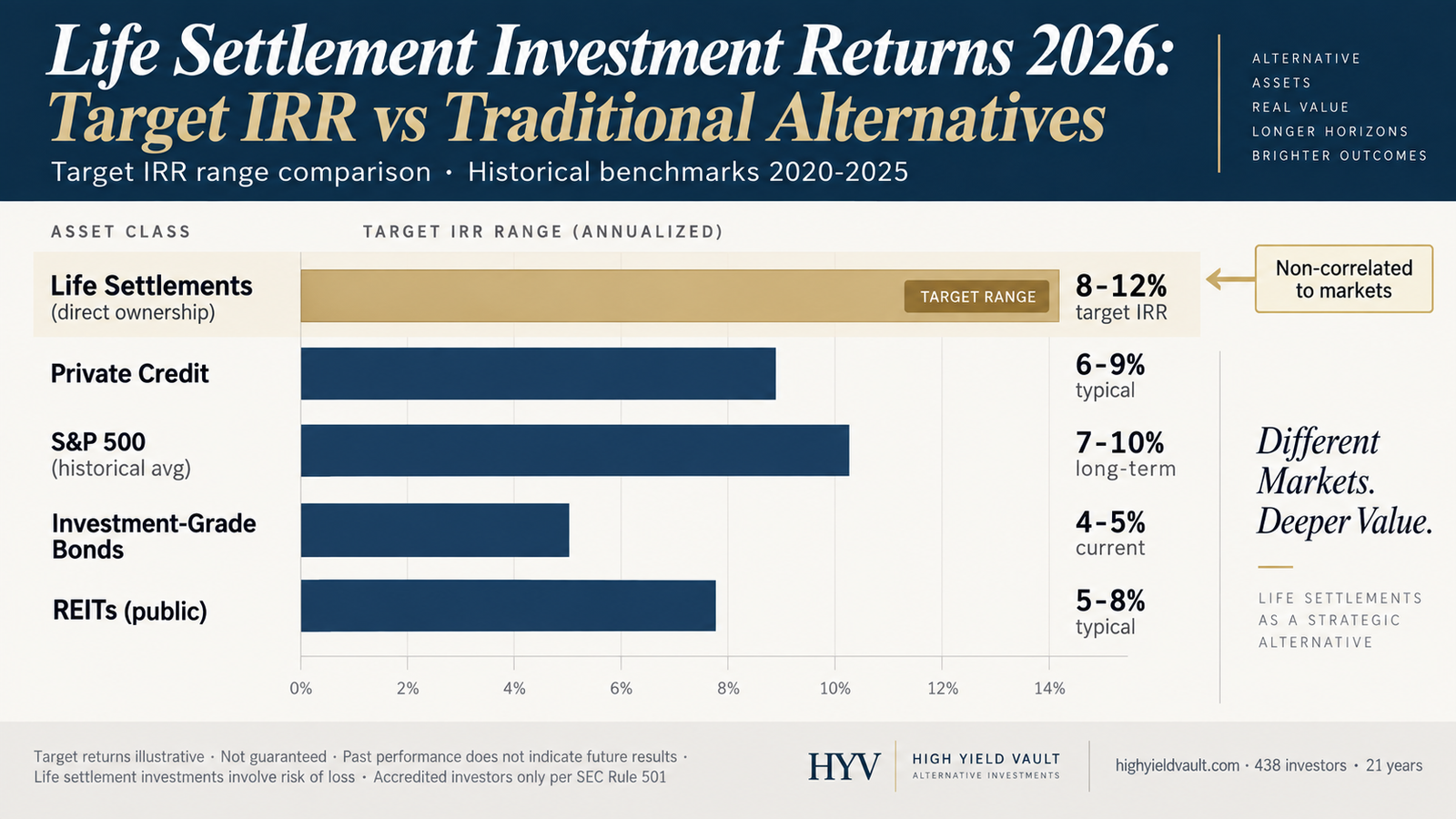
Accredited investors buying life settlement policies through direct ownership typically target 8–12% IRR — outperforming investment-grade bonds (4–5%), REITs (5–8%), and often matching or exceeding S&P 500 long-term averages (7–10%), with zero correlation to public equity volatility.
The range is target, not guaranteed. Actual returns depend on policy quality, life expectancy accuracy, premium optimization, and holding period. Life settlement investments are illiquid, long-duration, and available only to accredited investors under SEC Rule 501. See disclosures at bottom.
Browse vetted life settlement policies ready for direct ownership
Every listing includes full policy documentation, LE reports, carrier ratings, premium projections, and projected IRR — no shared premium reserves, no fund manager between you and the return.
Browse available policiesHow life settlement returns compare to other yield options
When accredited investors look for yield outside public markets, the shortlist usually includes private credit, REITs, direct real estate, and increasingly life settlements. Here's how the target return ranges stack up in 2026.
Ranges reflect illustrative target and historical benchmarks compiled from public sources including SEC filings, Morningstar, and industry reports as of 2026. Past performance does not indicate future results. Individual investor outcomes vary substantially. Life settlement investments involve risk of loss including longevity extension risk and carrier credit risk.
What stands out isn't just the return range — it's where the return comes from. Life settlements produce a contractual death benefit at policy maturity, not from company earnings, interest rate movements, or real estate valuations. That structural difference is why institutional allocators including Apollo Global Management, Berkshire Hathaway, and Partner Re have committed billions to the asset class over the past decade.
Not sure if life settlements fit your portfolio?
Schedule a 20-minute consultation. We'll walk through your capital deployment goals, look at where LS could fit your allocation, and answer specific questions about direct ownership before you look at any policy.
Two illustrative scenarios: how life settlement returns play out
To make the numbers concrete, here are two hypothetical scenarios showing how life settlement investment returns typically develop in practice. These are illustrative composites — not real client accounts — designed to show the mechanics of how capital, policies, and timelines translate into IRR.
HNW pre-retiree · $500K allocation
A retired sales executive rebalancing away from a heavily-equity portfolio ahead of retirement transition. Concerned about volatility eroding capital during decumulation phase. Allocated $500K across two direct-ownership policies ($250K each) with LE profiles of 6 years and 8 years — providing staggered maturity timing plus meaningful diversification within LS allocation. Retains full ownership of record on both policies; funds premiums directly through custodial account. Total premium reserve set aside: approximately $180K over projected holding period.
Family office · $3M allocation
A single-family office managing multi-generational patient capital, adding LS as a non-correlated fixed-income alternative within its alternatives sleeve. Allocated $3M across six direct-ownership policies ($400K–$650K each) with LE profiles staggered from 5 to 10 years — creating a maturity ladder that produces expected distributions across multiple years. Uses institutional custodian structure for policy ownership and premium administration. Committee reviews new opportunities quarterly; targets 2–3 additional allocations per year within LS sleeve.
Both scenarios illustrate the same core mechanic: capital deployed into policies with actuarially-priced life expectancies produces a target IRR at maturity that's structurally uncorrelated to what stocks or bonds are doing on any given day. The scenarios are composites — not real accounts — but they reflect the allocation patterns and target return ranges we've helped 438 accredited investors deploy against.
See policies matched to your allocation size
Tell us your target allocation and time horizon. We'll show you 2–3 vetted policies that fit — with full LE reports, premium schedules, and projected IRR before you commit anything.
What actually drives your life settlement returns
The 8–12% target range isn't automatic. Four factors determine where your specific return lands within — or outside — that band. Understanding them is what separates accredited investors who compound consistent returns from those who don't.
-
01
Life expectancy accuracy
Your IRR is inversely proportional to how long the insured actually lives beyond projected LE. Institutional-grade underwriting from established LE providers narrows the variance window — the single biggest driver of realized vs projected returns.
-
02
Premium optimization
Every dollar of premium paid reduces net return. Optimized premium funding (minimum required to keep policy in force through projected LE plus buffer) preserves IRR that gets eroded when policies are over-funded through outdated premium schedules.
-
03
Policy quality at acquisition
A well-structured universal life policy from an A-rated carrier past its contestability window is a fundamentally different asset than an over-funded VUL with contestability exposure. Acquisition-side due diligence is where most of the return gets locked in or given away.
-
04
Direct ownership vs pooled
Fund structures charge 1–2% management fees plus performance fees, cutting into gross IRR. Direct ownership eliminates management-layer drag — you pay no ongoing manager fee, and the full policy return accrues to your account.
Why direct ownership is how HYV investors capture returns
Most accredited investors first encounter life settlements through pooled fund vehicles — the kind of structures charging 2-and-20 fee arrangements that meaningfully compress net returns. HYV works differently.
Every investor on our platform acquires direct ownership of individually-vetted policies. You are the owner of record. You are the named beneficiary. You make premium decisions. No shared premium reserve exposure, no premium call risk from other investors' failure to fund, no dependence on a sponsor for ongoing administration. This is the same institutional-grade direct ownership model used by Apollo, Berkshire Hathaway, and Partner Re — deployed for individual accredited investors at the $250K+ per-policy entry tier.
The 8–12% target IRR isn't a marketing figure — it's what accredited investors on this platform have realistically deployed capital against across two decades of practice. When you eliminate fund-manager fee layers and take direct ownership of a well-priced policy, the returns show up on your account statement, not on a fund manager's carry.
View currently available policies for direct ownership
Full policy documentation, LE reports, carrier ratings, and projected IRR on every listing. Accredited investor verification required per SEC Rule 501.
Frequently asked questions about life settlement returns
What are typical life settlement investment returns for accredited investors?
Direct-ownership life settlement investments typically target 8–12% IRR for accredited investors, though actual returns vary by policy quality, life expectancy accuracy, premium optimization discipline, and holding period. This range compares favorably to investment-grade bonds (4–5%), REITs (5–8%), and often matches or exceeds long-term S&P 500 historical averages (7–10%) — with the added benefit of zero correlation to public equity markets. Life settlement returns are contractual (paid at policy maturity from carrier death benefit), not dependent on company earnings, interest rates, or asset valuations. Individual investor results vary; the range is target, not guaranteed. Life settlement investments involve substantial risks including longevity extension risk, carrier credit risk, and illiquidity — and are available only to accredited investors as defined under SEC Rule 501 of Regulation D.
How long does it take to receive returns from a life settlement investment?
Life settlement investments typically hold 5–10 years, with returns paid as a lump sum at policy maturity when the death benefit is paid by the insurance carrier. There is no interim income during the holding period — investors must fund premiums during the hold, and returns arrive as a single event at maturity. This makes life settlements structurally different from bonds (which pay periodic coupons) or dividend stocks (which pay quarterly distributions). Some accredited investors build "maturity ladders" by acquiring multiple policies with staggered LE profiles — for example, allocating across policies with 5, 7, and 9-year LE projections — creating expected distribution timing spread across multiple years. Because life settlements are illiquid alternatives without a secondary market for individual policy interests, investors should only allocate capital that can remain deployed through projected policy maturity.
Are life settlement returns guaranteed?
No. The 8–12% target IRR range is a target range, not a guaranteed return. Actual returns depend on multiple factors including how closely the insured's actual mortality tracks with the projected life expectancy (LE extension is the single biggest driver of underperformance), premium funding decisions during the hold period, the financial strength of the insurance carrier issuing the underlying policy, and the acquisition price paid for the policy. Life settlements can produce returns above the target range if the insured passes earlier than projected, or below the target range (potentially with loss of principal) if the insured lives materially longer than projected combined with elevated premium costs. All investors should review the specific policy documentation, LE reports, and premium projections for any allocation and consider consulting qualified tax, legal, and financial advisors before committing capital.
What's the minimum investment for a life settlement policy?
Direct ownership of a life settlement policy through HYV typically starts at $250K per policy at the institutional direct-ownership tier. Some larger policies with higher face values may require larger minimum allocations. Accredited investors deploying across multiple policies for diversification typically build allocations in the $500K–$3M range spread across 2–8 policies. Accredited investor verification per SEC Rule 501 is required before viewing any specific policy — the standard thresholds are $200K annual income (individual) or $300K joint, or $1M net worth excluding primary residence, or certain professional certifications.
How do life settlement returns compare to the S&P 500?
Life settlement target IRR (8–12%) is competitive with S&P 500 long-term historical averages (7–10%), but the two are fundamentally different return profiles. S&P 500 returns come with meaningful year-to-year volatility (double-digit drawdowns are common in a given year even when long-term averages are positive), while life settlement returns are contractual — you receive the death benefit at policy maturity regardless of what happened in equity markets during the holding period. That structural non-correlation is the primary reason institutional allocators including Apollo, Berkshire Hathaway, and Partner Re have deployed billions into the asset class: not because life settlements always outperform stocks in absolute return terms, but because they don't move with stocks. In a portfolio context, adding a non-correlated asset with comparable target return improves the overall risk-adjusted return of the portfolio (Sharpe ratio improvement) — which is why family offices and sophisticated accredited investors treat LS as a fixed-income alternative rather than an equity substitute.
How do I get started with life settlement investing?
There are two straightforward starting points. If you're accredited and ready to look at specific policies, browse currently available policies — each listing includes full policy documentation, LE reports, carrier ratings, and projected IRR you can evaluate before requesting more information. If you'd rather discuss your allocation goals first, schedule a 20-minute consultation — we'll walk through your capital deployment situation, look at where life settlements might fit within your alternative sleeve, and answer specific questions about direct ownership before you evaluate any policy. Either path leads to accredited investor verification, policy selection, and coordinated acquisition — with you as owner of record throughout.
Ready to put capital to work?
Browse available policies now, or schedule a consultation with an advisor first. Either way, you'll get clarity on whether life settlements make sense for your allocation — and see specific IRR-projected policies matched to your investment size.
