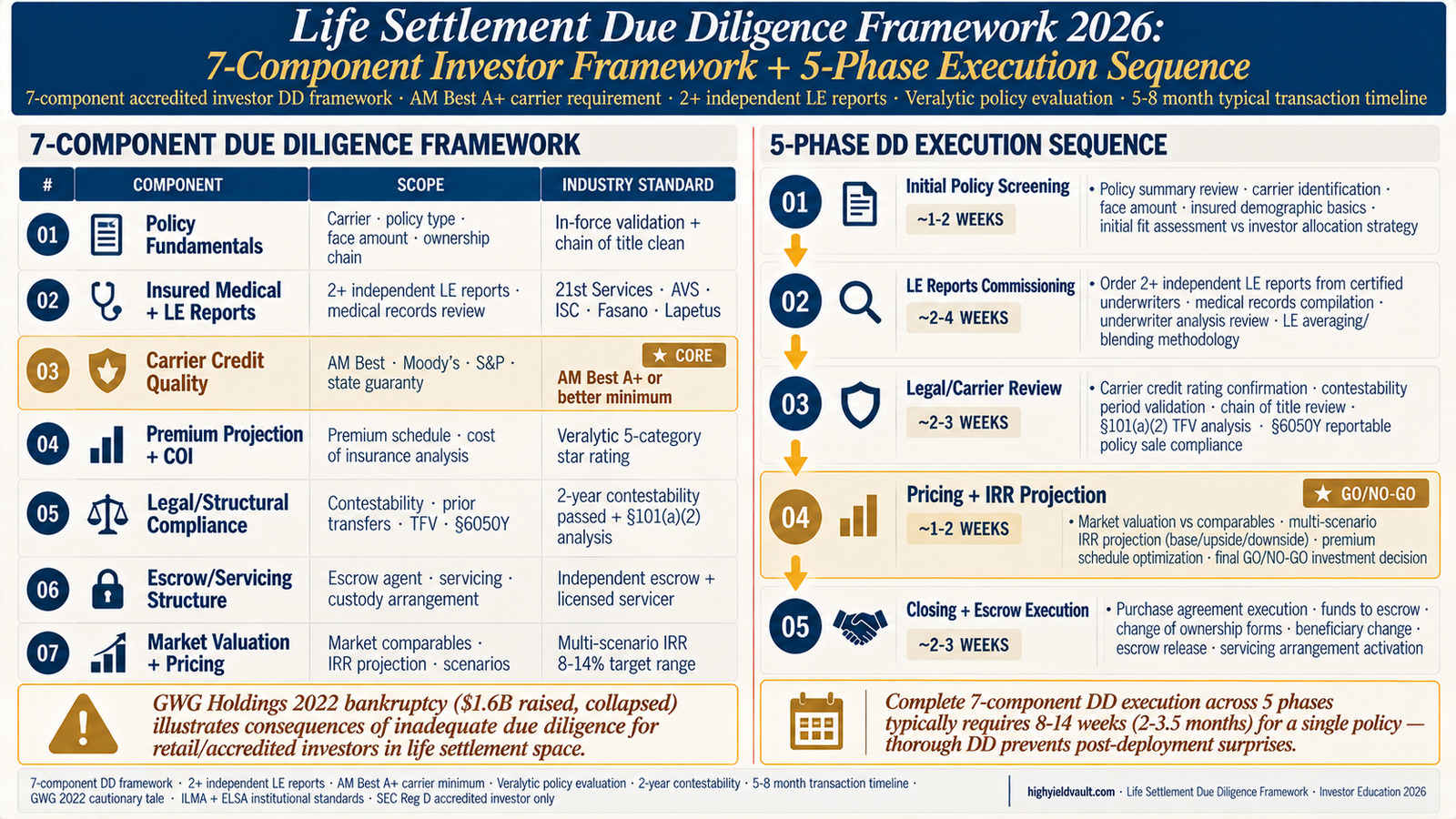
Life settlement due diligence requires systematic execution across 7 components: (1) Policy Fundamentals Validation (carrier, policy type, face amount, ownership chain history); (2) Insured Medical Profile + LE Reports (2+ independent LE reports from certified underwriters — 21st Services, AVS, ISC, Fasano, Lapetus); (3) Carrier Credit Quality Assessment (AM Best A+ or better minimum + state guaranty coverage analysis); (4) Premium Projection + Cost of Insurance (Veralytic-style policy illustrations); (5) Legal/Structural Compliance (2-year contestability + IRC §101(a)(2) TFV + §6050Y RPS); (6) Escrow/Servicing Structure (independent escrow + licensed servicer); (7) Market Valuation + Pricing (comparables + multi-scenario IRR projection). The framework executes across 5-phase sequence from initial policy screening through LE commissioning, legal/carrier review, GO/NO-GO pricing decision, and closing with escrow execution — typically 8-14 weeks per single policy.
The GWG Holdings 2022 bankruptcy ($1.6B raised from retail/accredited investors, collapsed into Chapter 11) represents the industry cautionary tale for inadequate DD consequences — investors who deployed capital without comprehensive DD execution faced substantial losses when systematic policy portfolio issues emerged. The PHL (Phoenix) insurance carrier rehabilitation represents the first case of carrier failure with sizeable LS investor exposure, illustrating why Component 03 Carrier Credit Quality assessment is non-negotiable. The framework's deliberate design ensures investor execution of each component sequentially prevents the inadequate DD patterns that produced those historical investor losses.
See currently available policies for your DD workflow
Every HYV listing includes full policy documentation prepared for accredited investor DD execution — LE reports, AM Best ratings, premium projections, legal review summaries, and multi-scenario IRR projections. Our internal DD workflow precedes platform listing; your independent DD completes your position-specific analysis.
Browse available policiesWhy systematic DD matters: the GWG and PHL cautionary tales
Two institutional events in recent LS market history illustrate why systematic DD framework execution is foundational for accredited investor LS deployment. GWG Holdings, a Dallas-based firm that raised approximately $1.6 billion from retail investors and accredited investors through L Bonds offerings backed by life settlement portfolios, filed for Chapter 11 bankruptcy in April 2022. The collapse followed years of portfolio performance issues, LE assumption deterioration, and liquidity management challenges that progressed from internal operational concerns to insolvency. Investors who deployed capital through GWG without independent DD on the underlying life settlement portfolio composition, LE assumptions, carrier concentration, premium projection accuracy, and liquidity structure faced substantial losses — in many cases total loss of invested capital or significant principal haircuts. The lesson is clear: deployment through an intermediary platform does not substitute for investor-independent DD on the underlying LS positions regardless of platform marketing or implied institutional endorsement.
The PHL Variable Life Insurance Company (formerly Phoenix) rehabilitation represents the LS market's first notable case of insurance carrier failure with sizeable LS investor exposure. In 2024, PHL entered a rehabilitation process under state insurance regulator supervision after years of financial distress. LS investors holding policies on insured individuals covered by PHL faced uncertainty on whether death benefit payments would be made in full upon policy maturity. State guaranty association coverage provides partial protection for smaller policies (typically $300K-$500K per policy depending on state) but may not fully cover larger policies common in institutional LS deployment. The PHL case illustrates why Component 03 Carrier Credit Quality assessment — insisting on AM Best A+ or better carrier ratings as minimum standard with proactive monitoring during multi-year hold periods — is foundational investor protection rather than optional refinement.
These two institutional events do not indicate systemic LS asset class failure — the broader LS market has continued functioning normally with consistent transaction volumes and investor returns through 2024-2026 period. However, both events illustrate that specific issuer-level and carrier-level failures occur and demonstrate why systematic investor DD execution across the 7-component framework meaningfully reduces exposure to concentrated failure scenarios. The 2+ independent LE reports requirement reduces LE assumption concentration risk; the AM Best A+ minimum reduces carrier credit concentration risk; the Veralytic policy illustrations reduce premium projection concentration risk; the multi-scenario IRR projection reduces pricing assumption concentration risk. The framework exists to deliver this systematic risk reduction consistently across every deployment.
The 7-component DD framework matrix
The matrix below enumerates the complete 7-component DD framework with specific scope and industry standard references per component. Component 03 Carrier Credit Quality is gold-highlighted as core non-negotiable requirement — carrier default risk is the single largest concentration risk in LS deployment that cannot be mitigated through other framework components if a non-rated or below-A carrier is accepted.
GWG Holdings 2022 bankruptcy ($1.6B raised, collapsed) illustrates consequences of inadequate due diligence for retail and accredited investors — systematic 7-component DD prevents concentration failure.
How does systematic DD execution work for your deployment?
Schedule a 20-minute consultation. We'll walk through the 7-component DD framework application to your deployment strategy, including LE report commissioning coordination, carrier credit quality standards, and multi-scenario IRR projection analysis preparation.
Or call (833) 250-9677The 5-phase DD execution sequence timeline
The timeline below walks through the complete DD execution sequence from initial policy screening through closing with escrow execution. Phase 04 (Pricing + IRR Projection) is gold-highlighted as the GO/NO-GO decision point — if base case IRR projection does not meet investor hurdle at this phase, deployment terminates before closing commitment regardless of DD completeness in prior phases.
Initial policy screening
~1-2 weeksPolicy summary review + initial fit assessment. Review policy summary materials including carrier identification, face amount, policy type, insured demographic basics (age, gender, residence state), initial LE estimate from provider, asking price range, and target IRR range. Compare against investor's allocation strategy, concentration limits (carrier, LE range, policy size), and portfolio construction criteria. GO decision moves to Phase 02; NO-GO terminates at screening without deeper DD cost commitment.
LE reports commissioning
~2-4 weeksOrder 2+ independent LE reports + medical records compilation. Commission LE reports from 2+ independent certified underwriters among industry standards (21st Services, AVS, ISC, Fasano, Lapetus). Compile complete insured medical records from treating physicians and specialists. LE reports delivery typically 2-4 weeks. Review LE outputs for consistency; investigate variance >20% between reports as potential red flag. Blend or average LE estimates per investor methodology. Document LE methodology for position-level file retention.
Legal + carrier review
~2-3 weeksCarrier credit confirmation + contestability + chain of title + §101(a)(2) TFV analysis. Confirm AM Best, Moody's, S&P carrier ratings currently meet A+ minimum standard. Review state guaranty association coverage per policy face amount. Validate 2-year contestability period passed (policy issued >2 years prior to settlement). Review complete chain of title documentation across policy ownership history. Licensed life insurance attorney review of IRC §101(a)(2) transfer-for-value analysis per Day 103 TFV framework. §6050Y reportable policy sale compliance confirmation.
Pricing + IRR projection
~1-2 weeksMarket valuation + multi-scenario IRR projection + final GO/NO-GO investment decision. Market comparables analysis using blended LE from Phase 02. Multi-scenario IRR projection: base case (blended LE), upside case (LE minus 20%), downside case (LE plus 30%). Veralytic-style policy illustration confirming premium projection realism. Target IRR range 8-14% depending on LE profile and risk tolerance. Final GO/NO-GO decision: if base case IRR meets investor hurdle AND downside case remains acceptable, GO; otherwise NO-GO terminates at pricing phase before escrow commitment.
Closing + escrow execution
~2-3 weeksPurchase agreement + funds to escrow + change of ownership + servicing activation. Execute purchase agreement with provider documenting all DD findings and pricing basis. Funds transfer to independent escrow agent. Change of ownership forms submitted to carrier and processed (typically 2-3 weeks carrier processing). Beneficiary change recorded. Escrow release upon carrier confirmation of ownership change. Servicing arrangement activated with licensed LS servicer for premium payment execution and policy monitoring during hold period.
Complete 7-component DD across 5 phases typically requires 8-14 weeks (2-3.5 months) for a single policy — thorough DD prevents post-deployment surprises.
Real walkthrough: Michael's 7-component DD on a $500K policy evaluation
Here's how the DD framework applies in practice, illustrated through a composite scenario based on the standard accredited investor policy evaluation pattern for a $500K position deployment.
55-year-old accredited investor · complete 7-component DD on $500K LS policy evaluation
Starting position: Michael, a 55-year-old private equity executive in Austin TX, is evaluating a specific $500K LS position offered through HYV. The policy summary shows: insured female age 82 Florida resident, carrier Pacific Life Insurance Company, universal life policy with $1.2M face amount, policy issued 2008 (16+ years in-force well past contestability), initial LE estimate 48 months (4 years) from provider, asking price $500K, target base case IRR 11-12%. Michael engages Thompson & Associates (licensed life insurance attorney Austin specializing in LS legal review) plus coordinates with his existing CPA at Grant Thornton for tax integration per Day 106 CPA reporting framework.
Phase 01 Initial screening (Week 1): Michael reviews policy summary against his allocation criteria. Policy fits: single position $500K matches target position size for his $8M total LS allocation (16 position target distribution for diversification); carrier Pacific Life AM Best A+ confirmed; insured age 82 Florida matches his longevity assumption range; universal life policy type consistent with his existing LS positions; target IRR 11-12% meets his 10% minimum hurdle. GO decision — proceed to Phase 02.
Phase 02 LE reports commissioning (Weeks 2-5): Michael's team commissions 3 independent LE reports from 21st Services, AVS, and Fasano Associates (preference for 3 reports rather than minimum 2 for sophisticated $500K+ deployments). Medical records compiled from insured's primary care physician + 2 specialists treating age-related conditions (hypertension, type 2 diabetes). LE reports deliver week 5: 21st Services 52 months, AVS 44 months, Fasano 50 months. Average LE = 48.7 months, closely matching provider's initial 48-month estimate (variance <10% between highest and lowest reports — no red flag). Blended LE 48.7 months used for Phase 04 pricing analysis.
Phase 03 Legal + carrier review (Weeks 6-8): Thompson & Associates completes legal review: Pacific Life AM Best A+ confirmed (also Moody's Aa3, S&P AA-); Florida state guaranty association coverage per policy face amount analyzed ($300K coverage per policy per owner — partial coverage below $1.2M face); 2-year contestability period passed (policy 16+ years in-force); complete chain of title clean (original policyholder → life settlement provider → HYV platform, no gaps); IRC §101(a)(2) TFV analysis confirms "exception for transfers to carrier or insured" does not apply but Michael's acquisition as investor is clean secondary market transaction; §6050Y RPS reporting coordinated. Legal review clear — proceed to Phase 04.
Phase 04 Pricing + IRR projection (Weeks 9-10): Michael's team executes multi-scenario IRR projection. Base case (blended LE 48.7 months): $500K purchase + $125K cumulative premiums over 48.7 months + $1.2M death benefit → IRR 11.8% matching provider's target range. Upside case (LE −20% to 39 months): $500K + $100K premiums + $1.2M → IRR 15.2%. Downside case (LE +30% to 63.3 months): $500K + $163K premiums + $1.2M → IRR 7.9% — below Michael's 10% hurdle in downside only. Risk analysis: base and upside acceptable; downside manageable within portfolio diversification (one position below hurdle offset by multiple positions above hurdle in diversified portfolio). Veralytic-style illustration confirms premium projection realism. GO DECISION at Phase 04.
Phase 05 Closing + escrow (Weeks 11-13): Purchase agreement executed documenting all DD findings. $500K transferred to independent escrow agent (First American Title specialty life insurance escrow services). Change of ownership forms submitted to Pacific Life — processed in 15 business days. Beneficiary change recorded naming Michael as beneficiary. Escrow release upon Pacific Life ownership change confirmation. Servicing arrangement activated with Welcome Funds LLC for premium payment execution ($2,604/month cost of insurance) and quarterly policy monitoring during hold period. Deployment complete at week 13 (3 months total DD execution).
Total DD cost analysis: Michael's DD execution cost summary: 3 LE reports × $800 each = $2,400; legal review Thompson & Associates = $4,500; medical records compilation = $650; CPA coordination = $800; Veralytic policy illustration = $300. Total DD cost = $8,650 on $500K deployment = 1.73% of position size — meaningful but reasonable fixed cost to execute comprehensive 7-component framework. For $500K+ positions, systematic DD execution is standard operational cost; for smaller $100K-$250K positions, pooled DD through institutional platforms often more cost-efficient than individual DD execution.
Michael's workflow reflects the standard accredited investor DD execution pattern for direct policy acquisitions. The framework: systematic 7-component DD execution across 5-phase sequence prevents the inadequate DD patterns that produced GWG-style investor losses historically. The 8-14 week timeline and ~1.5-2% DD cost on deployed capital are standard operational components of institutional-quality LS deployment. Investors who shortcut the DD framework trade cost savings for materially increased risk of post-deployment surprises. Specialized professional engagement essential for every policy evaluation regardless of apparent quality.
Get matched with policies for complete DD execution
Tell us your allocation strategy, position size preferences, LE range targets, and risk tolerance. We'll show you 2-3 vetted life settlement policies with pre-completed internal DD documentation ready for your independent 7-component DD execution.
When DD requires specialized expertise beyond standard framework
The 7-component DD framework and 5-phase execution sequence provide operational guidance for most accredited investor LS policy evaluations. However, certain scenarios involve regulatory or structural complexity requiring expanded specialized engagement beyond standard framework application.
Four scenarios requiring specialized DD expertise beyond standard framework
1. Pre-contestability policies (policy issued <2 years ago). Policies within the 2-year contestability window from issuance face elevated risk because the carrier retains the right to contest payment based on material misrepresentation in the original application. For LS deployment, pre-contestability policies are typically rejected at Phase 03 Legal review — the systematic framework rejects these at Component 05 Legal/Structural Compliance. In rare cases where pre-contestability policies are considered (unusual circumstances including policies very near 2-year mark with extensive application documentation review), specialized life insurance attorney engagement essential for material misrepresentation risk analysis including application review, medical history reconciliation, and conservative pricing adjustment for contestability risk premium. Standard framework recommendation: default rejection of pre-contestability policies regardless of other factors.
2. STOLI history concerns (Stranger Originated Life Insurance). STOLI arrangements involve third-party investors originating policies on insured individuals without insurable interest at origination — a legal structure that violates insurable interest requirements and may invalidate the policy entirely. For LS deployment, policies with STOLI history are typically rejected because of carrier contestability risk and legal validity concerns. Screening for STOLI history requires specialized investigation: review of policy origination documentation (application date, policyholder identification, premium funding source), chain of title analysis for unusual early transfer patterns, state regulatory filings in jurisdictions with STOLI-specific disclosure requirements. Any policy with suspicious origination patterns (very early transfer from original insured to third party, unusual premium funding structures, lack of clear insurable interest at origination) requires specialized life insurance attorney STOLI investigation beyond standard legal review.
3. Carriers below A rating (B++ or lower AM Best, non-A rated carriers). The standard framework rejects below-A carriers at Component 03 Carrier Credit Quality as default rule. In rare circumstances where below-A carriers are considered (specialized portfolios targeting higher-return structures or sophisticated investor accepting elevated carrier risk explicitly), specialized DD expands to include: Deeper carrier financial analysis beyond rating agency summaries including risk-based capital (RBC) ratios, statutory surplus analysis, and operational performance trends; State insurance regulator review for any supervision or rehabilitation history; Expanded state guaranty association coverage analysis given elevated carrier default probability; Pricing adjustment for elevated carrier credit risk premium (typically 100-300 bps higher IRR hurdle for below-A carriers to compensate for elevated default probability). The PHL rehabilitation case reinforces why Component 03 standard rejection of below-A carriers reflects institutional best practice.
4. Concentrated LE assumptions (single LE provider or minimal variance between providers). Standard framework requires 2+ independent LE reports with analysis of variance between reports. When LE reports show minimal variance (<5% difference between reports), investor may face false confidence that the shared LE assumption is correct. Specialized analysis for concentrated LE scenarios includes: Investigation of whether both LE providers used identical methodology (shared methodology reduces independence value); Independent medical review by specialist physician for complex medical cases; Scenario modeling with substantial LE adjustment (+30%, +50%) to test downside IRR sensitivity; Documentation of concentrated LE assumption limitations for position-level files. Conversely, LE variance >20% between reports also requires specialized medical investigation to resolve variance before pricing. The investor DD discipline requires skepticism of both too-tight and too-wide LE variance patterns.
For investors in these four specialized scenarios, standard 7-component framework provides starting point but requires expanded professional engagement. HYV's internal DD workflow applies elevated screening for these scenarios; investor-independent DD on policies HYV presents still requires completing the 7-component framework with specialized expansion where applicable.
See vetted policies ready for your DD execution
Every listing includes full policy documentation prepared for 7-component DD execution: carrier AM Best ratings, 2+ LE report summaries, premium projections, legal review documentation, and multi-scenario IRR projections. Independent DD by investor remains essential; HYV presents pre-screened policies to accelerate your workflow.
Or call (833) 250-9677Frequently asked questions about LS due diligence framework
How should accredited investors evaluate LE reports from different underwriters?
LE report evaluation involves four key analytical steps for accredited investor DD. Step 1: Verify minimum 2 independent LE reports commissioned from certified underwriters among industry standards (21st Services, AVS, ISC, Fasano Associates, Lapetus Solutions). Sophisticated $500K+ deployments often commission 3 reports for enhanced analytical robustness. Step 2: Compare LE outputs for variance between providers. Variance <10% between reports suggests consistent medical assessment; variance 10-20% is acceptable with explanation of methodology differences; variance >20% is red flag requiring specialized medical investigation before pricing commitment. Step 3: Review methodology notes in each LE report. LE reports include demographic information, medical rating analysis showing mortality debits by condition, and overall LE estimate in months. Compare medical debit assignments between reports — if one provider rates 75 debits for a cardiac condition and another rates 0 for same condition, methodology inconsistency requires investigation. Step 4: Blend LE estimates per investor methodology. Common approaches: simple average of all reports; weighted average favoring most conservative report; median value with outlier rejection. Document chosen methodology in position-level file. Industry note: LE reports are not standardized across providers — each underwriter applies proprietary methodology, mortality tables, and medical rating systems. Investor DD discipline requires acceptance of this inherent variance while applying systematic blending methodology for pricing analysis consistency. Specialized medical reviewer engagement recommended for complex medical cases with multiple interacting conditions or recent medical events that may affect LE estimates during 48-month+ hold periods.
What's the practical process for confirming AM Best A+ carrier rating?
AM Best A+ carrier rating confirmation involves systematic verification steps that take minimal investor time but provide foundational carrier credit quality assurance. Step 1: Access AM Best public rating system through ambest.com — Best's Credit Rating page provides free public rating lookup for any US insurance carrier. Search by carrier name (e.g., "Pacific Life Insurance Company") to retrieve current Financial Strength Rating (FSR). AM Best FSR scale: A++ (Superior), A+ (Superior), A (Excellent), A- (Excellent), B++ (Good), B+ (Good), B (Fair), B- (Fair), C++ (Marginal), C+ (Marginal), C (Weak), C- (Weak), D (Poor), E (Under Regulatory Supervision), F (In Liquidation), S (Suspended). Minimum standard A+ or better rejects B++ and lower categorically. Step 2: Verify rating date currency. Current ratings should reflect recent AM Best review (typically annual review cycle). Older ratings (>18 months without update) warrant investigation of whether rating is affirmed or under review. Step 3: Review AM Best rating report rationale. The rating report explains AM Best's assessment of carrier balance sheet strength, operating performance, business profile, and enterprise risk management. For LS investor purposes, balance sheet strength is primary consideration — carriers must maintain capital adequacy to pay death benefits over multi-decade liability horizons. Step 4: Cross-reference with Moody's and S&P ratings for triangulation. Carrier should hold consistent high ratings across all three major rating agencies — if AM Best shows A+ but Moody's shows A3 (Baa equivalent, 2-3 notches lower), investigate rating divergence. Step 5: Monitor during hold period. Carrier ratings can change during multi-year LS hold periods; standard investor practice includes annual rating confirmation during position hold. HYV coordinates ongoing rating monitoring; investor-independent monitoring recommended for sophisticated deployments.
How does 2-year contestability period work and when are exceptions acceptable?
The 2-year contestability period is a US life insurance regulatory framework giving carriers the right to contest death benefit payment within 2 years of policy issuance based on material misrepresentation in the original application. The standard LS DD framework requires policies to be past the 2-year contestability window before investor deployment. The rationale: once contestability has expired, the carrier can no longer deny death benefit payment based on application misrepresentation — eliminating a specific category of carrier default risk independent of carrier credit quality. For policies well past contestability (3+ years in-force, standard institutional LS target range 10+ years), the contestability consideration is settled and investor exposure is to standard carrier credit risk only. Exceptions to the standard framework rejection of pre-contestability policies are rare and require specialized analysis: Very near 2-year mark policies (23-month in-force where contestability expires within 1-2 months) may be considered with pricing adjustment but introduce timing complexity; Policies with extensive application documentation review demonstrating no material misrepresentation possibility may be considered by very sophisticated investors with specialized life insurance attorney engagement; Policies where the insured's original application was legitimately simple and medical conditions are clearly post-application developments may be considered in rare circumstances. Even in exception scenarios, specialized life insurance attorney engagement essential for material misrepresentation risk analysis, application reconciliation review, and conservative pricing adjustment including contestability risk premium. Standard framework recommendation remains: default rejection of pre-contestability policies regardless of other apparent quality indicators. The potential IRR improvement from pre-contestability pricing rarely compensates for the elevated carrier default risk — standard DD discipline rejects these as risk-reward asymmetric.
What are STOLI red flags and how are they screened during DD?
STOLI (Stranger Originated Life Insurance) refers to arrangements where third-party investors originate policies on insured individuals without legitimate insurable interest at origination — typically through financial inducement of insured to apply for maximum coverage with early intent to transfer policy to investor. STOLI violates insurable interest requirements that apply in all US states and may invalidate the policy entirely, exposing LS investor to total loss of deployed capital. Standard LS DD framework screens for STOLI indicators including: Red flag 1 - Very early transfer timing. Policy transfers within 2-3 years of issuance from original policyholder to third-party investor warrant investigation. Legitimate LS transactions typically involve policies 5+ years in-force where original policyholder's circumstances changed (financial need, policy no longer wanted, estate planning changes). Early transfer suggests pre-arrangement potential. Red flag 2 - Unusual premium funding sources. Policies where original premiums were funded by non-insured parties (loans from LS investors or facilitators, premium financing arrangements with intent to transfer, third-party funding structures) suggest STOLI origination. Standard investigation includes premium funding source review across early policy years. Red flag 3 - Maximum coverage without clear insurable interest. Policies issued at face amounts substantially exceeding insured's apparent financial need or estate value warrant investigation of insurable interest at origination. Standard analysis compares face amount against insured's income, estate value, and legitimate insurance need at application date. Red flag 4 - State-specific STOLI disclosure history. Several states (Florida, Delaware, Minnesota, others) have adopted enhanced STOLI disclosure requirements including application-time attestations about future transfer intent. Policies originating in these states with any contradictory later transfer patterns warrant specialized attorney investigation. Standard DD screening at Phase 03 Legal Review includes STOLI red flag analysis as component of insurable interest at origination verification. Any policy with suspicious origination patterns is rejected or requires specialized life insurance attorney STOLI investigation beyond standard legal review. HYV internal DD rejects obvious STOLI indicator policies before platform listing; investor-independent STOLI screening remains essential component of 7-component framework execution.
How do Veralytic policy illustrations fit into DD framework?
Veralytic is a specialized life insurance policy evaluation service providing comprehensive policy illustrations and 5-category star rating analysis designed for professional advisor and institutional investor use. Veralytic reports fit into Component 04 Premium Projection + COI assessment of the 7-component DD framework. The Veralytic methodology analyzes policy performance across 5 categories: internal rate of return, pricing competitiveness, cost of insurance, policy expenses, and performance of invested assets. Each category receives star rating 1-5 benchmarked against industry comparables for similar policy types. For LS investor DD purposes, Veralytic reports provide: Benefit 1 - Independent third-party policy performance verification beyond carrier illustrations. Carrier illustrations tend toward optimistic projections; Veralytic provides objective industry comparable benchmarking. Benefit 2 - Cost of insurance (COI) schedule analysis showing actual projected premium payments through policy maturity. Investor DD requires understanding complete premium obligation during hold period, not just current year premium. Veralytic illustrates full COI schedule projection. Benefit 3 - Policy performance star rating providing quick quality assessment benchmarking against comparables. Policies rating 4-5 stars across categories indicate quality performance; policies rating 1-3 stars indicate underperformance that may affect long-term COI escalation and policy sustainability. Benefit 4 - Documentation support for Uniform Prudent Investor Act compliance for trustees and institutional investors. Veralytic reports provide standardized documentation of DD process for fiduciary file retention. Standard DD framework integration: investor commissions Veralytic report during Phase 04 Pricing analysis as input to premium projection realism verification. Report cost typically $300-$500 per policy, modest fixed cost relative to position size. HYV coordinates Veralytic report commissioning as needed for platform-presented policies; investor-independent Veralytic analysis remains valuable component of 7-component framework execution for sophisticated deployments.
How long does complete DD execution realistically take?
Realistic DD execution timeline across the 5-phase sequence is 8-14 weeks (2-3.5 months) for a single policy evaluation under standard framework application. Timeline breakdown by phase: Phase 01 Initial Screening typically 1-2 weeks (quick review of policy summary materials against allocation criteria, minimal external cost); Phase 02 LE Reports Commissioning typically 2-4 weeks (LE provider turnaround time typically 2-3 weeks for complete reports, plus 1 week for medical records compilation); Phase 03 Legal + Carrier Review typically 2-3 weeks (licensed life insurance attorney engagement time for comprehensive legal analysis, plus parallel carrier rating confirmation and state guaranty analysis); Phase 04 Pricing + IRR Projection typically 1-2 weeks (quantitative modeling and multi-scenario analysis, Veralytic report commissioning and review); Phase 05 Closing + Escrow Execution typically 2-3 weeks (purchase agreement execution 1 week, change of ownership form processing by carrier 2-3 weeks). Timeline variations: Fast-track scenarios (8-10 weeks) occur when LE providers deliver quickly, legal review is straightforward, and carrier processes change of ownership efficiently; Standard timeline (10-12 weeks) represents typical execution; Extended timeline (12-14+ weeks) occurs for complex medical cases requiring deeper LE analysis, legal complications requiring additional attorney engagement, or carrier processing delays for change of ownership. Multi-position portfolio deployment (acquiring 5-10 policies simultaneously) can parallelize some phases but typically extends total deployment timeline to 4-6 months due to coordination complexity. Investor expectation setting: comprehensive DD is time-consuming operational investment that justifies deployed capital protection. Attempting to shortcut DD execution to 4-6 weeks typically means skipping components or reducing phase thoroughness — trading cost/time savings for materially increased risk of post-deployment surprises. The 8-14 week timeline reflects institutional-quality DD execution standard that distinguishes thorough accredited investor practice from inadequate retail-level evaluation.
Start with the DD-ready policy evaluation
Two paths to begin: browse currently available life settlement policies with pre-completed internal DD documentation ready for your independent 7-component DD execution, or schedule a consultation to walk through the DD framework application to your specific allocation strategy and deployment timeline.
Or call (833) 250-9677