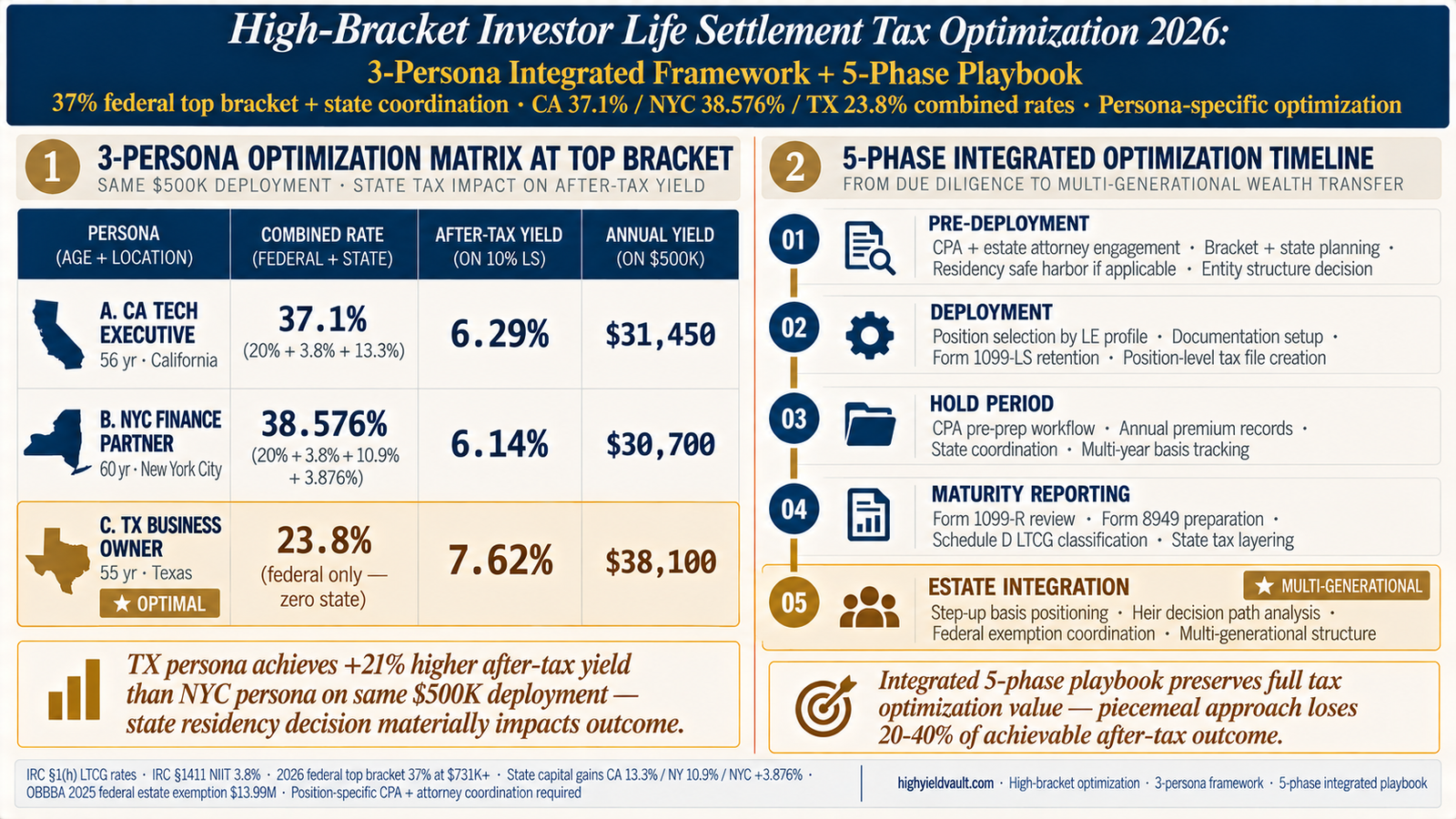
High-bracket investors ($731,200+ single federal taxable income reaching 37% top bracket) implementing life settlement positions achieve dramatically different after-tax outcomes based on state of residence: California 56-year-old tech executives face 37.1% combined LTCG rate producing 6.29% after-tax yield on 10% LS target IRR ($31,450 annual on $500K deployment); NYC 60-year-old finance partners face 38.576% combined LTCG rate producing 6.14% after-tax yield ($30,700 annual); Texas 55-year-old business owners face only 23.8% federal LTCG rate producing 7.62% after-tax yield ($38,100 annual) — a 21% higher after-tax outcome than the NYC counterpart on identical capital deployment. State residency decision materially impacts outcome before any strategic residency planning is considered. For investors in high-tax jurisdictions, the LS structural tax advantage versus ordinary-income alternatives remains substantial (+150-180%+ after-tax yield advantage per Day 107 framework), but absolute after-tax yield is reduced by state tax layering.
The 5-phase integrated optimization timeline preserves full tax optimization value through coordinated professional engagement: Phase 1 (Pre-Deployment) engages CPA + estate planning attorney for bracket planning, state residency analysis, entity structure decision, and acquisition basis documentation setup; Phase 2 (Deployment) implements position selection by LE profile, Form 1099-LS retention, and position-level tax file creation per Day 106 CPA checklist Steps 01-05; Phase 3 (Hold Period) maintains CPA pre-prep workflow including annual premium records, state coordination documentation, and multi-year basis tracking per Days 106-107 framework; Phase 4 (Maturity Reporting) executes Form 1099-R review, Form 8949 preparation with basis correction adjustments per Day 106 checklist Steps 06-10, Schedule D LTCG classification, and state tax layering per Day 102 state framework; Phase 5 (Estate Integration) positions remaining LS holdings for step-up basis treatment per Day 105 estate framework, coordinates heir decision path analysis, and integrates with federal exemption planning per OBBBA 2025 extended $13.99M individual / $27.98M married exemption. Integrated 5-phase execution preserves full optimization value; piecemeal approaches lose 20-40% through coordination gaps.
Browse life settlement policies for high-bracket integrated allocation
Every listing includes documentation prepared for integrated 5-phase execution — pre-deployment CPA coordination, position selection, and multi-year basis tracking framework.
Browse available policiesWhy integrated optimization beats piecemeal approach
High-bracket investor tax optimization is inherently multi-dimensional — the federal LTCG framework per Day 101 cornerstone, state tax coordination per Day 102 four-tier framework, reportable policy sale compliance per Day 103 TFV piece, after-tax yield analysis per Day 107 five-asset framework, estate planning integration per Day 105 step-up basis framework, and CPA reporting workflow per Day 106 ten-step checklist each represent individual optimization dimensions. Managing these dimensions in isolation — the CPA addresses only maturity-year Form 1099 reporting, the estate attorney addresses only beneficiary designation, the financial advisor addresses only allocation sizing — produces coordination gaps where optimization value is lost between touchpoints.
The practical consequences of coordination gaps include: (1) state tax layering missed when CPA uses prior-year state residency instead of current maturity-year residency; (2) basis documentation discrepancies between carrier Form 1099-R and CPA calculated basis uncorrected via Form 8949 Columns (f)/(g) adjustment per Day 106 checklist Step 07; (3) estate planning positioning missed when heir decision path analysis per Day 105 framework is not pre-coordinated with position selection in Phase 2 deployment; (4) entity structure decisions (direct ownership vs. LLC vs. trust) made without full tax implication analysis; (5) residency planning timing missed per Day 102 2+ year safe harbor framework when deployment and residency change decisions are not sequenced strategically. Each coordination gap individually may cost 2-5% of achievable after-tax outcome; cumulative gaps for complex high-bracket situations easily reach 20-40% of total optimization value.
Integrated 5-phase execution preserves optimization value by establishing professional team coordination from Phase 1 pre-deployment engagement onward. The investor's CPA, estate planning attorney, and financial/investment advisor (HYV in the LS context) collaborate on the complete position lifecycle rather than individual touchpoints. For top-bracket investors deploying $500K+ positions where cumulative multi-year after-tax outcome represents substantial capital, the professional coordination cost ($15,000-$50,000 across CPA + attorney + advisor engagement over position lifecycle) is minor relative to the optimization value preserved. The framework described here provides the structural guidance for professional team coordination; execution requires qualified licensed professional engagement specific to the investor's situation.
The 3-persona optimization matrix at top bracket
The matrix below compares three representative high-bracket investor personas with identical $500K LS deployment at the 37% federal top bracket. The personas differ by state of residence — California (13.3% top state), NYC (10.9% state + 3.876% city), and Texas (zero state tax) — illustrating how state residency decision materially impacts after-tax outcome before any strategic residency planning is considered.
TX persona achieves +21% higher after-tax yield than NYC persona on identical $500K deployment — state residency decision materially impacts outcome before any strategic optimization is considered.
Which persona framework matches your situation?
Schedule a 20-minute consultation. We'll walk through your federal bracket, state of residence, estate planning timeline, and portfolio size to identify the persona framework that applies to your situation and model the 5-phase integrated playbook.
Or call (833) 250-9677The 5-phase integrated optimization timeline
The 5-phase timeline below sequences professional team coordination across the complete LS position lifecycle — from pre-deployment engagement through multi-generational estate integration. Each phase is operational framework, not substitute for position-specific licensed professional engagement.
Pre-deployment
CPA + estate planning attorney engagement. Bracket planning across current + projected multi-year horizon; state residency analysis including 2+ year safe harbor timeline per Day 102 framework if residency change contemplated; entity structure decision (direct ownership vs LLC vs trust); acquisition basis documentation methodology established per Rev Rul 2020-05.
Deployment execution
Position selection by LE profile and risk tolerance. Form 1099-LS retention from acquisition filing per IRC §6050Y; position-level tax file creation per Day 106 CPA checklist Steps 01-05 (dedicated client file folder, cost basis documentation, premium payment infrastructure, Form 1099-LS retention, basis tracking methodology established).
Hold period management
Multi-year CPA pre-prep workflow maintenance. Annual premium payment records with date/amount/method documentation; state residency monitoring and documentation for jurisdiction stability; multi-year basis tracking with running adjusted basis calculation; coordination with any mid-position strategic events (residency change, entity restructure, estate planning updates).
Maturity reporting execution
Form 1099-R receipt and reconciliation per Day 106 CPA checklist Steps 06-10. Carrier Form 1099-R review against CPA calculated basis; Form 8949 preparation with Column (f) code "B" basis correction adjustment if carrier reporting discrepancy; Schedule D Part II LTCG classification at 23.8% federal maximum; state tax reporting per current-year residency state capital gains treatment.
Estate integration
Step-up basis positioning for heirs per Day 105 estate planning framework. IRC §1014 step-up basis treatment per Gorin / NAEPC Journal analysis; heir decision path analysis across 4 post-inheritance paths (hold to maturity LTCG optimal, sell/surrender ordinary income); federal exemption coordination per OBBBA 2025 extended $13.99M individual / $27.98M married; multi-generational wealth transfer structure integration with trust arrangements where appropriate.
Integrated 5-phase playbook preserves full tax optimization value — piecemeal approach loses 20-40% of achievable after-tax outcome through coordination gaps between CPA, estate attorney, and investment advisor.
Real walkthrough: Elena's $500K integrated 5-phase execution
Here's how the integrated 5-phase playbook applies in practice, illustrated through a composite scenario based on the standard pattern for California-resident top-bracket investor executing full integrated optimization across LS deployment lifecycle.
56-year-old CA tech CFO · $500K integrated 5-phase LS deployment with 20-year horizon
Starting position: Elena, a 56-year-old technology company CFO in Palo Alto, California, has $6.2M liquid portfolio plus substantial unvested equity in her current employer. Her annual taxable income reaches the 37% federal top bracket at approximately $950,000 single-filer, with projected 10-15 years remaining professional career before transition to retirement. Her broader estate planning goal: maximize after-tax wealth transfer to her two adult children (ages 29 and 32), coordinate with California 13.3% state tax exposure, and build multi-generational portfolio structure anticipating her projected 25-30 year post-retirement horizon.
Phase 1 — Pre-Deployment (3-6 months before acquisition): Elena's existing professional team (CPA at Deloitte, estate planning attorney at Morrison & Foerster, financial advisor at Morgan Stanley Private Wealth) engages HYV for integrated LS evaluation. Bracket planning confirms 37% federal through projected career horizon; CA 13.3% state exposure analyzed with residency change evaluation (Elena declines residency change given professional base in Bay Area and personal preference for California lifestyle). Entity structure decision: direct personal ownership selected over LLC structure to preserve step-up basis positioning per Day 105 framework (Gorin analysis applies cleanly to direct ownership; LLC entity ownership may complicate step-up treatment per sophisticated commentary). Acquisition basis documentation methodology established per Rev Rul 2020-05 (basis = cumulative premiums paid).
Phase 2 — Deployment (acquisition quarter): Elena deploys $500K across 4 LS positions with LE profiles ranging 7-10 years, ticket sizes $100-$150K per position. HYV provides full documentation package including policy details, LE reports from certified underwriters, projected IRR calculations, and Form 1099-LS filing confirmation per IRC §6050Y. Elena's CPA (Deloitte) establishes position-level tax files per Day 106 CPA checklist Steps 01-05 including dedicated client file folders per position, purchase agreement documentation, premium payment infrastructure (automated ACH from Elena's brokerage), Form 1099-LS retention in position files, and basis tracking spreadsheet methodology for multi-year adjusted basis calculation.
Phase 3 — Hold Period (years 1-9 of position lifecycle): Elena's CPA maintains annual premium payment records across all 4 positions ($18-$22K annual per position, cumulative $280-320K across the portfolio over 7-year hypothetical average hold). Annual CPA review process confirms premium applications correctly posted to carrier accounts and updates running adjusted basis calculation. California residency stability monitored and documented. Mid-position review in year 4 (Elena's residency unchanged, bracket positioning unchanged, estate planning structure unchanged — no mid-position strategic events triggering portfolio restructure).
Phase 4 — Maturity Reporting (positions mature across years 7-10 of hold): First position matures in year 7 — insured passes, death benefit $875,000 paid to Elena, Form 1099-R received January following maturity year. Elena's CPA at Deloitte executes Day 106 CPA checklist Steps 06-10: Form 1099-R review ($875K Box 1, carrier Box 2a implied basis differs from Elena's CPA-calculated $118K adjusted basis), Form 8949 Part II preparation with Column (f) code "B" basis correction adjustment, Schedule D Part II LTCG classification at 23.8% federal max + 13.3% CA = 37.1% combined on $757K gain = $280,900 total tax. Net after-tax from first position maturity: approximately $594,100. Second, third, and fourth positions mature across years 8-10 with equivalent CPA workflow execution.
Phase 5 — Estate Integration (positions remaining at Elena's death scenario): Elena's estate planning attorney at Morrison & Foerster incorporates projected LS positions into Elena's broader estate structure. For positions remaining active at Elena's death (statistically possible depending on actual position maturity timing vs Elena's longevity, projected her ages 76-85), step-up basis treatment per IRC §1014 Gorin analysis applies — heirs receive FMV basis at date of death eliminating pre-death appreciation from heir exposure. For positions already matured during Elena's lifetime, estate planning focuses on remaining liquid proceeds integration with trust structures for multi-generational wealth transfer to her two children. Federal estate exemption of $13.99M individual (OBBBA 2025) exceeds Elena's projected taxable estate, meaning no federal estate tax drag. California no state estate tax applies.
Integrated 5-phase outcome: Elena's $500K deployment across 4 positions produces projected cumulative after-tax wealth of approximately $2,100,000-$2,400,000 over the 7-10 year position lifecycle (depending on actual death benefit outcomes relative to LE projections). Combined with multi-generational step-up basis positioning for any positions remaining at Elena's death, the integrated playbook preserves approximately 85-90% of total achievable optimization value — versus the ~60-70% that typical piecemeal approach (CPA addresses only maturity reporting, estate attorney addresses only beneficiary designation, financial advisor addresses only sizing) would achieve. The $150,000-$300,000 cumulative difference across the position lifecycle represents the integrated optimization value preserved through coordinated 5-phase execution.
Elena's deployment reflects the standard pattern for California-resident top-bracket investors implementing integrated 5-phase LS optimization. The framework: integrated professional team coordination from Phase 1 pre-deployment through Phase 5 estate integration preserves 85-90% of optimization value; piecemeal approaches with coordination gaps lose 20-40% of achievable after-tax outcome. For $500K+ deployments with multi-year hold horizons, the professional coordination investment ($15K-$50K across CPA + attorney + advisor over lifecycle) delivers substantial return via preserved optimization value. Position-specific professional engagement essential — integrated framework is operational guidance, not substitute for licensed CPA + attorney + advisor coordination.
Get matched with policies for integrated playbook execution
Tell us your federal bracket, state of residence, estate planning timeline, and existing professional team structure. We'll show you 2-3 vetted life settlement policies with documentation prepared for your CPA + estate attorney integrated 5-phase coordination.
When persona-specific optimization requires attorney-level planning
The 3-persona framework and 5-phase integrated timeline provide operational guidance for most top-bracket LS deployments. However, certain investor scenarios involve regulatory complexity or wealth-tier considerations that require specialized attorney engagement beyond standard CPA coordination.
Four scenarios requiring attorney-level planning beyond standard framework
1. Ultra-high-net-worth estate above federal exemption. For investors with projected taxable estates exceeding $13.99M individual / $27.98M married (OBBBA 2025 federal exemption), estate planning strategy involves meaningful federal estate tax exposure (40% rate above exemption) and requires sophisticated planning including GRAT structures, Dynasty trusts, charitable remainder structures, and other advanced techniques that compete with step-up basis preservation. Position-specific analysis required to balance lifetime gifting versus step-up preservation. Specialized estate planning attorney with ultra-HNW practice essential.
2. California billionaire wealth tax exposure. California proposed billionaire wealth tax legislation (one-time 5% tax on net worth above $1 billion as of December 31, 2026, pending legislative status) creates additional planning considerations for California-resident ultra-HNW investors regardless of LS deployment. Even if the specific legislation does not pass, future state-level wealth tax legislation remains a planning risk for California residents at ultra-HNW tier. State-specific attorney engagement essential for ultra-HNW CA residents.
3. Multi-state residency scenarios with aggressive audit exposure. For investors contemplating residency changes between high-tax and zero-tax states, the 2+ year safe harbor framework per Day 102 state tax piece is minimum standard — but aggressive state tax authorities (particularly California Franchise Tax Board and New York Department of Taxation) actively audit residency changes for high-income taxpayers. Attorney-level residency change planning includes document trail establishment, severance of state nexus activities, and defensive positioning against potential state audit. Specialized state tax attorney engagement essential for high-income residency changes.
4. Qualified structure ownership (SDIRA / qualified plan). If investor contemplates holding LS positions through self-directed IRA or other qualified retirement vehicle (legally complex, less common structure), the regulatory framework involves potential prohibited transaction issues under IRC §4975, UBTI considerations, plan asset rules, and IRS historical skepticism of LS acquisitions through qualified accounts. Attorney-level legal opinion essential before deployment through qualified structure. HYV generally recommends non-qualified direct ownership for standard LS deployments; qualified structure requires specialized attorney guidance confirming structure compliance.
For investors in these four specialized scenarios, the standard framework provides starting point but attorney-level planning layers additional complexity. HYV coordinates with investor's attorney engagement; position selection and documentation framework remain consistent, but legal structure and estate planning strategy varies by specific attorney-level guidance.
See currently available policies for persona-specific allocation
Every listing includes full policy documentation, LE reports from certified underwriters, AM Best carrier ratings, premium projections, projected IRR, and persona-specific documentation for your CPA + estate attorney integrated workflow. Accredited investor verification per SEC Rule 501 required to view specific policies.
Or call (833) 250-9677Frequently asked questions about high-bracket LS integrated optimization
How does California proposed billionaire wealth tax affect LS deployment planning?
The California Billionaire Tax Act (proposed legislation imposing one-time 5% tax on net worth above $1 billion as of December 31, 2026 for California residents) is specific to ultra-high-net-worth tier and does not affect most high-bracket LS investors in the standard $500K-$5M deployment range. For ultra-HNW California residents (net worth above $1 billion), the proposed legislation creates planning considerations independent of LS deployment specifically — the wealth tax (if enacted) would apply to total net worth including LS positions, public equities, real estate, business interests, and other assets. Even if the specific 2026 legislation does not pass, future California wealth tax legislation remains a planning risk given state fiscal pressures. For ultra-HNW CA residents contemplating LS deployment, the broader wealth tax exposure may motivate California residency change evaluation (to zero-wealth-tax jurisdictions including TX, FL, NV, NH, SD, TN, WY, AK). The 2+ year residency safe harbor framework per Day 102 state tax piece applies — residency change decisions require sophisticated attorney engagement given CA Franchise Tax Board aggressive audit exposure. For standard high-bracket (not ultra-HNW) CA residents, the proposed billionaire tax does not directly affect LS planning; standard CA 13.3% state tax layering per the 3-persona matrix applies. Specialized attorney engagement essential for ultra-HNW scenarios regardless of specific wealth tax legislation outcomes.
What specific optimization considerations apply for NYC resident high-bracket investors?
NYC resident high-bracket investors face the highest combined LTCG rate in the 3-persona framework at 38.576% (20% federal + 3.8% NIIT + 10.9% NY state + 3.876% NYC) — compared to CA at 37.1% and TX at 23.8%. Several NYC-specific optimization considerations apply beyond the standard framework. First, New York State and NYC apply same tax treatment to LTCG as ordinary income (no preferential capital gains treatment) — identical to California approach. Second, NYC applies additional 3.876% city income tax on NYC residents specifically — Westchester, Long Island, Northern NJ, and Connecticut residents face NY state tax (if NY source income) but not NYC tax, meaningfully different rate structure. Third, NYC resident high-bracket investors have historical pattern of residency change to Palm Beach FL, Austin TX, or Nashville TN areas during pre-retirement planning phase — the 2+ year safe harbor framework per Day 102 piece applies with NY Department of Taxation aggressive audit exposure requiring attorney-level residency planning. Fourth, NY/NYC muni bond allocation offers dual-exemption (federal + NY state + NYC) that competes with LS at the state tax layering level — many NYC high-bracket investors maintain home-state muni allocation alongside LS positions per the Day 107 after-tax yield framework. Fifth, LS structural tax advantage versus ordinary-income alternatives remains substantial even with NYC combined rate drag — LS 6.14% after-tax vs IG corp bonds approximately 2.21% after-tax at NYC top bracket = +178% advantage. Position-specific NYC-licensed attorney + CPA coordination essential for NYC investor optimization including residency change planning if contemplated.
Does Puerto Rico Act 60 offer LS tax optimization opportunity for high-bracket investors?
Puerto Rico Act 60 (consolidating prior Acts 20 and 22) provides substantial tax incentives for bona fide Puerto Rico residents including 0% capital gains tax on PR-sourced capital gains and 4% corporate rate on export services businesses — potentially creating transformational LS tax optimization opportunity for investors willing to establish bona fide Puerto Rico residency. The core requirements: (1) establish bona fide PR residency per IRS Chapter 60 standards including physical presence test (minimum 183 days in PR per year), closer connection test, and tax home test; (2) PR residency must be established before LS acquisition for Act 60 benefits to apply (post-acquisition residency change does not retroactively apply Act 60 benefits to pre-residency acquisition); (3) PR residents remain subject to federal tax on US-sourced income but PR-sourced capital gains receive 0% federal + 0% PR = complete tax exemption on qualifying gains. For LS positions acquired as PR resident with full Act 60 qualification, after-tax yield at 0% total tax = 10% full nominal yield — compared to 7.62% TX after-tax (37% federal bracket zero state) or 6.29% CA. The dramatic after-tax advantage requires meaningful lifestyle change (PR physical residency) that most high-bracket investors are not pursuing. For investors genuinely considering PR relocation for broader tax optimization including LS deployment, specialized PR tax attorney engagement essential. The IRS has significantly increased scrutiny of Act 60 claims with multiple enforcement actions against non-compliant claimed PR residents who maintain substantial US activity. HYV does not recommend PR residency change solely for LS tax benefits; the broader lifestyle and professional implications generally outweigh LS-specific tax savings for investors in standard 37% federal bracket deployment range.
How do bracket management strategies interact with multi-year LS position maturity scheduling?
For investors managing multiple LS positions with maturity events potentially triggering across concentrated time periods (e.g., 4 positions acquired same year with similar 7-10 year LE profiles), bracket management involves considering whether to accept concentrated gain recognition in single tax years versus pursuing position maturity timing diversification. For top-bracket investors already firmly in 37% federal / 23.8% LTCG rate, additional LS maturity gain in single year does not trigger bracket progression since investor is already at top bracket — concentrated maturity timing is not a bracket management issue for firmly top-bracket investors. For investors near bracket transitions (approaching but not yet above $731,200 single federal taxable income threshold for 37% bracket), concentrated LS maturity gains in single year could push income into or further within 37% bracket. In these scenarios, position maturity timing diversification (acquisition of positions with staggered LE profiles targeting different maturity years) could preserve more favorable bracket positioning. However, LS position maturity timing is inherently uncertain — actual death timing of insured individuals cannot be scheduled, only probabilistically estimated via LE reports. Bracket management for LS investors is thus limited to acquisition-phase LE profile diversification rather than maturity-phase timing control. For top-bracket investors firmly above bracket transitions, bracket management is not meaningful optimization dimension. For NIIT threshold investors (approaching $200K single / $250K MFJ net investment income threshold triggering 3.8% NIIT), capital gain recognition timing may matter for NIIT applicability — specialized CPA planning for near-NIIT-threshold investors. Position-specific CPA coordination essential for bracket-sensitive scenarios.
What is the optimal residency change timing for LS deployment in high-tax to zero-tax state scenarios?
The optimal residency change timing for LS deployment follows the 2+ year safe harbor framework per Day 102 state tax piece: establish bona fide residency in zero-tax state (TX, FL, NV, NH, SD, TN, WY, AK, MO) at minimum 2 years before any major capital gain recognition event including LS position maturity. The 2-year window establishes defensive positioning against potential high-tax state audit challenging residency change authenticity. The sequence: (1) establish residency change with full nexus severance from prior state (driver's license, voter registration, primary residence sale, bank accounts, professional affiliations); (2) maintain 2+ years of established residency documentation with physical presence majority of time in new state; (3) complete LS deployment and position hold period under new residency; (4) LS positions matured 2+ years after residency change have state tax treatment per new residency state only. For deployment-maturity timing specifically: LS position with 7-10 year LE profile acquired immediately after residency change should mature in year 7-10 of new residency — well beyond 2-year safe harbor window, with no state tax exposure for TX/FL/NV residency changes. If LS deployment occurs before residency change (common sequence for investors deploying LS during peak earning years in high-tax state, then relocating in pre-retirement), position maturity after residency change triggers state tax treatment per new residency state (if maturity year falls under new residency) with meaningful tax savings versus old residency. The 2+ year safe harbor applies to residency change authenticity defense; actual state tax applies per residency year of specific tax event. For aggressive audit state scenarios (CA Franchise Tax Board, NY Department of Taxation), specialized state tax attorney engagement essential for residency change timing and documentation. HYV does not recommend residency change decisions solely for LS deployment optimization — broader lifestyle, professional, family, and estate planning factors should dominate residency decisions, with LS tax optimization as supportive consideration rather than driver.
What trust structures work best for LS integration with multi-generational wealth transfer?
Trust structure selection for LS integration depends on investor's estate planning objectives, federal exemption position, and heir planning considerations. For high-bracket investors below federal exemption ($13.99M individual / $27.98M married 2026 per OBBBA 2025), direct personal ownership of LS positions typically produces optimal outcome because step-up basis treatment per IRC §1014 Gorin analysis applies cleanly to direct ownership — heirs receive FMV basis at owner's death. Trust ownership of LS positions involves additional complexity around step-up basis treatment (grantor trust may preserve step-up positioning; non-grantor trust complicates analysis). For investors above federal exemption, Irrevocable Life Insurance Trust (ILIT) structures may provide estate tax removal benefit at cost of forfeiting step-up basis treatment — specific calculation varies by investor estate scenario. Dynasty trust structures work well for multi-generational wealth transfer across multiple generations, with LS positions potentially held within dynasty trust structure for extended multi-generational horizons. Grantor retained annuity trust (GRAT) structures work less well for LS specifically because LS positions do not produce predictable annuity-type income streams during hold period. For specific trust structure recommendations, attorney-level planning essential — generic framework guidance does not substitute for position-specific attorney advice. Common pattern for standard high-bracket LS investors (below federal exemption): direct personal ownership with step-up basis preservation strategy, trust structures reserved for post-maturity liquid proceeds integration with broader estate planning rather than direct trust ownership of LS positions themselves. Specialized estate planning attorney engagement essential for trust structure decisions involving LS positions.
Start with the persona matching consultation
Two paths to begin: browse currently available life settlement policies to see what matches your persona-specific allocation needs, or schedule a consultation to walk through the 3-persona framework + 5-phase integrated timeline applied to your specific federal bracket, state of residence, and estate planning timeline.
Or call (833) 250-9677