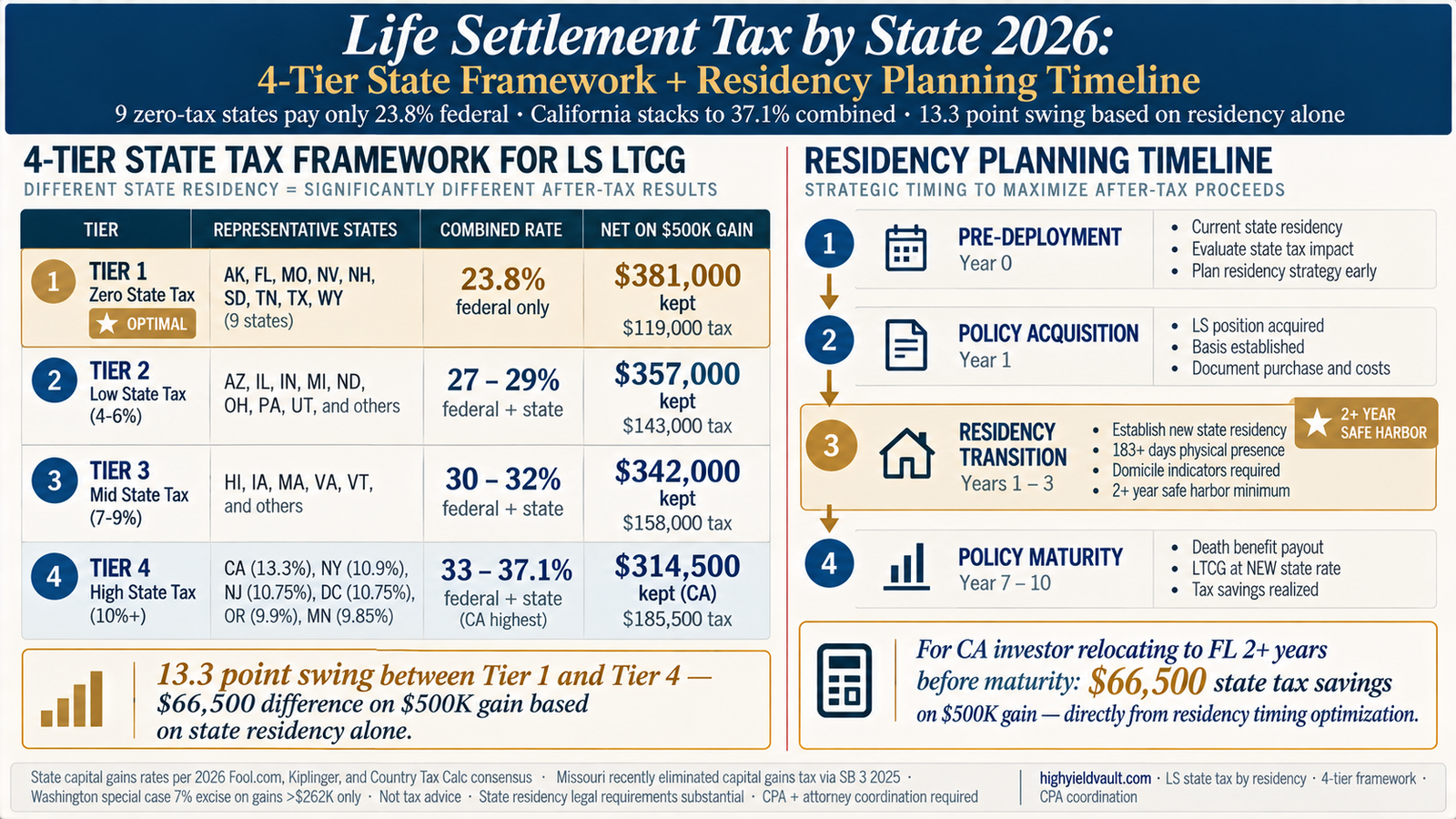
Life settlement tax treatment at the state level in 2026 follows a 4-tier framework based on each state's capital gains taxation. Tier 1 (zero state tax): Alaska, Florida, Missouri, Nevada, New Hampshire, South Dakota, Tennessee, Texas, and Wyoming impose no state income or capital gains tax, meaning accredited investors residing in these 9 states pay only the 23.8% federal LTCG ceiling. Tier 2 (low state tax, 4-6%): most states applying standard income tax rates to capital gains including AZ, IL, IN, MI, OH, PA, UT — combined federal + state rate approximately 27-29%. Tier 3 (mid state tax, 7-9%): HI, IA, MA, VA, VT — combined approximately 30-32%. Tier 4 (high state tax, 10%+): California (13.3%), New York (10.9%), New Jersey (10.75%), Washington DC (10.75%), Oregon (9.9%), Minnesota (9.85%) — combined approximately 33-37.1%.
On a $500K policy maturity gain, the swing between Tier 1 optimal ($381,000 kept after $119,000 federal tax) and Tier 4 California worst case ($314,500 kept after $185,500 combined federal + state tax) reaches $66,500 — a 13.3 percentage point rate differential driven entirely by state residency. For pre-retirement investors already planning state relocation, coordinating policy maturity timing with established new state residency (minimum 2-year safe harbor typical for high-stakes tax events) can produce substantial LTCG optimization. Washington State operates as a special case: 7% excise tax applies only to long-term gains above $262,000 (2026 threshold), making WA effectively tax-free for smaller gains and 7% stacked for larger gains. All tax rates and outcomes illustrative; not guaranteed. Life settlement investments involve substantial risk including loss of capital and are available only to accredited investors per SEC Rule 501.
Browse life settlement policies with CPA-coordinated state tax framework
Every listing includes documentation for CPA state tax modeling — essential for investors optimizing combined federal + state LTCG outcome at policy maturity.
Browse available policiesWhy state residency determines compound tax outcome
Federal LTCG rates are fixed by statute at the federal level: 20% maximum long-term capital gains rate plus 3.8% net investment income tax, producing a 23.8% federal ceiling that applies regardless of where the investor resides. State tax, however, stacks on top of federal treatment based on the investor's state of residence in the tax year that the capital gain is recognized. For life settlement positions, the gain recognition event is policy maturity — the year the death benefit is paid to the investor. Residency on that specific tax year determines which state tax rate applies to the LTCG, not residency during the hold period or at the time of policy acquisition.
The practical implication is substantial for high-bracket investors: the same $500K LS maturity gain produces dramatically different after-tax outcomes based on state residency. In a Tier 1 zero-tax state (Alaska, Florida, Missouri, Nevada, New Hampshire, South Dakota, Tennessee, Texas, Wyoming), the investor pays $119,000 total tax (23.8% federal only) and keeps $381,000 net. In Tier 4 California — the highest-tax state applying 13.3% top rate as ordinary income (California does not distinguish between short-term and long-term capital gains for state tax purposes, applying the same 13.3% top rate) — the same $500K gain produces $185,500 total tax (23.8% federal + 13.3% state) and $314,500 net. The $66,500 difference is directly attributable to state residency at maturity, with no behavioral change required beyond choice of residence.
The scale of the state tax impact increases proportionally with gain size. On a $1M maturity gain, the Tier 1 vs Tier 4 California swing reaches $133,000 ($238K vs $371K total tax). On a $2M gain (typical for larger LS positions deployed in family office or ultra-institutional frameworks — see our $2M ultra-institutional framework), the swing reaches $266,000. For pre-retirement investors already contemplating state relocation for lifestyle, climate, or general tax optimization reasons, coordinating the move with LS policy maturity timing can produce transformational tax savings beyond the general benefits of state tax optimization.
The 4-tier state tax framework for LS LTCG
The matrix below groups all 50 US states into 4 tiers based on 2026 state capital gains tax treatment applied to LS LTCG at maturity. Tier 1 (zero state tax, 9 states) is highlighted as the optimal residency framework for LS investors; Tier 4 (high state tax, 10%+) represents the worst-case combined rate scenarios. Washington State operates as a special case not fully captured in the standard tiers (see state-specific notes).
13.3 point rate swing between Tier 1 and Tier 4 California — $66,500 difference on $500K gain based on state residency alone, driven entirely by where the investor files their tax return in the maturity year.
State capital gains tax lists reflect 2026 consensus data per Fool.com, Kiplinger, and Country Tax Calc; state capital gains tax status changes via state legislative action. Missouri recently eliminated capital gains tax via Senate Bill 3 in 2025 (prior Day 101 cornerstone reference to the 9 zero-tax states listed Washington instead; this Day 102 reflects the current authoritative 2026 list including Missouri). Washington State operates as a special case: 7% excise tax applies only to long-term capital gains above $262,000 (2026 threshold), making WA effectively tax-free for smaller gains and stacking 7% on larger gains above the threshold. Arkansas has a unique treatment: 50% of long-term capital gains are state-tax-exempt, effectively halving the state rate on LTCG. California, New Jersey, and New York treat all capital gains as ordinary income without distinguishing between short-term and long-term — applying the full state ordinary income rate to LTCG recognized at the state level. State tax rates referenced reflect top marginal rates and may vary based on income level, filing status, and other factors specific to the taxpayer. Combined federal + state rates assume high-federal-bracket investor (37% federal ordinary bracket, 20% LTCG + 3.8% NIIT = 23.8% federal); investors at lower federal brackets experience smaller federal portion but same state portion. Net calculations are illustrative, not specific tax outcomes applicable to any individual investor. Representative state lists are not exhaustive; specific states not listed should be evaluated individually by qualified CPA before relying on tier placement. Rates subject to Congressional and state legislative modification. OBBBA 2025 did not modify LTCG rates (only affected ordinary income threshold indexing and other provisions).
How does your state residency affect LS LTCG outcome?
Schedule a 20-minute consultation. We'll walk through your state tax situation, model combined federal + state tax at policy maturity, and coordinate with your CPA on documentation needed for state tax tracking.
Or call (833) 250-9677The residency planning timeline: pre-maturity optimization framework
For pre-retirement investors already contemplating state relocation for lifestyle, climate, or general tax optimization reasons, coordinating the move with LS policy maturity timing can produce substantial additional LTCG savings. The framework below shows the 4-phase timeline from LS position acquisition through policy maturity, with specific emphasis on the residency transition phase that requires minimum 2-year safe harbor establishment before high-stakes tax events.
Pre-deployment
Year 0Current state residency established — Tier 2/3/4 state typical for pre-retirement professional investors in high-tax metros (CA, NY, NJ, IL, MA). State tax situation modeled for existing portfolio and projected additions.
Policy acquisition
Year 1LS position acquired via direct ownership. Cost basis established (purchase price). Current state tax situation acknowledged in position-level documentation. CPA notes projected residency change timing for maturity-year tax planning.
Residency transition
Years 1-3Establish new state residency with substantial domicile indicators and 2+ year safe harbor before projected policy maturity. Specific legal requirements vary by state but typically include:
Policy maturity
Year 7-10Death benefit payout received. LTCG calculated at NEW state tax rate (Tier 1 zero-tax state if relocation completed to AK/FL/MO/NV/NH/SD/TN/TX/WY). State tax savings realized based on established new residency, documented through 2+ years of substantive domicile change.
For a CA investor relocating to FL 2+ years before maturity: $66,500 state tax savings on $500K gain — directly from residency timing optimization combined with general lifestyle relocation benefits.
Real walkthrough: Jennifer's CA to FL relocation coordinated with LS maturity
Here's how the residency planning framework applies in practice, illustrated through a composite scenario based on the standard pattern for pre-retirement high-bracket investors coordinating state relocation with LS policy maturity timing.
Pre-retirement CA investor relocating to FL · $750K LS deployment with coordinated residency change
Starting position: Jennifer, a 63-year-old partner at a Silicon Valley tech consulting firm, operates in California at the top federal bracket (37% + 3.8% NIIT = 40.8%) plus California top state rate 13.3% (combined 45.75% on ordinary income, 37.1% on LTCG). Her existing portfolio of $5.8M includes concentrated firm equity, diversified public equities, muni bonds (CA tax-exempt in-state munis), and modest private credit position. Her lifestyle plans include retirement relocation to Naples, Florida within the next 3-5 years — a decision driven by family connections, climate preference, and general state tax optimization.
The strategic coordination: Jennifer's wealth advisor and CPA identify an opportunity to coordinate her planned FL relocation with LS deployment timing to compound the tax benefits. She deploys $750K into a direct-ownership LS position with 7-year projected LE and target IRR 10.3%. The position is acquired while she remains a California resident (Phase 02 Policy Acquisition in Year 1). She initiates FL residency establishment immediately upon acquisition, with substantial completion by Year 2.5 (Phase 03 Residency Transition). Projected policy maturity falls in Year 7-8, well within FL residency safe harbor window.
Residency transition execution: Jennifer and her CPA structure the residency change following California's specific requirements for breaking CA domicile (particularly stringent given CA's aggressive audit of former residents). She acquires a Naples primary residence in Year 1.5, changes driver's license and voter registration in Year 2, documents 183+ days physical presence in FL for Years 2 and 3, redomiciles primary bank and investment accounts to FL by Year 2, maintains day-count documentation (travel records, utility bills, credit card location tracking) throughout the transition period. Her consulting firm practice shifts to remote/project-based work allowing geographic flexibility. By Year 3, FL residency is substantively established with 2+ years of safe harbor before projected policy maturity in Year 7-8.
Projected tax outcome: At policy maturity in Year 7-8, Jennifer's $750K LS position (assuming full LE realization) produces approximately $950K-$1.0M death benefit. Adjusted basis at maturity: $750K purchase + approximately $160K cumulative premiums = $910K adjusted basis. Projected gain: $40K-$90K at policy maturity (relatively modest gain reflecting the shorter LE and higher basis accumulation). If Jennifer remained a CA resident: gain taxed at 37.1% combined ($14,840-$33,390 total tax). With established FL residency: gain taxed at 23.8% federal only ($9,520-$21,420 total tax). State tax savings on this specific position: approximately $5,320-$11,970 directly from residency coordination.
Portfolio-wide impact: The $5,320-$11,970 LS state tax savings is modest in isolation, but represents one component of Jennifer's broader portfolio-wide state tax optimization achieved through the FL relocation. Her projected lifetime state tax savings across all capital gains events (concentrated firm equity, portfolio rebalancing gains, additional LS positions, estate planning transactions) over her remaining 20-year horizon reach approximately $400K-$600K per lifestyle-driven planning projections. The LS state tax coordination is a specific example of the compound tax optimization that pre-retirement relocation decisions can produce when coordinated with major tax events.
Jennifer's reallocation reflects the standard pattern for pre-retirement high-bracket investors coordinating state residency changes with major tax events. The framework: LS policy maturity timing coordination with established new state residency can produce meaningful tax savings on each specific position, with the aggregate benefit compounding across broader portfolio decisions. For pre-retirement investors already contemplating state relocation, the residency planning framework provides a specific decision structure for timing both the move and the related tax events.
Get matched with policies for CPA-coordinated state tax framework
Tell us your current state residency, projected relocation timing, and planned LS allocation. We'll show you 2-3 vetted life settlement policies with LE profiles suited to your state tax coordination timeline.
Why direct ownership preserves state tax clarity
The state tax framework described here applies cleanly to direct-ownership life settlement positions where the investor acquires beneficial ownership of individual policies. In pooled LS fund structures, the state tax treatment at the investor level can be substantially more complex because the fund's partnership or LLC structure may require state tax filings in multiple states where the fund is registered or where portfolio activities occur. Investors in multi-state pooled vehicles sometimes receive state tax surprise bills from states they have no personal connection to, driven entirely by the fund's business footprint. Direct ownership eliminates this complexity: the investor's tax situation is governed by their personal state of residence at policy maturity, with no additional state filing complications from fund-level activities.
Direct ownership also provides clean documentation chain for state tax auditors evaluating residency establishment claims. When a former California resident files their maturity-year return as a Florida resident claiming only federal tax on LS LTCG, California tax authorities may audit the residency change thoroughness — particularly for high-gain tax events like policy maturity payouts. Direct-ownership documentation (purchase agreement, premium records, Form 1099-B at maturity) is simpler to defend than complex pooled fund K-1s where state attribution may be disputed. This is the same institutional approach deployed by Apollo Global Management, Berkshire Hathaway, and Partner Re at scale — accessible to accredited investors at $200K per policy ticket sizes through HYV.
See currently available policies for state-coordinated allocation
Every listing includes full policy documentation, LE reports from certified underwriters, AM Best carrier ratings, premium projections, and projected IRR. Accredited investor verification per SEC Rule 501 required to view specific policies.
Or call (833) 250-9677Frequently asked questions about state tax treatment of life settlements
Which 9 states have no state capital gains tax on life settlements?
Nine states impose no state income or capital gains tax for 2026: Alaska, Florida, Missouri, Nevada, New Hampshire, South Dakota, Tennessee, Texas, and Wyoming. Accredited investors residing in these states pay only the 23.8% federal LTCG ceiling on life settlement maturity gains. This list reflects 2026 updates — Missouri recently eliminated capital gains tax via Senate Bill 3 in 2025 (replacing Washington in the prior 9-state list; Washington introduced a 7% excise tax on long-term gains above $262,000 effective in recent years, moving it out of the "zero-tax" category). The prior cornerstone piece in our tax cluster referenced the pre-SB 3 list; this article reflects the current 2026 authoritative composition. Among the 9 zero-tax states, Florida and Texas are the two most common relocation destinations for pre-retirement high-bracket investors from California, New York, and other high-tax metros — driven by combination of general state tax optimization, climate, and family or business relocation factors. The specific choice among the 9 states typically turns on lifestyle preferences (climate, proximity to family, cultural fit) rather than tax differences, since the state tax outcome is identical across all 9. Residents of these states who are also high federal bracket investors experience the maximum tax advantage of LS LTCG treatment at 23.8% combined — the lowest possible rate structure on the asset class in the United States.
What is Washington State's 7% excise tax and how does it affect LS?
Washington State implemented a 7% capital gains excise tax that applies only to long-term capital gains above $262,000 (2026 threshold, with annual inflation adjustments). This is a special case that doesn't fit neatly into standard state capital gains tax frameworks because it operates as an excise tax rather than an income tax, and applies only above a specific threshold rather than to all gains. For LS investors in Washington State: policy maturity gains below $262,000 are not subject to the 7% excise tax (effectively treating WA as zero-tax for smaller LS positions); gains above $262,000 are subject to 7% WA excise tax on the gain amount exceeding the threshold. For example, a $500K LS maturity gain in Washington would face: 23.8% federal on the full $500K ($119K federal tax) + 7% WA excise on $238K excess above threshold ($16.66K WA tax) = $135,660 total tax, or approximately 27.1% effective combined rate. This is substantially better than CA (37.1%) but worse than true zero-tax states (23.8%). The WA excise tax has been subject to legal challenges and legislative debate — specific application and future viability should be confirmed with CPA familiar with current WA tax law before relying on this treatment. For investors evaluating WA as a potential relocation destination for LS tax optimization, the 7% excise tax over threshold meaningfully reduces the tax advantage versus moving to one of the 9 true zero-tax states (AK, FL, MO, NV, NH, SD, TN, TX, WY).
How much does California residency actually cost on LS LTCG?
California's 13.3% top capital gains rate (applied as ordinary income — California does not distinguish between short-term and long-term for state purposes) stacks on top of the 23.8% federal LTCG ceiling to produce a combined 37.1% rate for high-bracket CA investors. For specific gain sizes: $100K LS gain costs $37,100 total in CA vs $23,800 in zero-tax state ($13,300 CA tax penalty); $500K gain costs $185,500 CA vs $119,000 zero-tax state ($66,500 CA penalty); $1M gain costs $371,000 CA vs $238,000 zero-tax state ($133,000 CA penalty); $2M gain costs $742,000 CA vs $476,000 zero-tax state ($266,000 CA penalty). The CA penalty scales linearly with gain size, making CA residency particularly costly for larger LS positions. California's aggressive residency audit practices add another dimension: former CA residents who achieve substantial tax savings at major events (like LS policy maturity) are frequently audited to verify that CA residency change was substantive rather than paper-only. California's "burden of proof" standard for departure requires demonstrating clear and convincing evidence of residency change — not just driver's license update but comprehensive domicile shift including primary residence, employment relocation, family connections, and asset redomicile. The 2+ year safe harbor between CA departure and major CA-sourced income events is standard best practice for navigating this audit risk, which is why pre-retirement coordination of LS acquisition timing with planned CA departure matters structurally.
What are the legal requirements for establishing new state residency?
State residency legal requirements vary substantially by state but generally involve two components: physical presence (quantitative) and domicile intent (qualitative). Physical presence typically requires 183+ days per tax year in the new state, documented through travel records, utility bills, credit card location tracking, cell phone records, and other objective evidence. Domicile intent — the more complex requirement — involves demonstrating that the new state is the taxpayer's permanent home with no intention to return to the previous state. Standard domicile indicators include: primary residence acquired in new state (owned home or long-term lease), driver's license and vehicle registration changed to new state, voter registration changed, primary bank and investment accounts redomiciled, physician and professional service relationships moved, family and social connections shifted, estate planning documents updated to reference new state. Specific state rules vary — California's requirements are particularly stringent, with the California Residency Questionnaire explicitly requesting evidence across multiple domicile dimensions. For high-stakes tax events like LS policy maturity (potentially $100K+ in state tax at stake for larger positions), the 2+ year safe harbor between residency change and major event is standard best practice. State residency change coordination requires attorney and CPA involvement — this is not a DIY tax optimization project, particularly when departing from high-aggression audit states (CA, NY, MA, NJ). Written legal opinion addressing specific residency change timeline and documentation is standard pre-maturity practice for larger LS positions where state tax savings justify the professional cost.
Does Arkansas's 50% capital gains exemption apply to life settlements?
Arkansas has a unique state tax provision excluding 50% of long-term capital gains from state taxation, effectively halving the Arkansas state rate on LTCG. For 2026, Arkansas's top ordinary income rate is approximately 4.4%, meaning the effective rate on LTCG after the 50% exemption is approximately 2.2%. For LS investors residing in Arkansas, the combined federal + state rate on LS LTCG at policy maturity would be approximately 23.8% federal + 2.2% effective Arkansas state = approximately 26% combined — placing Arkansas in a favorable position within Tier 2 of our 4-tier framework despite the nominal state rate being higher than the pure Tier 2 range would suggest. The 50% exemption applies specifically to long-term capital gains (held more than 1 year), which fits LS positions typically held 5-10 years. Position-specific CPA review essential for confirming Arkansas treatment applies to specific LS structures, since certain investment categories can face exemption limitations. Arkansas is not typically chosen as a specific residency destination for LS tax optimization (zero-tax states offer better outcomes), but Arkansas residents already in the state benefit from more favorable LTCG treatment than nominal state rates would suggest. Several other states have specific LTCG preference rules worth evaluating individually — Montana, Vermont, and others have special provisions that may affect specific scenarios. For investors in states with unusual tax provisions, specific CPA review essential before relying on general state tax framework.
Did OBBBA 2025 change state capital gains tax treatment?
The One Big Beautiful Bill Act (OBBBA) signed July 4, 2025 is federal tax legislation and does not directly modify state capital gains tax rates — those remain under state legislative authority and vary state by state. The federal OBBBA changes affecting LS investors indirectly include: ordinary income tax bracket thresholds (inflation-indexed, affecting the breakpoints where different ordinary rates apply but not the state LTCG stacking math); QSBS (Qualified Small Business Stock) provisions enhanced in OBBBA affecting entrepreneurial accredited investors; estate and gift tax exemption threshold changes affecting multi-generational planning around LS positions; carried interest treatment adjustments; and various other federal provisions. For state tax specifically, state legislatures continue to modify state capital gains treatment independently — Missouri's SB 3 2025 eliminated state capital gains tax effective 2026; Washington's 7% excise tax continues under WA state law; other states may modify rates in future legislative sessions. The 4-tier framework described in this piece reflects 2026 state capital gains treatment current as of research; investors should verify current state rules at the specific time of their LS maturity planning via CPA consultation. State legislative changes have modest impact on this framework — the structural distinction between zero-tax states (Tier 1) and high-tax states (Tier 4) has been stable for years and is unlikely to shift dramatically, but specific tier placement for individual states can change with state legislative action.
Start with the 4-tier state framework analysis
Two paths to begin: browse currently available life settlement policies to see what matches your state-coordinated allocation, or schedule a consultation to walk through the 4-tier framework applied to your specific state residency and relocation plans.
Or call (833) 250-9677