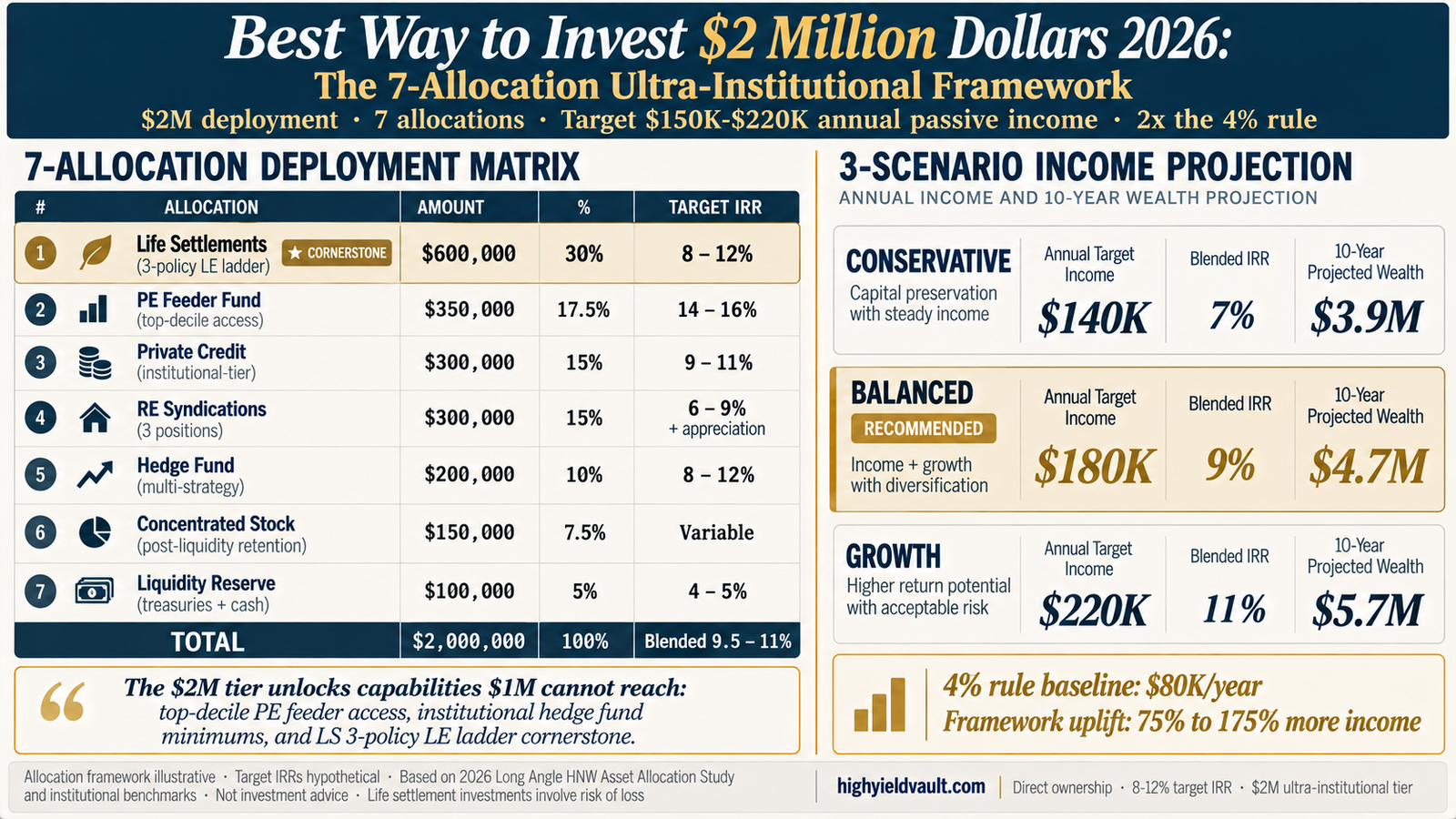
The best way to invest $2 million dollars for accredited investors in 2026 is a 7-allocation ultra-institutional deployment framework: life settlements 3-policy LE ladder as cornerstone ($600K, 30%), PE feeder fund for top-decile GP access ($350K, 17.5%), institutional-tier private credit ($300K, 15%), real estate syndications across 3 positions ($300K, 15%), hedge fund multi-strategy allocation ($200K, 10%), concentrated single-stock retention from post-liquidity events ($150K, 7.5%), and liquidity reserve in short treasuries plus cash ($100K, 5%).
This framework targets $140K-$220K annual passive income across three scenarios (conservative 7% blended IRR / balanced 9% / growth 11%) — meaningfully above the $80K generated by the traditional 4% rule on $2M. The $2M tier specifically unlocks capabilities lower tiers cannot reach: PE feeder funds require $250K+ minimums for top-decile GP access, institutional hedge funds require $500K-$1M typical minimums, and a 3-policy life settlement LE ladder at $600K provides staggered maturity timing impossible at smaller LS allocations. All returns illustrative; not guaranteed. Life settlement investments involve substantial risk including loss of capital and are available only to accredited investors per SEC Rule 501.
Browse life settlement policies for your 3-policy LE ladder cornerstone
Every listing includes LE reports, AM Best carrier ratings, premium schedules, and projected IRR — the data needed to build the $600K LS ladder anchor across staggered life expectancies.
Browse available policiesWhy $2M unlocks capabilities that $1M cannot reach
The jump from $1M to $2M in deployable capital is not merely a doubling of position sizes — it crosses specific capability thresholds that fundamentally change which allocation categories become accessible. At $1M, the institutional-tier framework typically includes 5-6 allocations (see our $1M institutional deployment guide) covering LS, private credit, real estate, dividend equities, treasuries, and alternatives. Several institutional categories remain inaccessible at the $1M tier because their minimums or operational complexity exceed what a single-million portfolio can structurally support.
At $2M, three specific capability thresholds unlock. First, PE feeder fund access: top-decile private equity funds typically require $5M+ direct commitments, inaccessible to most individual accredited investors. Feeder fund structures aggregate multiple accredited LPs into a single commitment vehicle, but the per-LP minimums for institutional-quality feeders typically start at $250K and often require $500K+. At $2M total portfolio, a $350K PE feeder allocation represents 17.5% of the portfolio — meaningful without concentration. At $1M, the same allocation would represent 35% — concentration that compromises the diversification function of the alternatives sleeve. Second, institutional hedge fund tier: multi-strategy hedge funds and the better single-strategy funds typically require $500K-$1M minimums. These are inaccessible at $1M portfolio tier (concentration prohibitive) but become operationally feasible at $2M where a $200K allocation can access certain structures and $500K+ can access the full multi-strategy tier if preferences warrant. Third, LS 3-policy LE ladder cornerstone: a $600K LS allocation enables 3 direct-ownership policies at $200K minimum each with staggered life expectancies — producing portfolio-level maturity timing diversification that a $300K single-policy allocation (typical at $1M tier) cannot achieve.
These three unlocked capabilities compound: the $2M framework targets $140K-$220K annual income across scenarios, versus $76K-$112K at the $1M tier — approximately 2x income uplift at only 2x capital deployment, reflecting the structural capability advantages of the ultra-institutional tier. The $2M portfolio also typically coincides with a specific investor archetype: post-liquidity-event accredited investors arriving at this capital level from business sales, inheritance events, exec comp vesting, or retirement payouts, often with concentrated single-stock positions worth retaining as a seventh allocation category.
The 7-allocation deployment framework: category-by-category
The matrix below shows the complete 7-allocation ultra-institutional framework for $2M deployment, with specific dollar amounts, portfolio weightings, target IRRs, hold periods, and strategic roles for each category. The LS 3-policy LE ladder is highlighted as the cornerstone position — the dominant allocation that anchors the framework structurally.
The $2M tier specifically unlocks PE feeder access, institutional hedge fund minimums, and 3-policy LS LE ladder cornerstone — capabilities unavailable at the $1M tier.
Allocation framework reflects balanced-scenario weightings and is illustrative, not specific portfolio recommendation. Individual investor allocations should be tailored to specific liquidity needs, time horizon, risk tolerance, existing portfolio structure, and liquidity event characteristics (post-business-sale concentrated holdings, inheritance tax basis considerations, exec comp vesting restrictions, retirement payout structuring). Target IRRs are hypothetical ranges based on 2026 consensus data from institutional-tier sources including Long Angle 2026 HNW Asset Allocation Study, Goldman Sachs 2025 Family Office Investment Insights, BlackRock Family Office Survey, UBS Wealth Report, and category-specific benchmarks; actual investor returns vary substantially. PE feeder fund IRRs reflect net-of-fee returns after feeder structure costs typically 1-2% annually plus underlying GP fees; direct top-decile PE commitments typically require $5M+ minimums. Hedge fund tier target IRR reflects multi-strategy allocation; single-strategy fund returns vary substantially by strategy and manager. Concentrated single-stock position target IRR shown as "variable" reflecting the position-specific risk and return characteristics of post-liquidity retained equity; this allocation assumes the investor arrived at $2M partially through concentrated equity holdings worth retaining for tax basis, strategic, or sentiment reasons.
Build your 7-allocation ultra-institutional sleeve
Schedule a 20-minute consultation. We'll walk through your capital deployment timing, map post-liquidity event considerations, and show how LS 3-policy LE ladder cornerstone anchors the ultra-institutional framework at the $2M tier.
Or call (833) 250-9677The 3-scenario income projection: conservative / balanced / growth
The 7-allocation framework can be weighted conservatively, balanced, or growth-tilted depending on the investor's income priorities, risk tolerance, and remaining time horizon. The three scenarios below show the target annual passive income, blended IRR, and 10-year projected wealth outcome for each weighting approach. The balanced scenario is typically recommended for most $2M post-liquidity-event investors.
4% rule baseline: $80K/year on $2M · Framework uplift: 75% to 175% more annual income through ultra-institutional allocation
Real walkthrough: David's post-business-sale $2M deployment
Here's how the 7-allocation ultra-institutional framework applies in practice, illustrated through a composite investor scenario based on the standard pattern for post-liquidity-event accredited investors at the $2M capital level.
Post-business-sale accredited investor · $2.0M ultra-institutional deployment across 7 allocations
Starting position: David, a 58-year-old recently sold his manufacturing business after 24 years of ownership. Net proceeds after taxes and recapture: approximately $2.0M in deployable capital, plus retained concentrated stock position of $150K in the strategic acquirer's equity (lockup-restricted for 18 months). Pre-sale household wealth was concentrated in business value; post-sale household now has $2.0M liquid plus the $150K concentrated equity position plus retained home equity. David has not previously managed a portfolio of this scale — business reinvestment and operating cash flow were his wealth-building mechanisms.
The challenge: David needs to replace approximately $160K annual pre-tax income (his previous owner-operator comp) through portfolio distributions while deploying the lump sum across institutional-tier allocations he's never previously accessed. His CPA has recommended against concentrating in muni bonds (post-business-sale tax basis makes muni tax-exempt yields less compelling than taxable alternatives at his bracket), and his wealth manager has suggested institutional-tier alternatives as the yield-generation anchor.
Scenario selection: David evaluates the three income-projection scenarios. He eliminates Growth (requires $220K annual target which exceeds his need and the 11% blended IRR assumes successful PE feeder vintage selection with execution risk he's uncomfortable underwriting at this life stage). He narrows to Balanced ($180K annual target, 9% blended IRR, closest to his $160K income replacement need with modest cushion). The Conservative scenario ($140K) is defensible but produces income below his replacement need, requiring supplementary withdrawals that would reduce principal over time.
Framework deployment: David implements the Balanced scenario 7-allocation framework over 90 days. Allocation 01 — Life Settlements ($600K, 30%): 3 direct-ownership policies with staggered LEs at 6.4 / 7.8 / 9.2 years, blended target IRR 10.2% — anchoring the ultra-institutional sleeve as the cornerstone. Allocation 02 — PE Feeder Fund ($350K, 17.5%): single institutional feeder accessing top-decile buyout GP with 15.4% target net IRR over 7-year hold. Allocation 03 — Private Credit ($300K, 15%): institutional direct-lending fund, 10.1% target quarterly distributions. Allocation 04 — RE Syndications ($300K, 15%): 3 multifamily core positions ($100K each) in defensive Sun Belt markets, blended 8.3% distributions. Allocation 05 — Hedge Fund Tier ($200K, 10%): multi-strategy allocation, 9.6% target. Allocation 06 — Concentrated Stock ($150K, 7.5%): retained acquirer equity position (18-month lockup, strategic retention post-lockup pending reassessment). Allocation 07 — Liquidity Reserve ($100K, 5%): 2-year treasury ladder generating 4.2% while providing operational liquidity.
Projected outcome: David's $2.0M deployment generates approximately $180K annual pre-tax income through the first 5-7 years (LS cornerstone pays at maturity so delivers back-loaded value, while PE/PC/RE/HF generate ongoing distributions). The sleeve preserves principal while meeting his $160K income replacement need with 12.5% cushion for inflation or discretionary allocation increases. 10-year projected wealth: approximately $4.7M at the balanced 9% blended IRR, versus $2.3M on the straight 4% rule trajectory — a 104% wealth differential over the decade, driven by the structural capability advantages of ultra-institutional-tier allocation at the $2M capital level.
David's deployment reflects the standard pattern for post-business-sale accredited investors arriving at the $2M capital tier with specific income replacement objectives. The framework: a 7-allocation ultra-institutional deployment anchored by LS 3-policy LE ladder cornerstone can replace owner-operator income while unlocking capability thresholds (PE feeder access, institutional hedge fund tier, scaled LS allocation) that lower capital tiers cannot reach. Post-liquidity-event investors specifically benefit from the retained concentrated stock allocation category — a legacy sleeve that most other framework tiers don't require but $2M post-business-sale investors typically carry.
Get matched with policies for your 3-policy LE ladder
Tell us your capital source (business sale, inheritance, exec comp, retirement), deployment timing, and income replacement target. We'll show you 3-6 vetted life settlement policies specifically matched to build your $600K cornerstone LE ladder — before you commit anything.
Why direct ownership preserves the ultra-institutional target IRR
The 9-11% blended IRR target across the 7-allocation framework assumes that the LS cornerstone delivers its full 8-12% target IRR at the investor level — which only holds when the investor acquires direct ownership of individual policies. In pooled LS fund vehicles with typical 2-and-20 fee structures, fee drag over 7-10 year holds consumes 30-40% of gross IRR — compressing LS category yield from 8-12% target to 5-7% net at the investor level. At that compression, the 7-allocation framework's blended IRR falls to approximately 7-8% (near conservative scenario) rather than 9-11% (balanced scenario). The 2x income uplift versus the 4% rule narrows significantly, and the $2M tier's capability advantages are partially consumed by pooled-fund fee drag on the dominant allocation.
Direct ownership is the structural approach that preserves ultra-institutional target IRR at the investor level. The direct-ownership model is the same institutional approach deployed by Apollo Global Management, Berkshire Hathaway, and Partner Re — accessible for accredited individuals at $200K per policy tickets through HYV. For $2M portfolios building the 3-policy LE ladder cornerstone, direct ownership preserves both the 8-12% target IRR AND the staggered-maturity timing diversification simultaneously at the investor level.
See currently available policies for cornerstone deployment
Every listing includes full policy documentation, LE reports from certified underwriters, AM Best carrier ratings, premium projections, and projected IRR. Accredited investor verification per SEC Rule 501 required to view specific policies.
Or call (833) 250-9677Frequently asked questions about $2 million deployment
Why 7 allocations at $2M versus 5-6 at $1M?
The jump from 5-6 to 7 allocations at $2M reflects specific capability thresholds that unlock at this capital level. Three new categories become operationally feasible: PE feeder fund access ($250K+ typical minimums become non-concentrating at 17.5% of $2M), institutional hedge fund tier ($200K+ meaningful without over-allocation), and the LS 3-policy LE ladder structure ($600K enables 3 direct-ownership policies with staggered maturities, versus a single $300K policy at the $1M tier). Additionally, post-liquidity-event $2M investors often carry a seventh "concentrated stock" allocation that's specific to their arrival path (retained equity from business sales, exec comp vesting, strategic acquirer stock from acquisitions). The 7-allocation framework specifically addresses the typical $2M investor archetype and the capabilities unlocked at this capital tier. At lower capital tiers, several of these categories either become concentration-problematic or operationally inaccessible due to minimums. For the $1M tier framework, see our $1M institutional deployment guide.
What's required to access PE feeder funds at the accredited tier?
PE feeder funds aggregate multiple accredited investors into a single commitment vehicle that can meet the institutional LP minimums required by top-decile PE GPs (typically $5M+ direct commitments, often $10M+ for the most sought-after funds). Per-LP minimums for quality feeders typically range from $250K to $500K, with better-structured feeders charging annual management fees of 1.0-1.5% plus pass-through of underlying GP fees. Access typically requires: (1) accredited investor verification per SEC Rule 501, (2) sometimes qualified purchaser status for certain feeder structures (QP: $5M in investments), (3) relationship with a wealth manager or RIA with feeder platform access (Fidelity, Schwab Alts, iCapital, CAIS, and similar platforms aggregate feeder access), and (4) acceptance of 7-10 year hold periods with capital calls over the first 3-5 years. The target net IRR of 14-16% for top-decile feeder-accessible PE reflects historical top-quartile performance net of all fees; actual investor experience varies substantially by vintage year and specific GP selection. The $350K allocation in the balanced scenario provides meaningful PE exposure without over-concentration — representing 17.5% of the $2M portfolio versus the 35% it would represent at a $1M portfolio tier.
Should I retain or divest concentrated stock from a liquidity event?
Post-liquidity-event concentrated stock positions require individual analysis across several dimensions. Factors favoring retention: (1) low tax basis from original acquisition or exec comp vesting (immediate divestment triggers large taxable gains that reduce net proceeds substantially), (2) lockup restrictions that prohibit immediate liquidation anyway (18-24 month lockups common in acquisition and IPO scenarios), (3) continued strategic belief in the specific company (business owner retaining strategic acquirer equity because they understand the acquirer's thesis), (4) step-up basis planning for estate strategies (basis step-up at death eliminates gain for heirs). Factors favoring divestment: (1) single-stock concentration risk (positions over 10% of portfolio create idiosyncratic risk the framework can't diversify away), (2) tax-loss harvesting opportunities elsewhere that could offset gains, (3) psychological concentration bias (overweight to companies the investor knows well without objective risk assessment), (4) sector or company-specific risk indicators (industry disruption, competitive deterioration, management changes). The framework includes 7.5% ($150K) allocation for retained concentrated stock reflecting typical post-liquidity-event portfolios — but this is situation-specific and some investors deploy without any concentrated stock allocation (framework becomes 6-allocation with the $150K redistributed), while others retain substantially more if lockup or basis considerations warrant. CPA and wealth advisor coordination essential for this allocation decision.
How does the 3-policy LE ladder work in the LS cornerstone?
The 3-policy LE ladder is a staggered-maturity structure for the LS cornerstone that provides portfolio-level timing diversification impossible with a single-policy allocation. At $600K cornerstone, the investor acquires 3 direct-ownership policies at $200K each (meeting HYV's $200K minimum per policy at this scale), selected with specific LE differentials — typically one policy with shorter LE (5-7 years), one medium (7-9 years), one longer (9-11 years). The staggered structure delivers three distinct benefits. First, maturity timing diversification: as policies mature at different horizons, the investor receives death benefit payments at staggered intervals rather than concentrated at a single maturity event — approximating interim income delivery despite the back-loaded individual position structure. Second, mortality risk diversification: longevity outcomes against LE estimates vary at the individual-insured level; a 3-policy ladder averages across 3 independent mortality curves, reducing idiosyncratic longevity extension risk compared to single-policy concentration. Third, carrier credit diversification: by selecting policies from different A-rated issuing carriers across the ladder, the investor avoids single-carrier concentration if any specific insurer were to experience credit downgrade or failure during the 7-10 year horizon. The ladder structure is specifically enabled at the $2M tier because the $600K cornerstone meets the 3-policy minimum; smaller LS allocations (typical at $500K-$1M portfolio tiers) typically deploy as single-policy or 2-policy structures.
What tax optimization matters most at the $2M deployment tier?
Tax optimization at the $2M tier involves several structural considerations that compound meaningfully over 7-10 year holds. First, allocation sequencing: generally fill tax-advantaged account space (401k, IRA, HSA) with ordinary-income-producing allocations (private credit, bonds) and use taxable accounts for capital-gains-favored allocations (LS under Rev Rul 2020-05, PE, concentrated stock) — most $2M post-liquidity investors have most capital in taxable accounts, but any available tax-advantaged space should be prioritized for ordinary income positions. Second, LS tax treatment: direct-ownership LS under IRS Revenue Ruling 2020-05 generally receives long-term capital gains treatment on gain above cost basis at policy maturity, with maximum federal rate 20% plus 3.8% NIIT — substantially lower than the 37% federal ordinary rate that applies to private credit distributions, hedge fund ordinary income, and bond interest. The LS cornerstone's tax treatment compounds the pre-tax IRR advantage into even stronger after-tax outcomes at high federal brackets. Third, RE syndication depreciation: K-1 depreciation deductions shield significant portions of RE syndication distributions from current taxation — the $300K RE allocation can produce meaningful tax shield for the full portfolio in good RE vintage years. Fourth, PE feeder fund tax drag: feeder structures sometimes impose state tax filing complexity across multiple states where the underlying fund invests — important to confirm with CPA before commitment. For comprehensive LS tax framework, see our CPA guide for life settlement tax coordination.
What's the next tier above $2M — when does family office tier apply?
Family office tier typically applies at approximately $30M-$50M+ in investable assets, where the operational infrastructure required (dedicated CIO, legal, tax, due diligence teams) becomes economically justified. The $5M-$30M range represents a transition zone where investors access multi-family office relationships or sophisticated RIA platforms but don't yet justify single-family office infrastructure. Within this transition zone, the 7-allocation framework at $2M scales upward with specific capability additions: at $5M, direct top-decile PE commitments become operationally feasible (vs feeder-fund access at $2M), institutional hedge fund multi-strategy minimums are easily met, and alternatives sleeve can expand to 35-40% of total portfolio. At $10M+, direct real estate deals (vs syndication participation), venture capital allocations become meaningful, and sometimes direct lending to businesses (vs private credit fund participation). At $25M+, the UHNW framework fully applies — see our UHNW allocation framework for the family office tier approach with 42-55% alternatives weightings. The $2M framework is specifically calibrated for the lower-middle accredited tier — meaningful ultra-institutional access without yet requiring the operational infrastructure of true family office structures.
Start with the 3-policy LE ladder cornerstone
Two paths to begin: browse currently available life settlement policies to see what matches your LE ladder construction, or schedule a consultation to walk through the 7-allocation framework applied to your specific liquidity event timing and income replacement objectives.
Or call (833) 250-9677