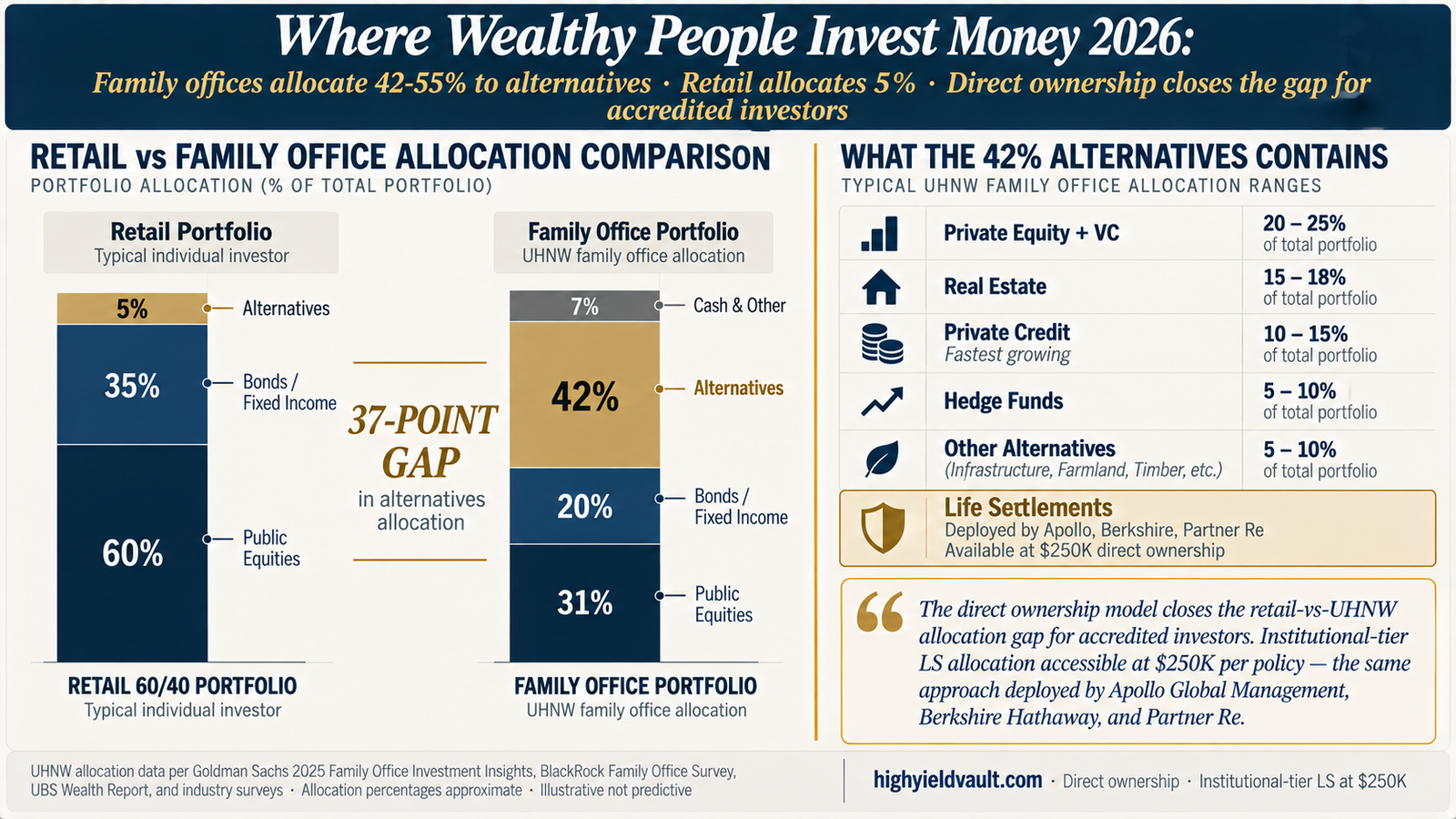
Wealthy people — specifically ultra-high-net-worth families and the family offices that manage their capital — allocate 42-55% of their portfolios to alternative investments in 2026, versus approximately 5% for typical retail 60/40 portfolios. According to Goldman Sachs' 2025 Family Office Investment Insights report, family offices average 42% alternatives. BlackRock's family office survey confirms the 42% figure. UBS data on American family offices shows 54% alternatives (27% private equity, 18% real estate, 3% private debt). The 2026 breakdown of family office alternatives sleeves: private equity + venture capital 20-25% of total portfolio, real estate 15-18%, private credit 10-15% (fastest-growing category), hedge funds 5-10%, other alternatives (including life settlements, infrastructure, farmland) 5-10%.
The 37-point allocation gap between retail (5%) and family office (42%) reflects structural differences in access, time horizon, and risk tolerance — not just wealth. For accredited investors between these tiers, direct-ownership models have made institutional-tier allocation approaches accessible at meaningful but non-institutional ticket sizes. Life settlements specifically, deployed at scale by Apollo Global Management, Berkshire Hathaway, and Partner Re, are accessible at $250K per policy through direct ownership — the same asset class, same return mechanism, same institutional approach, scaled to accredited rather than family-office minimums. All returns illustrative; not guaranteed. Life settlement investments involve substantial risk including loss of capital and are available only to accredited investors per SEC Rule 501.
Browse life settlement policies at institutional-tier approach
Every listing includes LE reports, AM Best carrier ratings, premium schedules, and projected IRR — the data needed to deploy the institutional direct-ownership approach used by Apollo, Berkshire Hathaway, and Partner Re at accredited-tier $250K ticket sizes.
Browse available policiesWhy the retail-vs-UHNW allocation gap matters
The 37-point allocation gap between retail (5% alternatives) and family offices (42-55% alternatives) is one of the most striking data points in modern wealth management. It's not a marketing claim — it comes from systematic surveys conducted by institutional-tier research including Goldman Sachs' 2025 Family Office Investment Insights report, BlackRock's family office survey, UBS Wealth Report, and BNY Wealth family office research. The data has been consistent across sources for several years, and the gap has actually widened over the past decade as family offices increased alternatives from approximately 30% to the current 42-55% range.
The gap exists for structural reasons, not simply because wealthy families are smarter investors. First, access: many private market opportunities require minimum commitments ($1M+ for PE funds, $5M+ for top-tier VC) that exclude retail investors structurally. Second, time horizon: family offices invest across multi-generational horizons, making the 7-10 year lockups typical of alternatives operationally feasible in ways that retail investors with specific near-term goals cannot match. Third, risk tolerance for illiquidity: UHNW families can accept position-level illiquidity because they maintain substantial liquid reserves elsewhere in their portfolios; retail investors typically can't absorb the same illiquidity without impacting cash flow needs. Fourth, operational infrastructure: family offices have CIOs, legal teams, and tax specialists who can evaluate complex private market opportunities; retail investors generally lack these resources.
None of these barriers are about intelligence or ambition — they're about structural access. The accredited investor tier (SEC Rule 501: $200K individual income, $300K joint, or $1M net worth excluding primary residence) sits operationally between retail and family office levels. Historically, accredited investors have been offered pooled fund vehicles (interval funds, feeder funds, LP positions in multi-strategy funds) as a bridge — but these vehicles typically carry fee drag (2-and-20 structures compound to 30-40% of gross IRR over 7-10 year holds) that compresses institutional yield to retail-equivalent net returns. The direct-ownership model is a different approach: it provides access to the same institutional assets that family offices deploy, without the pooled-fund fee drag, at ticket sizes meaningful for accredited investors ($250K per position) but below family-office institutional minimums.
The allocation gap visualization: retail vs family office
The visualization below shows the striking structural gap between retail and family office portfolios in composition terms. The visible contrast — a small 5% gold band versus a dominant 42% gold section — is what the 37-point allocation gap looks like when portfolios are rendered side-by-side.
Goldman Sachs 2025 Family Office Investment Insights · BlackRock Family Office Survey · UBS Wealth Report (American family offices 54% alternatives: 27% PE, 18% RE, 3% PD)
The 37-point gap reflects structural differences in access, time horizon, and acceptance of illiquidity — not just investment sophistication or wealth.
How much of your sleeve should sit in institutional-tier alternatives?
Schedule a 20-minute consultation. We'll walk through your current allocation, measure the gap versus UHNW benchmarks, and show where LS can anchor the institutional-tier portion of your allocation at direct-ownership $250K ticket sizes.
Or call (833) 250-9677What the 42% alternatives sleeve actually contains
The 42% family office alternatives allocation is not a monolithic bucket — it breaks down into six distinct categories, each with specific institutional allocators and risk-return profiles. Understanding the composition is essential to replicating any portion of the institutional-tier approach at the accredited-investor level. The breakdown below reflects 2026 category weightings based on cross-source institutional surveys.
Family office alternatives sleeve
6 categories · 42% total portfolio allocation
Life settlements sit within the "other alternatives" bucket institutionally — but the direct-ownership model makes this institutional allocation accessible at $250K per policy for accredited investors.
Allocation percentages reflect approximate category weightings based on cross-source institutional surveys (Goldman Sachs 2025 Family Office Investment Insights, BlackRock Family Office Survey, UBS Wealth Report, BNY Wealth family office research). Specific family office allocations vary substantially by family preferences, size, generation, and strategic objectives. Named institutional allocators are referenced based on publicly-documented asset management activities and do not imply endorsement or affiliation with HYV. Private equity allocation shown trending down slightly per most recent UBS data due to distribution frustrations; private credit shown as fastest-growing category per BlackRock data. Life settlements sit within the "other alternatives" bucket at institutional scale; specific LS allocation percentages at family office level are not consistently disclosed in cross-industry surveys.
Real walkthrough: William's accessible UHNW-style allocation
Here's how the UHNW allocation framework applies in practice at the accredited-investor tier, illustrated through a composite scenario based on the standard pattern for sophisticated accredited investors building allocations modeled after UHNW benchmarks.
Successful business owner · $1.5M alternatives sleeve modeled after UHNW allocation framework
Starting position: William, a 56-year-old successful construction company owner with $4.2M investable, meets accredited investor thresholds comfortably through business ownership proceeds and accumulated savings. His current portfolio sits at 70% public equities / 25% bonds / 5% alternatives — a mildly aggressive version of retail 60/40 that leaves him meaningfully under-allocated to alternatives versus UHNW benchmarks. His goal: close part of the retail-vs-family-office allocation gap while maintaining liquidity for business operations and family cash flow.
Framework-based target allocation: William targets a scaled-down version of the family office framework: 25-30% alternatives (vs 5% current, vs 42% UHNW) within his $4.2M portfolio — a $1.0M-$1.3M alternatives sleeve. The approach deliberately falls between retail (5%) and family office (42%) to reflect his tier and liquidity needs. He commits to deploying $1.5M (36% of portfolio) across institutional-tier allocations over the next 18 months.
Allocation 01 — Life Settlements ($500K, 33% of alts sleeve): William deploys the largest sleeve into 2 direct-ownership life settlement policies (staggered LE at 6.4 and 8.2 years). Selected first specifically for the institutional-tier approach (Apollo/Berkshire/Partner Re deploy the same asset class at scale) at accredited-tier $250K ticket. Target blended IRR: 10.4%. The direct ownership preserves the institutional yield without pooled-fund fee drag.
Allocation 02 — Private Credit Fund ($400K, 27%): One institutional-tier private credit fund with QP eligibility ($250K minimum but higher-tier access). Target yield: 9.2% quarterly distributions. Mirrors the family office 10-15% private credit allocation at scaled dollars.
Allocation 03 — Real Estate Syndications ($350K, 23%): Two multifamily core syndications in defensive Sun Belt markets. Total: $350K across both ($175K each). Mirrors family office 15-18% RE allocation (defensive-weighted sector selection).
Allocation 04 — Private Equity Feeder ($250K, 17%): One PE feeder fund accessing a top-decile buyout GP that would otherwise require $5M+ direct commitment. Target net IRR 14-16% over 7-year hold. Accepts the fee drag of the feeder structure to access the top-tier PE opportunity.
Portfolio outcome: William's alternatives sleeve now mirrors the family office framework in composition (LS as institutional-tier anchor + PC + RE + PE representation). Weighted average target IRR: approximately 10.7% across the $1.5M alternatives sleeve, versus approximately 5-6% on an equivalent dollar amount in his previous public equity + bond mix. The 36% overall alternatives allocation closes approximately 85% of the retail-vs-UHNW gap while preserving the liquidity needed for his operating business.
William's $1.5M deployment reflects the standard pattern for sophisticated accredited investors modeling their alternatives sleeve after UHNW frameworks at scaled dollar amounts. The LS cornerstone (33% of alternatives sleeve, 12% of total portfolio) anchors the institutional-tier approach; private credit, RE syndications, and a PE feeder round out the sleeve to mirror family office category composition. The framework: accredited investors between the retail and family office tiers can close most of the structural allocation gap through direct-ownership models that eliminate pooled-fund fee drag on the institutional components.
Get matched with policies for your UHNW-style sleeve
Tell us your current allocation, target alternatives percentage, and existing holdings. We'll show you 2-3 vetted life settlement policies specifically matched to anchor the institutional-tier portion of your allocation — the same asset class used by Apollo, Berkshire, and Partner Re at scaled accredited ticket sizes.
Why direct ownership delivers institutional-tier access
The accredited-tier access to UHNW-style allocation only holds when the investor acquires direct ownership of individual positions rather than pooled fund wrappers. In pooled fund vehicles (interval funds, feeder funds, LP positions in multi-strategy structures) with typical 2-and-20 fee structures, the fee drag over 7-10 year holds consumes 30-40% of gross IRR — compressing institutional-tier yields down to retail-equivalent net returns. At that compression, the "institutional access" claim becomes largely marketing: the investor is paying institutional-asset exposure but receiving retail-asset returns net of fees.
Direct ownership is the structural approach that preserves institutional yield at the investor level. For life settlements specifically, the direct-ownership model means the accredited investor acquires beneficial ownership of individual policies rather than fund units. The investor receives the full death benefit payout at policy maturity (not a fund NAV calculation net of manager fees). The target 8-12% IRR is what the investor actually receives, not what the gross asset returns before pooled-fund fee drag. This is the same approach deployed by Apollo Global Management, Berkshire Hathaway, and Partner Re at institutional scale — accessible to accredited individuals at $250K per policy tickets through HYV, versus the $5M-$25M typical institutional minimums for the same asset class.
See currently available policies at institutional-tier approach
Every listing includes full policy documentation, LE reports from certified underwriters, AM Best carrier ratings, premium projections, and projected IRR. Accredited investor verification per SEC Rule 501 required to view specific policies.
Or call (833) 250-9677Frequently asked questions about where wealthy people invest
Why do family offices allocate so much more to alternatives than retail investors?
Four structural factors drive the gap. First, access: many private market opportunities require minimum commitments ($1M+ for PE funds, $5M+ for top-tier VC) that exclude retail investors structurally — family offices meet these minimums easily. Second, time horizon: family offices invest across multi-generational horizons (20-50+ year planning windows), making the 7-10 year lockups typical of alternatives operationally feasible in ways that retail investors with specific retirement or education goals cannot match. Third, risk tolerance for illiquidity: UHNW families maintain substantial liquid reserves outside their alternatives sleeve, allowing position-level illiquidity without impacting day-to-day cash flow; retail investors typically can't absorb the same illiquidity without stress. Fourth, operational infrastructure: family offices employ CIOs, legal teams, tax specialists, and dedicated analysts to evaluate complex private market opportunities; retail investors generally lack these resources. The gap is structural, not about intelligence or ambition — understanding this is essential to accurately evaluating which portions of the family office framework are replicable at the accredited-investor tier and which require operational resources only family offices maintain.
Is the 42% family office alternatives allocation applicable to accredited investors?
Not directly — the 42% target reflects UHNW families with substantial liquid reserves and multi-generational horizons. For accredited investors (SEC Rule 501: $200K individual income, $300K joint, or $1M net worth excluding primary residence), a scaled-down version typically makes sense: 20-30% alternatives allocation that closes most of the retail-vs-UHNW gap while preserving liquidity for near-term goals. The specific target within this range depends on individual circumstances: investment horizon (longer horizons justify higher alternatives percentages), liquidity needs (lower cash flow dependence allows higher alts), existing portfolio structure (if other sleeves provide needed liquidity, alts can run higher), and accredited status duration (newly-accredited investors typically ramp alternatives more gradually than those with established alternative portfolios). The framework is directional: close the structural allocation gap without exceeding your tier's liquidity tolerance. For specific deployment frameworks by capital tier, see our guides for $250K entry, $500K balanced, and $1M institutional.
Why has private equity allocation declined slightly in recent family office data?
UBS data shows family office private equity allocation falling for two consecutive years, which reflects specific frustrations that have emerged in the asset class. Family offices surveyed by BlackRock and other researchers have cited three primary concerns: lack of distributions (PE funds are holding portfolio companies longer than historical norms before realizing exits, meaning capital stays locked up without generating the expected distributions), middling valuations (recent vintage PE funds show weaker mark-to-market returns than prior cycles), and lack of transparency (fund-level reporting has not kept pace with family office expectations for position-level detail). This hasn't led to abandonment of PE — the asset class remains the largest alternatives allocation at 20-25% of family office portfolios — but it has driven reallocation toward private credit, which has grown rapidly as family offices seek shorter-duration, income-producing alternatives with more transparent cash flow characteristics. The private credit market has doubled from 2% to 4% of family office portfolios in a single year per UBS data, becoming the fastest-growing category within alternatives.
How are life settlements actually used by institutional investors?
Life settlements are deployed at scale by several documented institutional allocators including Apollo Global Management, Berkshire Hathaway, and Partner Re — using the direct-ownership model that provides access to the full death benefit payout at policy maturity rather than pooled-fund NAV calculations. At institutional scale, these allocators acquire portfolios of hundreds or thousands of policies, benefiting from large-sample mortality averaging that reduces idiosyncratic longevity risk at the portfolio level. Within family office alternatives sleeves, LS typically sits in the "other alternatives" bucket (5-10% of total portfolio) alongside infrastructure, farmland, and specialty strategies. Specific LS allocation percentages at family office level are not consistently disclosed in cross-industry surveys because allocation detail at this granularity is typically treated as proprietary. The structural appeal for institutional allocators is clear from publicly-documented engagement: mortality-driven returns that are structurally independent of economic cycles (see our recession-proof investments scorecard for the empirical validation), yield levels of 8-12% target IRR that exceed most public fixed-income alternatives, and zero correlation to equity markets. For accredited investors, the direct-ownership model makes the same institutional approach accessible at $250K per policy ticket sizes versus the $5M-$25M typical institutional minimums.
What's the minimum capital needed to meaningfully close the retail-vs-UHNW gap?
Meaningful gap-closing starts at approximately $500K-$1M in total portfolio value, which allows deployment of $100K-$300K into alternatives (20-30% of portfolio) at ticket sizes meaningful enough to deliver institutional-tier results. At $250K total portfolio, the single direct-ownership life settlement policy minimum consumes the entire alternatives allocation if targeting a 10% allocation to the asset class — restrictive but workable (see our $250K entry framework). At $500K portfolio with a 20% alternatives target ($100K sleeve), direct-ownership LS is not accessible (below $250K per-policy minimum) and the investor must use pooled LS vehicles or alternative categories. At $1M+ portfolio with a 25% alternatives target ($250K+ sleeve), direct-ownership LS becomes operationally feasible as the LS anchor of a multi-category alternatives allocation. At $2M+ portfolio with a 30% alternatives target ($600K+ sleeve), the family office framework can be meaningfully replicated across LS + private credit + RE + a measured PE feeder allocation — approximating 70-80% of the structural gap closing available at accredited tier.
What's the difference between retail, accredited, and family office investor tiers?
Three operational tiers with specific regulatory and practical distinctions. Retail investors are any individuals purchasing publicly-registered securities and bank products — no net worth or income threshold required, with full retail-investor protections under SEC public market rules. Accredited investors meet SEC Rule 501 thresholds ($200K individual income, $300K joint, or $1M net worth excluding primary residence) and can access private offerings under Regulation D exemptions including private funds, direct-ownership alternatives, and specialty vehicles unavailable to retail investors. The accredited tier is where structural access to UHNW-style allocation becomes operationally available at scaled minimums ($250K per LS policy, $25K-$250K per private credit fund, $25K-$100K per RE syndication). Family office tier typically refers to UHNW families with $30M-$50M+ investable who maintain dedicated investment infrastructure (single-family office with full-time CIO) or multi-family office relationships at firms like WE Family Offices, Market Street Trust, Bessemer Trust. Family offices access institutional minimums ($5M+ PE, $25M+ hedge funds, direct deals) and operational resources (legal, tax, due diligence teams) unavailable at accredited tier. The direct-ownership model specifically targets the accredited tier bridge: structural access to institutional-grade assets at ticket sizes below family office minimums.
Start with the institutional-tier entry
Two paths to begin: browse currently available life settlement policies to see the institutional direct-ownership approach, or schedule a consultation to walk through the UHNW framework scaled to your accredited-tier allocation.
Or call (833) 250-9677