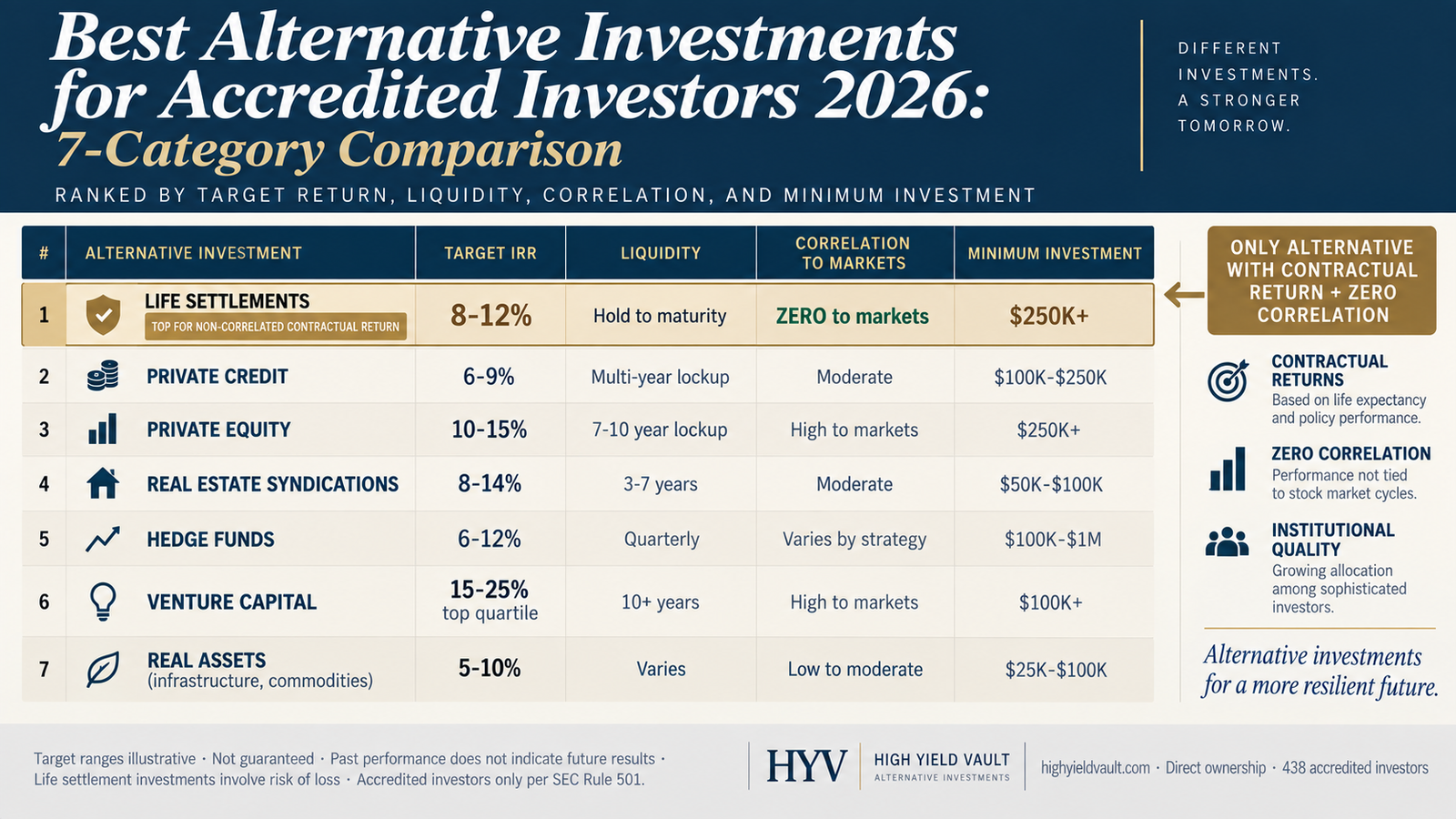
The 7 best alternative investment categories for accredited investors in 2026 are life settlements, private credit, private equity, real estate syndications, hedge funds, venture capital, and real assets. Life settlements rank #1 for accredited investors specifically seeking non-correlated contractual return — no other category delivers both structural non-correlation to equity markets AND a return defined at entry rather than dependent on manager execution or market cycle.
Ranking is criteria-specific. Private equity ranks higher for growth-oriented allocations, real estate syndications for tax-advantaged income, VC for asymmetric upside. But for the accredited investor looking to add a genuinely uncorrelated fixed-income alternative with contractual return — life settlements are the top-ranked category. All alternatives carry substantial risk including illiquidity and potential loss of capital.
Browse vetted life settlement policies for direct ownership
Every listing includes full policy documentation, LE reports, carrier ratings, and projected IRR — the same institutional model used by Apollo, Berkshire Hathaway, and Partner Re.
Browse available policiesWhat makes an alternative "best" for accredited investors
Before ranking anything, we need to define the criteria. An alternative that's "best" for a family office building a 20-year patient capital portfolio is different from an alternative that's "best" for an HNW pre-retiree bridging into decumulation. Five criteria drive the ranking for accredited investors in 2026.
-
01
Target return relative to risk
Higher-than-public target return with proportionate risk. The category should compensate the illiquidity and complexity investors accept in exchange for accreditation access.
-
02
Correlation to public markets
Non-correlation is the whole point of alternatives. If the category moves with the S&P 500, you're paying illiquidity for correlated returns — the worst trade in portfolio construction.
-
03
Return contractual or contingent
Contractual returns (defined at entry) reduce dependence on manager execution or exit market timing. Contingent returns (dependent on a future sale or valuation) concentrate execution risk.
-
04
Minimum investment accessibility
Institutional-quality access without institutional check size. The category should be reachable at accredited investor allocation scale ($100K–$500K per position).
-
05
Fee drag on net returns
Every fee layer compresses the return delivered to your account. Direct-ownership structures preserve gross IRR; fund structures with 2-and-20 arrangements can consume 30-40% of gross return over the hold period.
The 7 categories ranked and compared
Here's how the 7 primary alternative investment categories stack up across the criteria that matter most for accredited investors in 2026. Ranking prioritizes non-correlated contractual return — the criteria most alternative-seekers under-weight when comparing categories.
Ranges reflect illustrative targets from public industry sources including Sage Investment, BAM Capital, Freedom Family Investments, Invesco 2026 outlook, and Intralinks 2026 platform analysis. Past performance does not indicate future results. Individual investor outcomes vary substantially. All alternative investments involve risk of loss.
The reason life settlements rank #1 for the criteria that matter most is structural, not marketing. No other category delivers both zero correlation to equity markets AND a contractual return defined at entry. Private credit is contractually defined but moderately correlated to credit cycles. Real estate syndications produce income but returns partly depend on appreciation and manager execution. Private equity and VC generate high potential returns but concentrate correlation risk with public markets and depend heavily on exit timing. Hedge funds vary too widely by strategy to draw structural conclusions. Real assets provide some non-correlation but at lower target returns.
Get walked through life settlement policies matched to your allocation
Schedule a 20-minute consultation. We'll review your current portfolio mix, identify where a non-correlated contractual return fits, and show you 2–3 vetted policies matched to your allocation size.
Or call (833) 250-9677The balanced portfolio framework for accredited investors
The 7 categories aren't mutually exclusive — the strongest accredited portfolios typically deploy across 3-5 of them. Here's a balanced alternatives allocation framework showing how life settlements fit alongside the other top categories, drawn from institutional practice patterns.
Framework note: Percentages represent allocation within the alternatives sleeve, not total portfolio. Most accredited investors keep alternatives at 20–40% of total investable capital, with public equity and fixed income continuing to anchor the portfolio. Life settlements' 15–20% allocation reflects its role as the primary non-correlated contractual return exposure — sized larger than typical "single-category" allocations because of its unique diversification profile.
The 15–20% life settlements allocation within the alternatives sleeve typically translates to 3–8% of total investable capital for a well-diversified accredited investor portfolio — deployed across 2–6 individual policies with staggered life expectancy profiles to create a maturity ladder. This is the pattern most family offices and institutional allocators follow when adding life settlements to a broader alternatives program.
Why HYV is the platform for life settlement direct ownership
Most life settlement access for accredited investors happens through pooled fund vehicles charging 2-and-20 fee arrangements that meaningfully compress net returns. HYV operates the opposite model.
Every investor on the HYV platform acquires direct ownership of individually-vetted policies — the same institutional model used by Apollo Global Management, Berkshire Hathaway, and Partner Re, deployed for accredited individuals at the $250K+ per-policy entry tier. Your name (or your trust, LLC, or family entity) is on the carrier records. You control premium funding. The death benefit is paid directly to you at policy maturity. No fund manager fee layer between you and the return.
See currently listed policies for direct ownership
Every listing includes full policy documentation, LE reports, carrier ratings, premium projections, and projected IRR. Accredited investor verification per SEC Rule 501 required to view specific policies.
Frequently asked questions about alternative investments
What are the best alternative investments for accredited investors in 2026?
The 7 best alternative investment categories for accredited investors in 2026 are life settlements, private credit, private equity, real estate syndications, hedge funds, venture capital, and real assets. Ranking depends on criteria: for non-correlated contractual return, life settlements rank #1 (8–12% target IRR, zero correlation to markets, contractual return at policy maturity). For growth-oriented allocations, private equity and venture capital rank higher (10–25% target IRR range but with high correlation and long lockups). For tax-advantaged income, real estate syndications rank well (8–14% target IRR with depreciation benefits). Most accredited investors deploy across 3–5 categories rather than concentrating in any single one. All alternatives involve substantial risk including illiquidity and potential loss of capital.
Why do life settlements rank #1 for non-correlated return?
Life settlements are the only alternative investment category that delivers both structural non-correlation to equity markets AND a contractual return defined at entry. The return source is the policy death benefit paid by the insurance carrier at policy maturity — this payout has no dependence on stock prices, interest rate movements, real estate valuations, or company earnings. Private credit is contractually defined but moderately correlated to credit cycles. Real estate returns partly depend on appreciation and market cycles. Private equity and venture capital are highly correlated to public markets over meaningful time frames. Hedge fund correlation varies too widely by strategy to generalize. Real assets provide some non-correlation but typically at lower target returns (5–10%). This unique combination — zero correlation + contractual return + 8–12% target IRR — is why institutional allocators including Apollo Global Management, Berkshire Hathaway, and Partner Re have deployed billions into the life settlement asset class.
What percentage of my portfolio should be in alternative investments?
Most accredited investors allocate 20–40% of total investable capital to alternatives, with the remainder in public equity and fixed income. Within the alternatives sleeve, a balanced framework typically looks like: 30–40% real estate, 20–30% private equity, 15–20% life settlements, 10–15% private credit, 10–15% hedge funds, and 5–10% venture capital or real assets. Percentages vary based on investor objective, risk tolerance, time horizon, and liquidity needs. Family offices and institutional allocators often run higher alternatives allocations (40–60%+); HNW pre-retirees typically run lower (15–25%). Life settlements at 15–20% of the alternatives sleeve translates to 3–8% of total investable capital — appropriately sized as the primary non-correlated contractual return exposure. All alternative allocations should be sized based on individual circumstances after consultation with qualified financial advisors.
Are alternative investments only for accredited investors?
Most institutional-quality alternative investments are offered under SEC Regulation D exemptions, which limit participation to accredited investors — investors meeting income thresholds ($200K individual/$300K joint annual income for prior 2 years), net worth thresholds ($1M+ excluding primary residence), or certain professional certifications. Life settlements, private equity, private credit funds, hedge funds, venture capital, and most real estate syndications require accredited status. Some categories have accessible pathways for non-accredited investors: publicly-traded REITs, ETFs of commodity exposures, and some crowdfunded real estate platforms offer alternative-style exposure without accreditation. However, the highest-quality institutional access — direct policy ownership for life settlements, top-tier PE and VC funds, institutional real estate syndications — typically requires accredited status verification per SEC Rule 501.
How much do I need to start investing in alternatives?
Minimums vary substantially by category. At the accessible end: real estate syndications and real assets ($25K–$100K), private credit ($100K–$250K), venture capital ($100K+ for platform-access funds). At the institutional tier: private equity ($250K+), hedge funds ($100K–$1M+), and life settlement direct ownership ($250K+ per policy). Accredited investors seriously building an alternatives allocation typically want $500K–$2M+ available for the sleeve to enable meaningful diversification across 3–5 categories with appropriate position sizes. Starting with $250K–$500K allows meaningful entry into 1–2 categories (typically real estate syndication + one other). Life settlements at the $250K per-policy tier fit naturally as an initial or secondary allocation for accredited investors building their first alternatives exposure.
Where do I start if I've never invested in alternatives before?
The right entry point depends on your existing portfolio, time horizon, and specific objective. Two common first-alternative pathways: (1) if you have a heavily equity-weighted portfolio and want to reduce correlation, life settlements or real estate credit are strong first-allocation options — they add non-correlated exposure without adding equity-like beta; (2) if you have a strong income need alongside diversification, real estate syndications or private credit fit well as first allocations because they generate periodic distributions. For accredited investors specifically interested in life settlements as their first meaningful alternatives allocation, the practical path is: verify accredited status, review 2–3 vetted policies with an advisor, complete due diligence on the specific policy, and take direct ownership through the standard 30–60 day process. See the complete step-by-step investor guide for the full walkthrough.
Ready to add life settlements to your alternatives sleeve?
Two paths to get started: browse currently available policies to see what fits, or schedule a consultation to walk through your alternatives mix and identify where LS fits within your allocation.
Or call (833) 250-9677