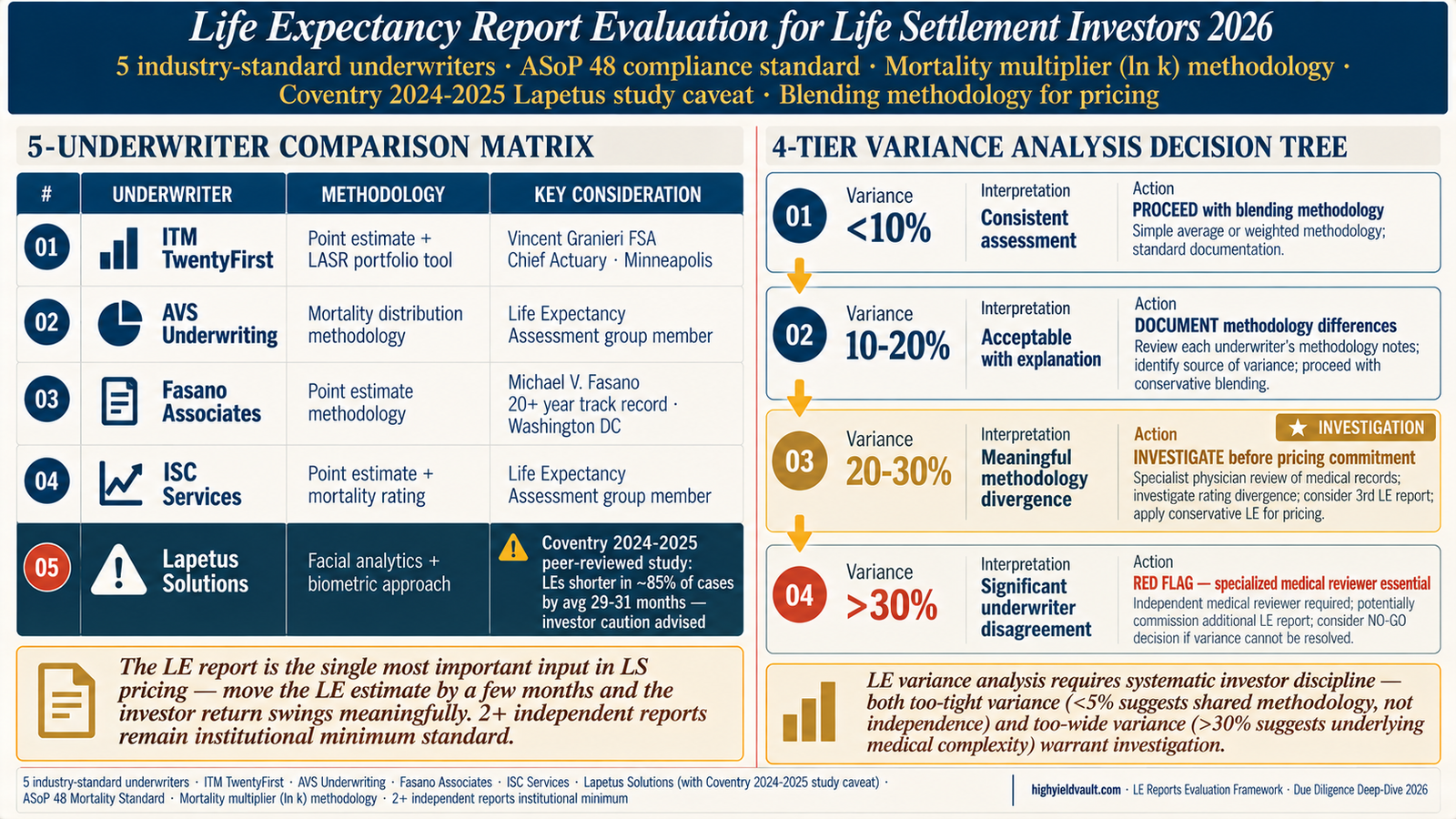
Accredited investors evaluating LE reports should commission minimum 2+ independent reports from the 5 industry-standard underwriters: (1) ITM TwentyFirst (formerly 21st Services LLC, Minneapolis) led by Vincent Granieri FSA Chief Actuary offering LASR portfolio tool; (2) AVS Underwriting LLC as Life Expectancy Assessment collective founding member; (3) Fasano Associates with Michael V. Fasano's 20+ year track record applying point estimate methodology from Washington DC; (4) ISC Services as Life Expectancy Assessment group member; (5) Lapetus Solutions — with important Coventry 2024-2025 Bauer/Zhu peer-reviewed study caveat. The study found Lapetus LEs shorter in ~85% of cases by average 29-31 months compared with other underwriters on the same dataset per ASoP 48 (Actuarial Standard of Practice No. 48) analysis, suggesting investor caution if Lapetus is the sole or primary LE source.
Report evaluation uses 4-tier variance analysis decision framework: Tier 01 (variance <10%) — consistent assessment, proceed with blending methodology; Tier 02 (variance 10-20%) — acceptable with explanation, document methodology differences; Tier 03 (variance 20-30%) GOLD-HIGHLIGHTED — investigation required before pricing commitment, specialist physician review recommended; Tier 04 (variance >30%) — RED FLAG requiring specialized medical reviewer engagement. The variance analysis is both lower-bound and upper-bound disciplined: variance <5% between reports may suggest shared methodology (reducing independence value); variance >30% suggests underlying medical complexity requiring expanded investigation. Blending methodology for pricing analysis typically applies simple average, weighted average favoring most conservative report, or median value with outlier rejection. Specialized medical reviewer engagement essential for complex medical cases including multiple interacting conditions, recent medical events, or when underwriter variance patterns indicate methodology divergence rather than consistent assessment uncertainty.
Browse LS policies with LE documentation ready for your evaluation
Every HYV listing includes LE report documentation from multiple industry-standard underwriters prepared for your Component 02 DD execution. Our internal LE evaluation precedes platform listing; your independent variance analysis completes your position-specific assessment.
Browse available policiesWhy LE report evaluation matters more than any other DD input
The LE estimate is the single most impactful input in life settlement pricing — small variations in LE assumption produce large variations in projected investor return. A policy acquired at $500K with projected death benefit $1.2M, premium cost $2,500/month, and base LE 48 months produces projected IRR approximately 11-12%. Change the LE assumption to 60 months (just 12 months longer) and the same policy produces IRR approximately 7-8% due to additional premium cost accumulation during extended hold period. Change LE to 36 months (12 months shorter) and IRR jumps to 15-17%. The LE sensitivity illustrates why Component 02 LE Reports evaluation is foundational to accurate pricing — all other DD components support but cannot substitute for rigorous LE assessment.
The industry developed 5 specialized LE underwriters providing medical underwriting services specifically for life settlement markets precisely because traditional life insurance company underwriting approaches do not directly apply to the LS secondary market context. Traditional life insurance underwriting assesses mortality risk at policy issuance for pricing initial premiums; LS secondary market underwriting assesses remaining life expectancy for insured individuals typically age 65+ with established medical histories, requiring different methodological frameworks. The 5 industry-standard underwriters each developed proprietary mortality rating systems and methodologies calibrated specifically for LS secondary market needs — but methodology differences between underwriters produce variance in LE estimates even for the same insured medical profile.
Peer-reviewed actuarial literature (notably Bauer, Fasano, Russ, Zhu "Evaluating Life Expectancy Evaluations" in North American Actuarial Journal, Vol. 22, Issue 2, pp. 198-209, 2017) establishes systematic methodology for comparing underwriter accuracy using mortality multiplier (ln k) analysis normalized by gender, age, and smoking status. The research framework provides institutional discipline for investor LE evaluation beyond simple averaging — understanding which underwriter methodology best fits specific insured demographic profiles. However, standard investor practice remains 2+ reports commissioning with systematic variance analysis rather than attempting to select "the single best" underwriter for a given policy.
The 5-underwriter comparison matrix
The matrix below profiles the 5 industry-standard LE underwriters currently providing services to the US life settlement market. Row 05 (Lapetus Solutions) carries caution flag per the Coventry 2024-2025 peer-reviewed study findings described above.
The LE estimate is the single most impactful input in LS pricing — move the LE by a few months and the investor return swings meaningfully. 2+ independent reports remain institutional minimum standard.
How does your LE evaluation workflow apply to deployment?
Schedule a 20-minute consultation. We'll walk through the 5-underwriter comparison applied to your deployment strategy, 2+ report commissioning coordination, variance analysis methodology, and specialized medical reviewer engagement for complex cases.
Or call (833) 250-9677The 4-tier variance analysis decision tree
The decision framework below applies systematic variance interpretation to the LE reports an investor receives from commissioned underwriters. Tier 03 (variance 20-30%) is gold-highlighted as the investigation threshold where specialist physician review becomes essential before pricing commitment. Tier 04 (variance >30%) carries red flag warning requiring specialized medical reviewer engagement before any pricing or deployment decision.
Consistent assessment
Variance <10%PROCEED with blending methodology. LE reports from independent underwriters produce consistent assessment with variance <10% between highest and lowest estimates. Interpretation: underwriter methodology convergence on medical profile assessment. Action: proceed to Phase 04 Pricing with blending methodology (simple average, weighted average favoring most conservative, or median value). Standard documentation sufficient. Note: variance <5% may suggest shared methodology (reducing independence value) — investigate briefly to confirm reports used genuinely independent analysis.
Acceptable with explanation
Variance 10-20%DOCUMENT methodology differences before pricing. LE reports show acceptable variance range reflecting legitimate methodology differences between underwriters. Interpretation: methodology diversity producing differentiated outputs on same medical profile. Action: review each underwriter's methodology notes identifying source of variance; apply conservative blending (weighted average favoring longer LE for pricing safety); document methodology analysis in position-level file. Proceed to Phase 04 Pricing with elevated conservatism in base case assumption selection.
Investigation required
Variance 20-30%★ INVESTIGATE before pricing commitment. LE reports show meaningful methodology divergence requiring expanded investigation. Interpretation: underwriters disagree substantively on medical profile interpretation beyond acceptable methodology diversity. Action: engage specialist physician for independent medical records review; investigate rating divergence between underwriters identifying specific condition assessments producing variance; consider commissioning third LE report to resolve variance; apply most conservative LE for Phase 04 Pricing analysis; document investigation findings extensively. Pricing commitment delayed until investigation complete.
Red flag resolution
Variance >30%⚠ RED FLAG — specialized medical reviewer essential. LE reports show significant underwriter disagreement indicating substantive medical profile complexity or methodology failure. Interpretation: variance beyond acceptable range for standard institutional practice. Action: engage specialized medical reviewer with LS underwriting experience; commission additional LE reports beyond initial 2+ to resolve variance; consider NO-GO decision if variance cannot be resolved through investigation. The policy may not be suitable for standard investor DD framework application. Pricing commitment prohibited until red flag resolution complete.
LE variance analysis requires systematic investor discipline — both too-tight variance (<5% suggests shared methodology) and too-wide variance (>30% suggests underlying medical complexity) warrant systematic investigation.
Real walkthrough: Rebecca's 3-report LE commissioning and variance analysis
Here's how the LE evaluation framework applies in practice, illustrated through a composite scenario based on the standard accredited investor LE commissioning pattern for a $400K position evaluation.
54-year-old accredited investor · 3-report LE commissioning + variance analysis on $400K policy
Starting position: Rebecca, a 54-year-old corporate finance executive in Chicago IL, is evaluating a specific $400K LS position offered through HYV. The policy summary shows: insured male age 79 California resident, carrier Mutual of Omaha (AM Best A+), universal life policy with $925K face amount, policy issued 2011 (15+ years in-force well past contestability), initial LE estimate 42 months (3.5 years) from provider, asking price $400K, target base case IRR 12-13%. Rebecca engages her existing US international tax counsel at Kirkland & Ellis for legal review coordinated with HYV internal DD; her allocation target is $400K-$600K position size for diversified LS allocation.
Phase 02 LE commissioning strategy: Rebecca's team commissions 3 independent LE reports for enhanced analytical robustness beyond minimum 2-report standard: ITM TwentyFirst (institutional-standard LASR portfolio tool investor), AVS Underwriting (mortality distribution methodology), and Fasano Associates (point estimate methodology). The 3-report strategy addresses two objectives: (1) ensure robust blended LE estimate for pricing; (2) enable 3-report consensus analysis if any 2 reports show material variance. Rebecca deliberately excludes Lapetus Solutions from commissioning given the Coventry 2024-2025 peer-reviewed study findings — her preference to apply conservative DD discipline avoiding underwriter with documented understatement patterns.
LE reports delivered (Weeks 2-5): Report timing: ITM TwentyFirst delivered week 3 ($850 cost); AVS Underwriting delivered week 4 ($800 cost); Fasano Associates delivered week 5 ($950 cost). Total LE commissioning cost = $2,600. Report outputs: ITM TwentyFirst 46 months, AVS Underwriting 42 months, Fasano Associates 40 months. Variance analysis: highest 46 months, lowest 40 months, variance range 6 months. Percentage variance = 6/42 = 14.3% (using average as base) — Tier 02 Acceptable with Explanation per the 4-tier framework. Blended average LE = 42.7 months (simple average of 3 reports); weighted conservative (favoring longer LE) = 43.3 months.
Methodology analysis (Week 6): Rebecca's team reviews each underwriter's methodology notes to understand variance source. ITM TwentyFirst 46 months reflects slightly more optimistic LE assessment with emphasis on positive controlled chronic conditions trajectory. AVS Underwriting 42 months reflects mortality distribution methodology producing median-range estimate consistent with insured demographic. Fasano Associates 40 months reflects point estimate methodology with slightly conservative rating for insured's age and gender demographic profile. The 14.3% variance reflects legitimate methodology differences rather than medical profile disagreement — all 3 reports agree on primary medical conditions and overall risk profile. Rebecca's team documents methodology analysis in position-level file for Phase 04 Pricing preparation and future audit defense.
Blending methodology application: For Phase 04 Pricing analysis, Rebecca's team applies conservative blending methodology: weighted average with longer LEs weighted at 40% / 35% / 25% producing blended LE 43.3 months. Base case IRR projection using 43.3 months: $400K purchase + $87K premiums + $925K death benefit → IRR 12.8% matching provider's target range. Upside case (shortest LE 40 months): $400K + $80K premiums + $925K → IRR 14.1%. Downside case (longest LE 46 months plus 20% extension to 55 months): $400K + $110K premiums + $925K → IRR 9.4% — slightly below Rebecca's 10% hurdle in downside. Risk analysis acceptable within portfolio diversification context.
Total LE evaluation cost analysis: Rebecca's LE evaluation cost summary: 3 LE reports × average $867 = $2,600; methodology analysis internal (no external cost); documentation preparation internal; specialist medical reviewer not required (Tier 02 variance). Total LE evaluation cost = $2,600 on $400K deployment = 0.65% of position size — the sophisticated 3-report commissioning strategy at modest incremental cost provides substantially more robust pricing confidence than 2-report minimum approach. For $400K+ positions, 3-report commissioning represents reasonable discipline enhancement; for >$1M positions, 4-report commissioning (adding 4th underwriter such as ISC Services) justified for maximum analytical robustness.
Rebecca's workflow reflects sophisticated accredited investor LE evaluation discipline. The framework: 3-report commissioning strategy with systematic variance analysis across 5-underwriter industry-standard providers (excluding Lapetus per Coventry study) produces robust pricing confidence at modest incremental cost over 2-report minimum. The 14.3% variance (Tier 02 Acceptable) with documented methodology analysis enabled confident Phase 04 Pricing commitment. Position-specific LE evaluation required for every policy regardless of apparent complexity.
Get matched with policies for complete LE evaluation
Tell us your LE commissioning preferences (2-report minimum, 3-report standard, or 4-report maximum), underwriter preferences, and complex medical case thresholds. We'll show you 2-3 vetted policies with pre-commissioned LE documentation ready for your independent variance analysis.
When LE evaluation requires specialized medical reviewer engagement
The 4-tier variance analysis framework provides systematic guidance for most LE evaluation scenarios. However, certain situations involve medical complexity or methodology concerns requiring specialized medical reviewer engagement beyond standard framework application.
Four scenarios requiring specialized medical reviewer engagement beyond standard framework
1. Complex medical conditions with multiple interacting diagnoses. Insured individuals with multiple significant medical conditions (cardiovascular disease + diabetes + chronic kidney disease + prior cancer history, for example) present complex underwriting cases where variance between LE reports often reflects legitimate methodology disagreement rather than resolvable interpretation differences. Standard variance analysis may show Tier 02-03 range but underlying complexity warrants specialized medical reviewer engagement regardless of variance magnitude. Reviewer specializing in geriatric comorbidity assessment provides independent third-party opinion on medical trajectory projections. Typical reviewer engagement cost: $2,500-$5,000 for comprehensive case review including medical records analysis, LE report comparison, and written opinion on reasonable LE range.
2. LE variance >30% between reports (Tier 04 Red Flag). Variance exceeding 30% between highest and lowest LE reports indicates substantive underwriter disagreement requiring resolution before pricing commitment. Standard specialized reviewer approach: engage reviewer with specific LS underwriting experience; commission additional LE reports beyond initial 2+ to broaden assessment base; consider rejecting the policy if variance cannot be resolved. In Red Flag scenarios, the specialized reviewer effectively functions as a "fifth opinion" alongside the commissioned underwriter reports, with specialized expertise in reconciling methodology differences and identifying any underwriter outlier assessment that may be anomalous rather than legitimate alternative view.
3. Concentrated LE methodology scenarios (all reports from similar methodology). If commissioned LE reports happen to come from underwriters using similar methodology (all point estimate methodology, for example, rather than mix of point estimate and mortality distribution approaches), the investor may face false confidence that shared methodology outputs confirm the underlying LE assessment. Specialized reviewer engagement adds methodological diversity to the evaluation — specialist with distribution-based mortality analysis approach reviewing reports originating from point estimate methodology (or vice versa) provides methodology triangulation beyond what the commissioned reports alone offer. Particularly valuable for sophisticated $500K+ deployments where methodology concentration cost deserves specialized reviewer offset.
4. Recent medical events during policy hold period. If insured experiences significant medical event during LS position hold period (hospitalization, new diagnosis, medication regimen change, surgery), ongoing LE assessment may require re-evaluation. Original LE reports commissioned at deployment may no longer accurately reflect current medical trajectory. Specialized reviewer engagement for hold-period medical events provides updated LE assessment input to investor's ongoing position monitoring. This is particularly relevant for institutional investors maintaining active portfolio management; retail accredited investors may defer to platform's internal monitoring without separate reviewer engagement. HYV coordinates ongoing LE monitoring across all positions during hold period as component of platform service.
For investors in these four specialized scenarios, standard 4-tier variance framework provides starting point but requires expanded specialized medical reviewer engagement typically costing $2,500-$7,500 for position-specific written opinion. HYV coordinates specialized reviewer engagement coordination as needed; investor-independent specialized review remains valuable for sophisticated deployments with elevated concentration or complexity concerns.
See pre-vetted policies ready for your LE evaluation
Every listing includes LE report documentation from multiple industry-standard underwriters prepared for your Component 02 DD execution. Our internal LE evaluation precedes platform listing; your independent variance analysis using the 4-tier decision framework completes your position-specific assessment.
Or call (833) 250-9677Frequently asked questions about LE report evaluation
How many LE reports should accredited investors commission minimum?
The institutional minimum standard is 2+ independent LE reports commissioned from certified underwriters among the 5 industry-standard providers (ITM TwentyFirst, AVS Underwriting, Fasano Associates, ISC Services, Lapetus Solutions — with Lapetus caution per Coventry 2024-2025 study). The 2-report minimum enables variance analysis — a single report provides no basis for triangulation or methodology verification. For position sizing considerations: $100K-$300K positions typically use 2-report commissioning as cost-efficient standard; $300K-$750K positions often benefit from 3-report commissioning for enhanced analytical robustness at modest incremental cost; $750K+ positions may justify 4-report commissioning (adding fourth underwriter such as ISC Services to standard trio) for maximum pricing confidence. Beyond 4 reports typically does not add meaningful analytical value for standard LS deployment scenarios. For specialized cases (complex medical conditions, Tier 03-04 variance situations, concentrated methodology scenarios), expanded reporting beyond 4 reports may be justified alongside specialized medical reviewer engagement. The commissioning cost structure (approximately $800-$950 per report) scales linearly, making 3-report strategy ($2,400-$2,850 total) materially more affordable per basis-point-of-confidence improvement than relying on 2-report minimum. HYV coordinates LE commissioning for platform-presented policies with 2+ reports as internal standard; investor-independent LE commissioning per their preferred strategy remains best practice for position-specific DD.
What are the implications of the Coventry 2024-2025 Lapetus study for investor LE commissioning?
The Coventry 2024-2025 Bauer/Zhu peer-reviewed study (released February 2025 following July 2024 initial analysis) found that Lapetus Solutions life expectancy estimates were shorter in approximately 85% of cases by average 29-31 months compared with other underwriters analyzing the same insured dataset per Actuarial Standard of Practice No. 48 (ASoP 48) methodology. The study implications for investor LE commissioning: Implication 1 - Lapetus LEs may systematically understate actual life expectancies for life settlement portfolios, producing misleading pricing confidence and potential portfolio underperformance. If investor pricing analysis relied on Lapetus LE as primary input, projected IRR likely exceeded realistic IRR by meaningful magnitude. Implication 2 - Investor commissioning strategy should carefully consider whether to include Lapetus in the 2+ underwriter commissioning set. Conservative approach: exclude Lapetus entirely until methodology concerns are addressed per Coventry recommendations. Moderate approach: include Lapetus as supplementary report but weight more conservatively or apply as variance analysis input rather than pricing input. Aggressive approach: continue including Lapetus with awareness of understatement bias and manual adjustment to blended LE. Implication 3 - Historical LS portfolios heavily reliant on Lapetus underwriting may face elevated underperformance risk requiring portfolio-level review. Institutional investors with LS positions acquired based on Lapetus LE primary input may benefit from independent re-underwriting using alternative providers. Implication 4 - The Coventry study illustrates why systematic peer-reviewed research on underwriter accuracy matters for investor DD discipline. Investors should monitor published actuarial research on LE underwriter accuracy including North American Actuarial Journal, Society of Actuaries publications, and specialized LS industry research. The academic literature provides institutional discipline for evaluating underwriter methodology beyond marketing claims. HYV platform LE commissioning strategy incorporates Coventry findings — Lapetus is not used as primary LE source for HYV-platform listed policies pending methodology review resolution.
What's the typical LE report cost structure and timing?
LE report cost and timing structure varies modestly across the 5 industry-standard underwriters but generally follows consistent patterns. Cost range: $700-$1,000 per LE report depending on provider, complexity of insured medical case, and report type (standard LE certificate vs expanded portfolio analysis report). ITM TwentyFirst typical range $800-$950 (with LASR portfolio tool at higher range); AVS Underwriting typical range $750-$900; Fasano Associates typical range $850-$1,000; ISC Services typical range $700-$900; Lapetus Solutions typical range $700-$850 (facial analytics approach allows modest cost efficiency). Report timing: typical delivery 10-18 business days from commissioning for complete reports including medical records review. Rush service available from most providers for 5-10 business day delivery at premium cost (approximately 30-50% premium). Medical records compilation: separate cost of $500-$1,500 depending on records complexity and provider coordination requirements. The medical records compilation is prerequisite for LE report commissioning — underwriters cannot generate LE estimates without complete medical records including primary care physician notes, specialist consultations, hospitalization records if applicable, lab results, and medication history. Total LE commissioning cost structure for 2-report standard: approximately $2,000-$3,000 all-in. For 3-report sophisticated approach: approximately $3,000-$4,500 all-in. For specialized cases requiring expanded medical records compilation or additional reports: $4,500-$8,000 total. For $400K+ deployments, LE commissioning cost represents 0.5-2% of position size — modest fixed cost component of institutional-quality DD execution.
How does point estimate methodology differ from mortality distribution methodology?
Point estimate methodology and mortality distribution methodology represent two primary analytical approaches used by LE underwriters, each with specific strengths and investor applications. Point estimate methodology produces a single LE estimate (expressed in months) representing the underwriter's best assessment of median remaining life expectancy for the insured. Methodology steps: assign mortality ratings for each medical condition using proprietary rating tables; apply gender/age/smoking status modifiers; produce aggregate mortality score; convert mortality score to LE estimate using mortality table calibrated to LS market. Used by: Fasano Associates (primary methodology), ISC Services, and ITM TwentyFirst for standard LE certificates. Investor application: point estimate methodology provides straightforward input for pricing analysis — single LE figure enables direct IRR calculation and sensitivity testing. Mortality distribution methodology produces probabilistic distribution of mortality outcomes across possible timeframes rather than single point estimate. Methodology steps: develop mortality probability curve across future months; identify key quantiles (25th percentile, median/50th percentile, 75th percentile mortality timing); report distribution characteristics alongside median. Used by: AVS Underwriting (primary methodology). Investor application: distribution methodology provides richer analytical input enabling scenario analysis beyond single-point sensitivity — investors can model base case using median, downside using 75th percentile longer survival, upside using 25th percentile shorter survival. Methodology comparison for investor DD: point estimate methodology produces simpler, more intuitive input for standard investor pricing analysis; mortality distribution methodology provides richer analytical input for sophisticated institutional pricing analysis including scenario modeling and risk management. Standard investor practice: commission mix of methodologies (point estimate + distribution) to leverage methodological diversity in variance analysis. Peer-reviewed literature (Bauer, Fasano, Russ, Zhu 2017) uses mortality multiplier (ln k) analysis to compare underwriter accuracy across methodologies on normalized basis.
What is ASoP 48 and how does it apply to LE evaluation?
Actuarial Standard of Practice No. 48 (ASoP 48) "Life Settlements Mortality" is the official standard issued by the Actuarial Standards Board governing actuarial practice for life settlement mortality estimation. ASoP 48 provides professional standards framework that qualified actuaries must follow when producing mortality estimates for life settlement transactions and portfolios. Key ASoP 48 requirements: (1) Documentation standards for mortality assumption development including data sources, methodology selection rationale, and sensitivity analysis; (2) Peer review requirements for institutional mortality estimation; (3) Disclosure of methodology limitations and uncertainty ranges; (4) Reasonableness testing against observed mortality experience including Social Security Death Master File validation where applicable. For investor LE evaluation application: ASoP 48 compliance establishes professional standards benchmark for underwriter methodology quality. Investors reviewing LE reports can assess underwriter ASoP 48 compliance as component of methodology quality evaluation — qualified actuaries working for the 5 industry-standard underwriters generally comply with ASoP 48 for their published LE methodologies. The Coventry 2024-2025 Lapetus study specifically applied ASoP 48 framework to evaluate Lapetus LE accuracy, concluding the methodology produces understatement bias relative to observed mortality experience per ASoP 48 reasonableness testing. The study publication in peer-reviewed context (building on earlier Bauer/Fasano/Russ/Zhu North American Actuarial Journal 2017 research framework) demonstrates institutional discipline for applying ASoP 48 standards to underwriter accuracy evaluation. Investor DD implication: ASoP 48 compliance should be considered component of underwriter selection beyond proprietary methodology marketing — investors can request ASoP 48 compliance documentation from commissioned underwriters as part of standard DD workflow. HYV internal LE evaluation integrates ASoP 48 framework considerations alongside industry research findings.
When should investors update LE assessments during policy hold period?
LE assessment updates during policy hold period reflect institutional investor practice for maintaining accurate portfolio valuation and risk management across multi-year LS positions. Update triggers include: Trigger 1 - Routine periodic updates. Standard institutional practice: update LE assessments every 24-36 months during hold period regardless of medical events. Rationale: LE assessments calibrated at policy acquisition may require refinement as insured ages and additional medical history develops. The 24-36 month update cadence aligns with position-level portfolio review discipline and portfolio valuation accuracy maintenance. Trigger 2 - Significant medical events. Hospitalization, new diagnosis (particularly for progressive conditions like cancer, heart disease, dementia), surgery, medication regimen changes, or hospice/palliative care initiation trigger immediate LE re-assessment regardless of time since last update. Specialized medical reviewer engagement may be warranted for complex medical event scenarios. Trigger 3 - Approaching initial LE estimate maturity. As initial LE estimate maturity approaches without actual mortality event (insured outliving initial LE estimate), updated assessment becomes essential for continued pricing accuracy. Standard practice: trigger comprehensive re-underwriting when 80% of initial LE estimate has elapsed without mortality event. Trigger 4 - Portfolio-level pattern recognition. If investor's LS portfolio shows pattern of insureds outliving initial LE estimates (indicating potential systematic underestimation bias in initial underwriting), portfolio-level LE re-assessment may be warranted. The Coventry 2024-2025 Lapetus study pattern is example of this concern. Update process: typically single update report commissioned from one of original underwriters or alternative provider; medical records update required covering interim period; cost structure similar to initial LE commissioning. HYV platform coordinates ongoing LE monitoring across all platform-presented policies as component of institutional service; investor-independent re-assessment coordination remains best practice for sophisticated accredited investor portfolios. ILMA and ELSA institutional standards both reference ongoing LE monitoring as component of best-practice LS portfolio management.
Start with LE-ready vetted policies
Two paths to begin: browse currently available life settlement policies with pre-commissioned LE documentation from multiple industry-standard underwriters, or schedule a consultation to walk through LE evaluation framework application to your specific position preferences and underwriter commissioning strategy.
Or call (833) 250-9677