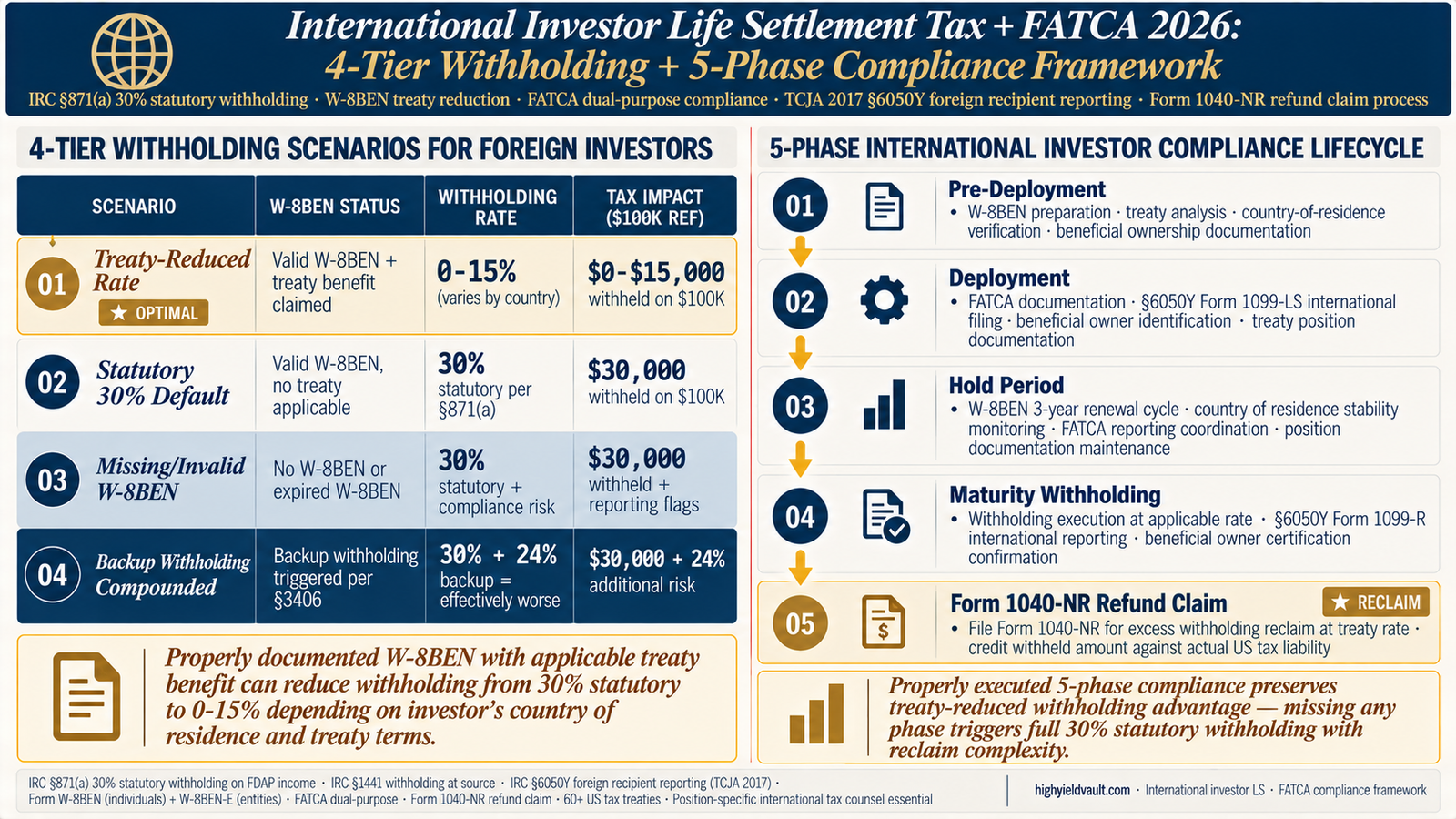
Non-US resident accredited investors evaluating US life settlement positions face IRC §871(a) 30% statutory US withholding on death benefit distributions by default — treated as FDAP (Fixed, Determinable, Annual, Periodical) income from US sources paid to non-resident aliens. This 30% statutory rate can be reduced through properly executed Form W-8BEN (individuals) or W-8BEN-E (entities) claiming treaty benefits under one of the 60+ bilateral US tax treaties — treaty-reduced rates typically range from 0% to 15% depending on investor's country of residence and specific treaty provisions governing insurance/life settlement payments. Many treaties characterize death benefit payments favorably (as capital gains exempt from US source withholding) while others treat as insurance/annuity payments subject to specific treaty article rates.
The compliance framework involves 5 phases: Phase 1 (Pre-Deployment) — W-8BEN preparation + treaty analysis + country-of-residence verification + beneficial ownership documentation; Phase 2 (Deployment) — FATCA documentation + §6050Y Form 1099-LS international filing + beneficial owner identification + treaty position documentation; Phase 3 (Hold Period) — W-8BEN 3-year renewal cycle + country of residence stability monitoring; Phase 4 (Maturity Withholding) — withholding execution at applicable rate + §6050Y Form 1099-R international reporting; Phase 5 (Refund Claim) — Form 1040-NR filing for excess withholding reclaim at treaty rate. Each phase requires precise documentation discipline; missing documentation triggers full 30% statutory withholding with reclaim complexity. Specialized US international tax counsel engagement essential for all international investor LS deployments.
Browse life settlement policies suited to international investor coordination
Our team coordinates with your US international tax counsel on W-8BEN preparation, treaty analysis specific to your country of residence, and FATCA compliance documentation for US-situated LS deployment.
Browse available policiesWhy international investors face a fundamentally different LS tax framework than US investors
US accredited investors evaluate life settlement positions through the long-term capital gains framework established by Rev Rul 2020-05 — death benefit at policy maturity minus adjusted basis equals LTCG taxed at 23.8% federal maximum rate (20% + 3.8% NIIT). This favorable classification reflects the US investor's taxation under the general capital gains regime applicable to residents and citizens. International investors face a fundamentally different framework because the US does not apply the capital gains regime to non-resident aliens for most US-source income — instead, the FDAP income regime under IRC §871(a) and §1441 applies to most US-source payments to non-US investors, with 30% statutory withholding at source.
The characterization of life settlement death benefit payments as FDAP income (versus capital gains) for international investor purposes depends on several factors: the specific nature of the payment, the investor's country of residence, the applicable US tax treaty terms (if any), and how the treaty characterizes insurance-related payments. Some treaties (particularly those with major financial centers like the UK, Germany, Switzerland, Netherlands) provide favorable characterization that may exempt capital gains entirely from US withholding — the position is taxable only in the investor's country of residence. Other treaties treat insurance payments under specific insurance/annuity articles with defined withholding rates. Jurisdictions without a US tax treaty face the full 30% statutory withholding without reduction opportunity.
The practical consequence: international investor LS deployment economics depend heavily on country of residence and treaty analysis — a UK resident may face effectively 0% US withholding (treaty exemption of capital gains from US withholding), a Mexican resident may face treaty-reduced rate of 10%, and a Cayman Islands resident (no treaty) faces full 30% statutory withholding. The $23.8% federal maximum rate reference that defines US investor LS tax economics is largely irrelevant to international investor analysis — the key figures are 30% statutory default, treaty-reduced rate specific to country of residence (0-15% typically), and the compliance framework required to achieve the treaty-reduced rate. Position-specific international tax counsel essential for every international investor LS deployment to confirm treaty analysis and documentation requirements specific to the investor's situation.
The 4-tier withholding scenarios matrix
The matrix below shows four withholding scenarios ordered from optimal (treaty-reduced rate properly documented) to worst case (backup withholding compounded with statutory withholding due to missing/invalid W-8BEN). All scenarios use $100K reference LS LTCG at maturity to illustrate differential impact.
Properly documented W-8BEN with applicable treaty benefit can reduce withholding from 30% statutory to 0-15% depending on investor's country of residence and treaty terms.
How does your country's US treaty apply to LS positions?
Schedule a 20-minute consultation. We'll walk through your country of residence treaty framework, applicable W-8BEN requirements, and projected LS deployment economics incorporating treaty-reduced withholding versus statutory default scenarios.
Or call (833) 250-9677The 5-phase international investor compliance lifecycle
The timeline below walks through the complete international investor LS deployment compliance lifecycle from pre-deployment W-8BEN preparation through refund claim filing. Phase 5 (Form 1040-NR refund claim) is gold-highlighted as the critical reclaim phase where excess withholding above the applicable treaty rate can be recovered through the US tax filing process.
Pre-Deployment
W-8BEN preparation + treaty analysis + country-of-residence verification. International investor engages US international tax counsel coordinated with home country tax counsel. W-8BEN (individuals) or W-8BEN-E (entities) prepared with: Line 1 beneficial owner identification; Line 3 permanent residence address; Line 5 US TIN or foreign TIN per treaty requirement; Line 8 date of birth MM-DD-YYYY US format; Line 9 treaty country of residence; Line 10 specific treaty article and withholding rate claimed. Treaty analysis identifies applicable article governing insurance/life settlement payments and treaty-reduced rate.
Deployment documentation
FATCA documentation + §6050Y Form 1099-LS international filing + beneficial owner identification. W-8BEN delivered to withholding agent (LS platform or custodian) prior to deployment execution. FATCA status confirmed per W-8BEN dual-purpose (treaty benefit + FATCA compliance). §6050Y reporting integrated — TCJA 2017 added language to Form W-8BEN specifically referencing foreign individuals as sellers of life insurance contracts or recipients of reportable death benefits. All beneficial ownership documentation retained for audit defense of treaty position.
Hold period maintenance
W-8BEN 3-year renewal cycle + country of residence stability monitoring + FATCA reporting coordination. W-8BEN valid for 3 years from signature date — must be renewed before expiration or statutory 30% withholding applies regardless of underlying treaty eligibility. Country of residence changes trigger W-8BEN re-documentation requirement; residence stability during hold period simplifies compliance. Annual FATCA reporting coordination with home country financial institutions per Model 1 IGA jurisdictions.
Maturity withholding
Withholding execution at applicable rate + §6050Y Form 1099-R international reporting. At LS policy maturity, withholding agent executes withholding at rate determined by W-8BEN status: treaty-reduced rate (0-15%) if valid W-8BEN with treaty claim on file, or 30% statutory default otherwise. §6050Y Form 1099-R international variant issued to foreign recipient with withholding details. Form 1042-S (Foreign Person's US Source Income Subject to Withholding) issued by withholding agent for international investor records and refund claim preparation.
Form 1040-NR refund claim
File Form 1040-NR for excess withholding reclaim at treaty rate. If actual withholding exceeded the treaty-reduced rate the investor is entitled to (common scenario: 30% statutory applied when 15% treaty rate should have applied, or Phase 1-3 documentation issues caused over-withholding), international investor files Form 1040-NR US Nonresident Alien Income Tax Return for the tax year of LS maturity. Form 1042-S from Phase 4 attached as source document. Withheld amount credited against actual US tax liability calculated at applicable treaty rate; excess refunded by IRS. Refund processing typically 6-12 months after filing. Coordination with home country tax counsel essential to prevent double taxation through foreign tax credit mechanism in home country return.
Properly executed 5-phase compliance preserves treaty-reduced withholding advantage — missing any phase triggers full 30% statutory withholding with complex reclaim through Form 1040-NR filing.
Real walkthrough: Simon's UK resident $500K US LS position maturity analysis
Here's how the international investor LS tax framework applies in practice, illustrated through a composite scenario based on the UK resident accredited investor pattern — the UK representing one of the most favorable US tax treaty jurisdictions for international LS investor economics.
UK 58-year-old accredited investor · $500K US LS position maturity with US-UK treaty framework
Starting position: Simon, a 58-year-old finance executive residing in London UK, qualifies as US accredited investor through net worth criteria (£3.2M portfolio value including £1.1M US-situated investments). His UK/US international tax counsel at Charles Russell Speechlys coordinates his US-situated investment positions including a $500K US-based life settlement allocation made 6 years prior through HYV. His W-8BEN originally filed at deployment claimed UK residency with specific US-UK Income Tax Convention treaty article application.
Pre-deployment analysis (Phase 1): At original deployment year, Simon's US international tax counsel analyzed US-UK treaty framework and determined that under Article 13 (Gains from Alienation of Property) of the US-UK treaty, gains from the sale of property (including life settlement positions characterized as capital property) are generally taxable only in the country of residence (UK) — not subject to US withholding when properly documented. W-8BEN filed with HYV identifying UK permanent residence, UK tax identifier (National Insurance number plus HMRC Unique Taxpayer Reference), and treaty Article 13 benefit claim on Line 10 reducing withholding to 0% US rate.
Hold period maintenance (Phases 2-3): HYV coordinated FATCA compliance confirmation and §6050Y foreign recipient documentation at deployment per TCJA 2017 updated reporting framework. W-8BEN renewed at year 3 by Simon's US tax counsel (second W-8BEN valid years 4-6 of hold period). Simon maintained UK residence throughout — no residence change triggering re-documentation requirements. Annual FATCA reporting coordinated with his UK financial institutions per US-UK Model 1 IGA framework.
Maturity event (Phase 4): In the current tax year, Simon's $500K US LS position matured — insured passes, death benefit $925K paid to Simon in October. Per Rev Rul 2020-05 methodology, adjusted basis = $500K purchase + $90K cumulative premiums paid = $590K adjusted basis. US gain = $925K − $590K = $335K gain. For US investor comparison, this would be $335K × 23.8% = $79,730 federal LTCG. For Simon's UK-resident framework with valid W-8BEN + treaty Article 13 claim: US withholding executed at 0% — $335K distributed to Simon in full without US withholding reduction. §6050Y Form 1099-R international and Form 1042-S issued to Simon with zero withholding documented.
UK tax treatment (home country): Simon's $335K gain is taxable in UK as capital gain per Charles Russell Speechlys UK tax counsel analysis. UK capital gains tax rate for higher-rate taxpayers in current year applies at 20% to assets outside the UK Annual Exempt Amount. UK tax = $335K × 20% = $67,000 (approximately £52,500 at current GBP/USD exchange rates). UK total tax burden $67K on $335K gain = 20% effective — meaningfully lower than hypothetical US investor burden of $79,730 at 23.8% federal rate (ignoring state tax). No Form 1040-NR filing required for Simon because zero US withholding was executed per Phase 4 — the treaty framework prevented over-withholding at source, eliminating the refund claim complexity. The outcome: Simon receives $335K distribution net of US withholding, pays $67K UK tax, retains $268K after all taxes = 80% retention of gross gain.
Comparison with suboptimal scenarios: If Simon had neglected W-8BEN filing or failed Phase 3 renewal, HYV withholding agent would have applied statutory 30% US withholding = $100,500 withheld on $335K gain = Simon receives $234,500 initially. Form 1040-NR filing would be required to reclaim $100,500 withholding against actual $0 US tax liability under treaty — refund of full $100,500 after 6-12 month IRS processing. UK tax still $67K on gross $335K gain. Final result still $268K net but with 6-12 month capital unavailability for refund timing plus professional fees for Form 1040-NR preparation ($3,000-$6,000). The properly executed Phase 1-4 compliance eliminates the Form 1040-NR complexity and preserves immediate full distribution of post-UK-tax wealth.
Simon's walkthrough reflects the standard UK resident accredited investor pattern for US LS deployment. The framework: properly executed W-8BEN with US-UK treaty Article 13 claim achieves 0% US withholding at source, home country UK capital gains tax applies at 20%, total tax burden 20% effective — competitive with or more favorable than US investor LS economics at 23.8% federal. Other favorable treaty jurisdictions (Germany, Switzerland, Netherlands, Ireland, Australia, Canada, Singapore for some structures) offer similar treaty framework benefits. Non-treaty jurisdictions (Cayman Islands, BVI, UAE, Monaco for some income types) face full 30% statutory withholding with no treaty reduction. Position-specific international tax counsel essential for every deployment to confirm country-specific treaty analysis.
Get matched with policies for international investor coordination
Tell us your country of residence, investor profile, portfolio allocation strategy, and any existing US tax counsel relationships. We'll show you 2-3 vetted life settlement policies suitable for your international investor deployment framework with treaty-coordinated economics.
When international investor LS requires specialized planning beyond standard framework
The 4-tier withholding matrix and 5-phase compliance lifecycle provide operational guidance for standard international investor LS deployment. However, certain scenarios involve regulatory or structural complexity requiring expanded specialized US international tax counsel engagement.
Four scenarios requiring specialized international investor planning beyond standard framework
1. No-treaty jurisdictions (Cayman, BVI, UAE for certain income types). Investors residing in jurisdictions without US bilateral tax treaty face full 30% statutory withholding with no treaty reduction opportunity. The deployment economics must account for this 30% US withholding as permanent cost (no refund reclaim available) plus any home country tax treatment of the net-of-US-withholding distribution. For some jurisdictions with 0% home country capital gains tax (Cayman, BVI), the total tax burden is simply 30% US withholding = $30K per $100K gain. For other no-treaty jurisdictions with home country tax, total burden can approach 40-50% depending on home country rates. Specialized analysis required to confirm no-treaty jurisdiction economics before deployment.
2. Entity ownership (foreign corporation, trust, partnership) complicating classification. International investor LS deployment through entity structures (common for sophisticated investor wealth structures) introduces W-8BEN-E (entities) requirements plus Chapter 4 FATCA entity classification analysis including Active NFFE, Passive NFFE, FFI, Participating FFI, or other categorizations each with different documentation requirements. Foreign corporations face additional US withholding and reporting complexity including potential controlled foreign corporation (CFC) issues if US persons own significant interests. Foreign trusts face grantor trust vs non-grantor trust distinction with different US tax implications. Partnerships face §1446(a) withholding complications. Specialized international entity tax counsel essential for any non-individual investor structure.
3. US citizenship/green card holder abroad (US person for tax purposes). US citizens and green card holders residing abroad remain US persons for US tax purposes regardless of foreign residence — they do NOT use W-8BEN framework but file Form W-9 confirming US person status. US tax follows them worldwide on all income including US LS positions, with foreign residence providing no US tax relief. The applicable framework is standard US investor LS treatment per Rev Rul 2020-05 (LTCG at 23.8% federal max), not international investor framework. Foreign earned income exclusion and foreign tax credit mechanisms may provide some relief for other foreign-source income but do not apply to US-source LS income. US citizens abroad considering LS deployment should treat as US investor case, not international investor case.
4. Treaty characterization ambiguity (life settlement vs insurance payment categorization). Some older US tax treaties lack specific articles addressing life settlement payments distinctly from other insurance payments or capital gains. Characterization affects which treaty article governs withholding — insurance article (often specific rates for insurance payments), capital gains article (often full exemption from US withholding for foreign investors), or FDAP income catch-all article (typically higher rates). The IRS has not issued definitive guidance characterizing life settlement payments under all US bilateral treaties, creating interpretive uncertainty for some country-of-residence combinations. Specialized US international tax counsel engagement essential to analyze specific treaty text, available IRS rulings, and conservative versus aggressive position options for each investor's specific country-of-residence circumstances.
For investors in these four specialized scenarios, standard international investor LS framework provides starting point but requires expanded US international tax counsel engagement typically costing $8,000-$25,000 for position-specific written tax opinion covering treaty analysis, entity classification, W-8BEN preparation, and FATCA compliance confirmation. For investor profiles that benefit meaningfully from US LS deployment, the specialized planning cost is minor relative to deployment value preservation.
See currently available policies for treaty-coordinated allocation
Every listing includes full policy documentation, LE reports from certified underwriters, AM Best carrier ratings, premium projections, projected IRR, and position-level documentation suitable for your US international tax counsel W-8BEN preparation and treaty analysis workflow. Non-US accredited investor verification coordinated with HYV compliance team.
Or call (833) 250-9677Frequently asked questions about international investor LS tax
How do I determine my country's US treaty rate for LS positions?
Treaty rate determination for LS positions involves three steps requiring US international tax counsel engagement. Step 1: Confirm your country of residence has an active bilateral tax treaty with the United States — the IRS publishes the complete list of 60+ US tax treaties on IRS.gov Treaties page. Step 2: Identify the specific treaty article governing insurance/life settlement payments or capital gains — treaties typically address income types through numbered articles with specific definitions and rate provisions. For most favorable jurisdictions (UK, Germany, Switzerland, Netherlands, Ireland), Article 13 (Gains from Alienation of Property) often provides capital gains exemption from US withholding for foreign residents. Step 3: Analyze specific treaty text as it applies to life settlement payments characterization — some treaties clearly address life settlement/insurance payments, others require interpretive analysis to determine proper characterization and applicable article. Common treaty rate ranges: UK, Germany, Switzerland, Netherlands typically 0% for capital gains-characterized LS payments; Canada, Australia typically 0-15% depending on characterization; Mexico, Japan, India typically 10-15%; emerging markets with less favorable treaties often 15-25%; no-treaty jurisdictions always 30% statutory. The IRS Publication 515 (Withholding of Tax on Nonresident Aliens and Foreign Entities) provides technical framework for withholding rate determination. Specialized US international tax counsel engagement essential — generic treaty rate guidance does not substitute for professional treaty analysis specific to your situation, country of residence, and the specific life settlement payment characterization applicable to your deployment.
What happens if my W-8BEN expires during LS hold period?
Form W-8BEN is valid for 3 years from the signature date — after expiration, the form must be renewed with new W-8BEN or statutory 30% US withholding applies regardless of underlying treaty eligibility. For LS positions with typical 5-10 year hold periods, this means W-8BEN renewal is required 2-3 times during a single position's hold period. If W-8BEN expires without renewal and LS maturity occurs during the expired period, withholding agent applies statutory 30% US withholding at maturity even if treaty-reduced rate would otherwise apply. Reclaim through Form 1040-NR filing is available but introduces 6-12 month refund processing delay plus professional fees for refund preparation. Prevention is dramatically preferable to reclaim. Best practice: implement W-8BEN renewal calendar system tracking expiration dates for all positions, work with US international tax counsel to prepare renewal forms 60-90 days before expiration, and submit renewal to withholding agent (HYV or custodian) before expiration date. Country of residence changes also trigger W-8BEN re-documentation requirement — if investor moves between countries during hold period, new W-8BEN with updated residence must be filed. Entity ownership structure changes similarly trigger W-8BEN-E re-documentation. HYV coordinates with investor's US international tax counsel on renewal timing and documentation delivery to prevent inadvertent lapse during hold period.
How does entity ownership (foreign corporation, trust) affect international investor LS deployment?
Entity ownership significantly complicates international investor LS deployment compared to direct individual ownership. Individual investors use Form W-8BEN (one-page form) with straightforward beneficial owner identification and treaty claim. Entity investors (foreign corporations, foreign trusts, foreign partnerships, foreign estates) use Form W-8BEN-E (nine-page form) with Chapter 4 FATCA entity classification requirement that is substantially more complex. FATCA entity categories include: Active NFFE (non-financial foreign entity with primarily active business operations), Passive NFFE (passive income investment entity), FFI (foreign financial institution), Participating FFI (FFI participating in FATCA reporting), Non-Participating FFI (triggers 30% withholding plus reporting flags), Direct Reporting NFFE, Sponsored FFI, and other categorizations each with different documentation requirements and withholding implications. Foreign corporations face additional complications: Controlled Foreign Corporation (CFC) issues if US persons own significant interests; Passive Foreign Investment Company (PFIC) issues for passive income entities; Subpart F income inclusion requirements. Foreign trusts face grantor trust vs non-grantor trust distinction with different US tax implications — foreign grantor trusts owned by US grantor face US tax on trust income; foreign non-grantor trusts face trust-level US tax with different withholding mechanics. Foreign partnerships face §1446(a) withholding complications for US-source effectively connected income. For any non-individual international investor LS deployment, specialized US international entity tax counsel essential — the complexity substantially exceeds individual investor framework. Fee range for entity structure analysis typically $12,000-$30,000 for position-specific written tax opinion covering FATCA classification, entity-level treaty position, and ongoing compliance requirements.
How does FBAR reporting intersect with international investor LS positions?
FBAR (FinCEN Form 114 Report of Foreign Bank and Financial Accounts) is a US reporting requirement applicable to US persons with foreign financial accounts exceeding $10,000 aggregate value at any point during the year. For international investor LS deployments, FBAR considerations are generally LIMITED because the investor is non-US person — US persons must file FBAR for foreign accounts, but non-US persons do not file FBAR with FinCEN. However, several related considerations may apply: (1) If the international investor has any US person beneficiaries (US citizen/green card holder children, trust beneficiaries), those US persons may have FBAR obligations if they have signatory authority or beneficial interest in foreign accounts related to the LS structure. (2) Home country reporting requirements may exist independent of US FBAR — many countries require residents to report foreign financial accounts and investments including US-situated LS positions. UK residents report via Self Assessment foreign income pages. Canadian residents report via Form T1135 Foreign Income Verification Statement. Australian residents report foreign income on Individual Tax Return. Each country has its own foreign investment reporting framework with its own thresholds and penalties. (3) FATCA reporting applies to foreign financial institutions in Model 1 IGA jurisdictions that automatically report US-held accounts of foreign residents to home country tax authorities. This reporting flow is institution-driven (not investor-driven) but creates transparency with home country tax authority of US LS position ownership. For individual international investors with direct LS ownership and no US person beneficiaries, FBAR specifically does not apply but home country equivalent reporting typically does — coordinate with home country tax counsel for specific requirements.
How does LS payment characterization affect treaty rate determination?
Life settlement payment characterization significantly affects treaty rate determination because different treaty articles apply different withholding rates to different income characterizations. Three potential characterizations exist with different treaty implications: (1) Capital gains characterization — characterizes LS death benefit minus adjusted basis as capital gain under treaty Article typically covering "Gains from the Alienation of Property" (common Article 13 in most US treaties). Capital gains characterization is highly favorable for foreign investors — most US treaties exempt capital gains from US withholding entirely, taxable only in investor's country of residence. UK, Germany, Switzerland, Netherlands, Ireland treaties all follow this favorable pattern. (2) Insurance payment characterization — some treaties include specific insurance/annuity articles with defined withholding rates for insurance-related payments. These articles may apply rates ranging from 0% to 15% depending on specific treaty terms. The characterization under insurance article may be less favorable than capital gains characterization but still better than FDAP catch-all. (3) FDAP income characterization — the catch-all for income not otherwise characterized. FDAP characterization under US domestic law triggers 30% statutory withholding under §871(a), reducible by treaty FDAP article (often 15-30% depending on treaty). FDAP is typically the least favorable characterization. The analysis of which characterization applies depends on: specific treaty text defining each income category; home country tax authority characterization position; US IRS guidance and ruling positions on life settlement treatment; aggressive versus conservative tax position considerations. The IRS has NOT issued definitive guidance characterizing life settlement payments uniformly across all treaties, creating interpretive uncertainty requiring specialized US international tax counsel engagement. Conservative position: characterize as FDAP income with treaty FDAP rate claim. Favorable position: characterize as capital gains with treaty capital gains article claim (often full exemption). The appropriate position depends on specific treaty text, available IRS guidance, and investor risk tolerance for position defense in event of IRS examination. Position-specific written tax opinion essential.
How does Form 1040-NR refund claim process work for excess withholding?
Form 1040-NR (US Nonresident Alien Income Tax Return) is the vehicle for international investor refund claims when excess US withholding occurred relative to treaty-reduced rate the investor was entitled to. The refund claim process involves five steps. Step 1: Obtain Form 1042-S (Foreign Person's US Source Income Subject to Withholding) from withholding agent at year-end — this documents the US-source income amount and withholding executed. Withholding agents must issue Form 1042-S by March 15 following tax year end. Step 2: Prepare Form 1040-NR for tax year of LS maturity reporting US-source LS income on Schedule NEC (Not Effectively Connected income) at applicable treaty rate, not statutory rate. Form 1040-NR filing deadline is June 15 for international investors (vs April 15 for US persons) with available extensions. Step 3: Attach supporting documentation including Form 1042-S, W-8BEN or W-8BEN-E copies demonstrating treaty position, treaty article citation supporting rate claim, and country of residence tax identification documentation. Step 4: Calculate refund as difference between amount withheld and actual US tax liability at treaty rate. For investor entitled to 0% treaty rate (common for UK, Germany, Switzerland, Netherlands) where 30% statutory was withheld, refund = full withheld amount. For investor entitled to 15% treaty rate where 30% statutory was withheld, refund = 15 percentage points difference × gross income. Step 5: File Form 1040-NR with IRS and await refund processing. IRS refund processing typically 6-12 months for international investor refunds. Payment via check mailed to foreign address or direct deposit to foreign bank account (foreign direct deposit requires IRS Form 8822 address update plus proper routing information). Coordination with home country tax counsel essential throughout — the refund represents reversal of US withholding but typically does NOT change home country tax obligation on the gross income, so no double counting or foreign tax credit implications typically arise. Fee range for Form 1040-NR preparation typically $3,000-$8,000 depending on complexity. Specialized US international tax counsel engagement essential.
Start with the treaty-coordinated assessment
Two paths to begin: browse currently available life settlement policies to see what matches your international investor allocation strategy, or schedule a consultation to walk through your country of residence treaty framework and W-8BEN coordination requirements with your US international tax counsel.
Or call (833) 250-9677