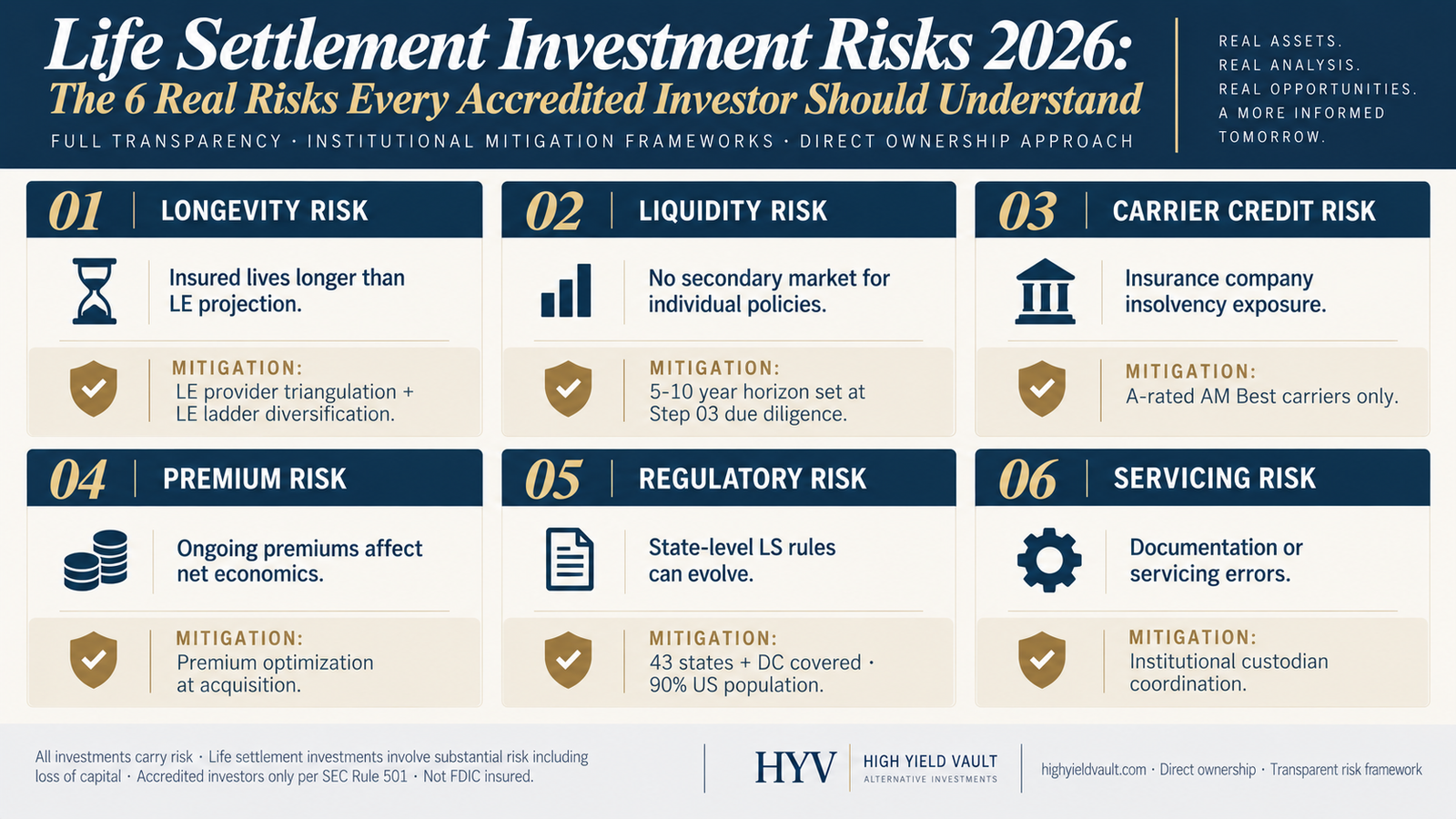
The 6 real life settlement investment risks are longevity, liquidity, carrier credit, premium, regulatory, and servicing. Each is real, quantifiable, and manageable through institutional frameworks. The largest single risk is longevity (insured living longer than projected life expectancy) — mitigated through independent LE provider triangulation and LE ladder diversification.
Life settlements are not FDIC insured. They involve substantial risk including loss of capital. They are illiquid, long-duration alternatives available only to accredited investors under SEC Rule 501. Direct ownership through HYV reduces certain risks (particularly fee-drag and manager-dependence) that pooled fund structures introduce — but does not eliminate risk. See full disclosures at bottom.
Browse vetted life settlement policies with full risk documentation
Every listing includes LE reports from recognized providers, AM Best carrier ratings, premium schedules, and projected IRR under multiple longevity scenarios — the specific risk mitigation data you need to evaluate.
Browse available policiesThe 6 real life settlement investment risks
Every accredited investor evaluating life settlements should understand all six risks explicitly — not because life settlements are unusually risky, but because informed capital allocation requires transparent risk framework analysis. Here's each risk with what it is, potential impact, and how HYV's direct-ownership model addresses it.
Longevity risk
Liquidity risk
Carrier credit risk
Premium risk
Regulatory risk
Servicing risk
Get walked through specific policy risk profiles
Schedule a 20-minute consultation. We'll review LE reports, carrier ratings, premium schedules, and specific risk mitigation on 2–3 vetted policies matched to your allocation — before you commit anything.
Or call (833) 250-9677Fund vs direct ownership: how risk exposure differs
Not all life settlement exposure carries the same risk profile. Fund structures introduce fee-drag, manager-dependence, and pooled premium reserve exposure that direct ownership eliminates. Here's how the 6 risks look under each approach.
Comparison reflects general framework differences between fund and direct-ownership structures. Individual fund managers vary substantially in quality; not every fund carries the maximum-risk profile described. Direct ownership does not eliminate risk — it changes the risk profile by removing certain fund-structure risks and shifting control to the individual investor. Both approaches involve substantial risk including loss of capital.
Direct ownership doesn't eliminate risk — it changes the profile. The 4 risks where direct ownership meaningfully reduces exposure are longevity (you control diversification), carrier credit (you select A-rated only), premium (no shared reserve risk), and servicing (owner-level visibility). Regulatory and market-level longevity risk apply equally to both structures.
Why HYV's direct ownership model is built for risk transparency
Every choice in the HYV platform architecture is designed for risk transparency and investor control. You see the full policy documentation before committing. You control your premium funding. You select A-rated carriers. Your name is on the ownership records. There's no fund manager between you and the policy — and no manager-dependence risk between you and the eventual return.
This is the same institutional model deployed by Apollo Global Management, Berkshire Hathaway, and Partner Re — accessible for accredited individuals at the $250K+ per-policy tier. Institutional-grade risk framework, direct ownership execution.
See available policies with complete risk framework
Every listing includes LE reports, AM Best carrier ratings, premium schedules, contestability status, and projected IRR under multiple longevity scenarios. Accredited investor verification per SEC Rule 501 required.
Frequently asked questions about life settlement investment risks
What are the biggest risks of life settlement investing?
The 6 primary risks of life settlement investing are longevity (insured living longer than projected life expectancy), liquidity (no secondary market for individual policies), carrier credit (insurance company insolvency), premium (ongoing premium costs affecting net economics), regulatory (state-level rules can evolve), and servicing (documentation or execution errors). Longevity is the largest single risk — each additional year beyond projected LE typically reduces IRR by 100-200 basis points. All 6 risks are manageable through institutional frameworks including independent LE provider triangulation, A-rated carrier selection, premium optimization at acquisition, operations only in NAIC-aligned jurisdictions, and institutional custodian coordination. Life settlements are not FDIC insured and involve risk of loss of capital.
Are life settlements a safe investment?
Life settlements are not "safe" in the sense of guaranteed return — no alternative investment is. They are a well-established institutional asset class with quantifiable, well-understood risks and mature mitigation frameworks. Compared to public equities, life settlements offer zero correlation to market volatility and contractual return at maturity, but at the cost of illiquidity and longevity uncertainty. Compared to bonds, life settlements offer higher target returns (8-12% target IRR vs. 4-5% investment-grade bonds) but with materially longer duration and no periodic income. Institutional allocators including Apollo, Berkshire Hathaway, and Partner Re have deployed billions into the asset class specifically because the risk-adjusted return profile — when managed through proper institutional frameworks — competes favorably with other alternatives. For accredited investors who can accept 5-10+ year illiquidity and understand longevity risk, life settlements can be a valuable portfolio addition. They are not appropriate for capital that may be needed short-term or for investors unable to accept potential loss.
What happens if the insured lives longer than expected?
Extended life expectancy — longevity risk — is the single largest risk in life settlement investing. When an insured lives beyond the projected LE, two effects compound: (1) the eventual return is discounted over a longer time frame, reducing IRR by approximately 100-200 basis points per year of extension; (2) additional premium payments during the extended hold period further reduce net return. Institutional mitigation approaches include: using independent LE providers (like ITM TwentyFirst and 21st Services) with track records of conservative estimation, triangulating across multiple LE providers rather than relying on single estimates, and diversifying acquisition across policies with staggered LE profiles so that longevity variance smooths at the portfolio level (Wharton research shows portfolios of 100+ policies reduce return standard deviation by over 40% vs portfolios of 10 or fewer). Individual investors can build meaningful diversification within a $500K-$2M allocation across 2-6 policies with different LE profiles.
Can I lose all my money in a life settlement investment?
Yes — total loss of capital is possible under specific adverse scenarios, though it is not the typical outcome. Total loss scenarios include: policy lapse due to non-payment of premiums (eliminates all return); severe carrier insolvency below state guaranty association coverage limits ($250K-$500K depending on state); or serious servicing errors that invalidate the policy. Institutional mitigation reduces total loss probability substantially: HYV operates with A-rated AM Best carriers only (dramatically reducing carrier insolvency risk), institutional custodian coordination for premium execution (reducing lapse risk from operational error), and documented ownership records (reducing servicing invalidation risk). More typical adverse outcomes are reduced returns (below target 8-12% IRR range) rather than total capital loss — driven primarily by longevity extension. All investors should size life settlement allocations at a level where potential adverse outcomes fit within their overall portfolio risk tolerance. Life settlement investments are not FDIC insured and involve substantial risk.
How does direct ownership reduce risk vs. life settlement funds?
Direct ownership reduces 4 of the 6 risk vectors relative to pooled fund structures. Longevity risk: you control which policies you acquire and can build diversification across LE profiles matching your specific risk tolerance rather than inheriting a manager's selection bias. Carrier credit risk: you see and select every carrier — HYV limits acquisition to A-rated AM Best carriers only, transparent on every listing. Premium risk: you fund your own policies through your custodian; no exposure to shared premium reserves where other investors' failure to fund can trigger policy issues. Servicing risk: you have owner-level visibility on every policy status; institutional custodian coordination handles execution but you remain owner of record. Direct ownership does not reduce liquidity risk (both have similar hold periods) or regulatory risk (same state-level framework applies). Direct ownership also eliminates fund manager fee-drag (typically 1-2% annual + performance fees) that meaningfully compresses net returns under fund structures — this isn't a "risk" reduction technically, but it does improve net return economics substantially.
How do I evaluate risk on a specific life settlement policy?
Every specific policy carries a discrete risk profile you can evaluate before committing capital. Key evaluation points include: (1) LE reports from recognized independent underwriters — look for multiple LE providers rather than single-source estimates, and consider the range of estimates rather than just the point projection; (2) carrier financial strength — AM Best rating of A or better is the institutional standard; (3) premium schedule — annual premium efficiency under 4% of face value is the standard threshold for policy-level acquisition; (4) contestability status — policies past the 2-year contestability window carry substantially reduced acquisition risk; (5) policy type — universal life and guaranteed universal life are the standard institutional acquisition types; (6) insured age and health profile — the standard institutional acquisition range is age 75+ with documented medical impairments supporting the LE projection. HYV's policy scoring framework applies all 6 criteria to every listing — see the full scoring framework or schedule a consultation to walk through a specific policy's risk profile with an advisor.
Ready to evaluate policies with full risk framework applied?
Two paths: browse currently available policies to see specific risk profiles, or schedule a consultation to walk through risk mitigation with an advisor before viewing any policy.
Or call (833) 250-9677