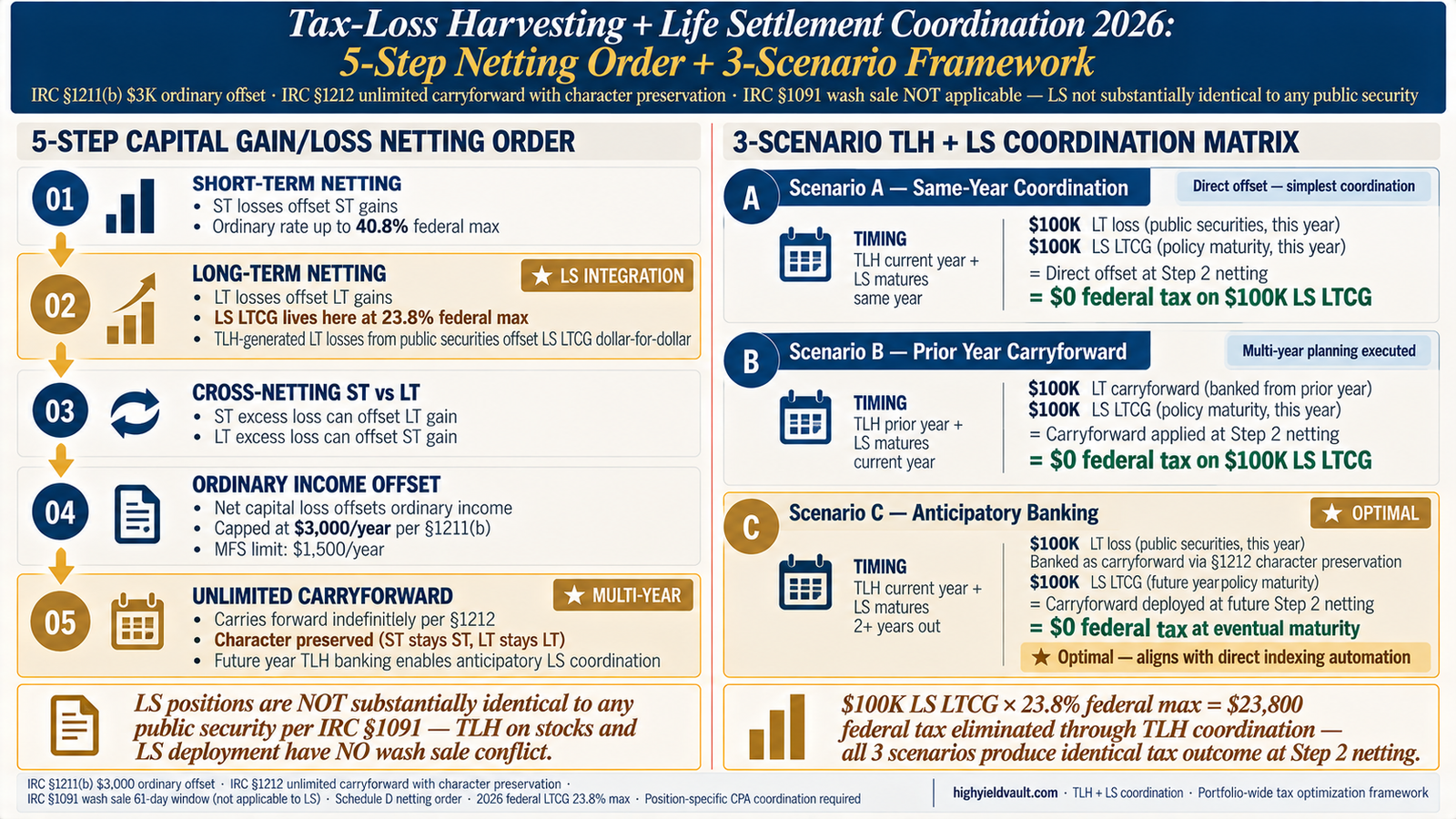
Yes — tax-loss harvesting from public securities (stocks, ETFs, bonds, mutual funds) can offset life settlement LTCG at maturity dollar-for-dollar through IRC §1211/§1212 capital netting framework, with no wash sale rule conflict because LS positions are NOT substantially identical to any public security per IRC §1091. The 5-step netting order: (1) short-term losses offset short-term gains; (2) long-term losses offset long-term gains — this is where LS LTCG lives at 23.8% federal maximum rate; (3) cross-net remaining ST vs LT excess; (4) net capital loss offsets ordinary income up to $3,000/year per §1211(b); (5) excess carries forward indefinitely per §1212 with character preserved (long-term stays long-term). A $100K TLH-generated long-term loss from public securities offsets $100K LS LTCG dollar-for-dollar at Step 2 = $0 federal tax on that gain = $23,800 federal tax eliminated at 23.8% top rate.
Three coordination scenarios apply depending on timing: Scenario A (same-year coordination) — TLH and LS maturity both occur same tax year, direct offset at Step 2; Scenario B (prior year carryforward) — accumulated TLH carryforward from prior years applied to current year LS maturity, multi-year planning executed; Scenario C (anticipatory banking — optimal) — TLH current year generates carryforward specifically targeted at projected LS maturity in future year, enables sophisticated multi-year coordination. For investors using direct indexing strategies (modern TLH automation), the carryforward banking approach aligns well with LS position LE profiles — direct indexing generates annual 1-2% realized loss generation that compounds into substantial carryforward balances available for future LS maturity year offsets. Position-specific CPA coordination essential for carryforward tracking, character preservation documentation, and state tax conformity analysis across multi-year horizons.
Browse life settlement policies for TLH coordination
Every listing includes LE profile documentation prepared for CPA coordination with your portfolio-wide tax-loss harvesting strategy and multi-year carryforward planning.
Browse available policiesWhy LS coordination with TLH preserves full portfolio-level tax optimization
Portfolio-level tax optimization for high-bracket investors involves coordinating capital gain and loss realization across all portfolio positions — public equities, bonds, REITs, alternative investments, and life settlement positions. Managing each asset class in isolation misses the dollar-for-dollar offset opportunity that IRC §1211/§1212 netting framework enables across the complete capital asset portfolio. A $100K public equity loss harvested in isolation produces only $3,000 current-year ordinary income offset per §1211(b) with $97,000 carried forward — the offset against the $3,000 ordinary deduction at 40.8% top rate = $1,224 current-year tax savings. The same $100K loss coordinated with $100K LS LTCG at maturity same year produces full $100K direct offset at Step 2 of netting order = $23,800 federal tax eliminated at 23.8% LTCG rate. The 20× tax savings improvement from coordination versus isolation illustrates why portfolio-wide TLH + LS coordination matters materially for high-bracket investors.
The IRC §1091 wash sale rule is the critical regulatory consideration that enables unconstrained TLH + LS coordination. The wash sale rule applies only to purchases of substantially identical securities within the 61-day window (30 days before and 30 days after the loss sale). The IRS and Treasury regulations have never characterized LS positions as substantially identical to any public security — LS positions are structured as direct ownership of specific life insurance policies on specific insured individuals, with risk profiles (longevity risk, carrier credit risk, servicing risk) that bear no resemblance to publicly-traded equity or debt securities. Even for Treasury securities or life insurance company equity shares (companies that may be among LS policy issuers), the regulatory analysis clearly treats these as fundamentally different asset classes from direct LS position ownership. The practical consequence: investors can harvest losses from any public security position and simultaneously maintain or add LS positions without wash sale rule interference.
For sophisticated high-bracket investors using direct indexing strategies (automated TLH across hundreds of individual stock positions representing broad market index exposure), the LS coordination compatibility is particularly valuable. Direct indexing typically generates 1-2% annual realized loss generation that creates substantial multi-year carryforward balances. For an investor with $5M direct indexing portfolio generating approximately $50K-$100K annual carryforward, the accumulated carryforward across 5-7 years ($250K-$700K cumulative) provides significant offsetting capacity for anticipated LS maturity events during that horizon. The anticipatory banking approach (Scenario C) aligns TLH generation timing with projected LS maturity windows for optimized multi-year coordination.
The 5-step netting order visualization
The vertical flowchart below shows the complete IRC capital gain and loss netting sequence per Schedule D rules. Step 2 (long-term netting) and Step 5 (unlimited carryforward) are gold-highlighted as the critical LS coordination touchpoints — LS LTCG lives at Step 2 where long-term losses from public securities directly offset it, and Step 5 carryforward enables multi-year coordination banking for anticipated future LS maturity events.
Short-term netting
ST losses offset ST gains within the same tax year. ST capital gains and losses include positions held one year or less. ST gains taxed at ordinary rates up to 40.8% federal max at top bracket. Result: net ST gain or net ST loss carries to Step 3.
Long-term netting
LT losses offset LT gains — LS LTCG lives here. LT capital gains and losses include positions held more than one year, including LS positions at policy maturity. TLH-generated LT losses from public securities (stocks, ETFs, bonds held >1 year) directly offset LS LTCG dollar-for-dollar at this step. LT gains taxed at 23.8% federal max at top bracket (20% + 3.8% NIIT). Result: net LT gain or net LT loss carries to Step 3.
Cross-netting ST vs LT
If one category produces net gain and the other net loss, cross-netting applies. ST excess loss can offset LT gain (reducing LTCG tax); LT excess loss can offset ST gain (reducing ordinary tax). The ordering is specifically prescribed to maximize tax outcome. Result: single net capital gain or net capital loss carries to Step 4.
Ordinary income offset
Net capital loss (if any) offsets ordinary income up to $3,000 per tax year per IRC §1211(b) ($1,500 limit for married filing separately). The ordinary income offset is capped — losses above the cap do not reduce ordinary tax in the current year. Result: offset applied; any excess loss carries to Step 5.
Unlimited carryforward
Carryforward unlimited per IRC §1212 — character preserved. Excess net capital loss above the $3,000 ordinary offset cap carries forward to subsequent tax years indefinitely with no expiration. Critically, character is preserved — ST losses carry forward as ST losses, LT losses carry forward as LT losses. This enables anticipatory banking: current year TLH-generated LT losses from public securities can be banked specifically for future year LS maturity events, with the character preservation ensuring the carryforward applies at Step 2 (long-term netting) when the LS LTCG materializes.
LS positions are NOT substantially identical to any public security per IRC §1091 wash sale rule — TLH on stocks and LS deployment have NO wash sale conflict.
How does portfolio-wide coordination fit your LS deployment?
Schedule a 20-minute consultation. We'll walk through your existing TLH strategy, carryforward balance, and projected LS maturity timeline to identify same-year, prior year, and anticipatory banking coordination opportunities for your portfolio.
Or call (833) 250-9677The 3-scenario coordination timeline matrix
The matrix below shows three timing scenarios for TLH + LS coordination, each illustrated with $100K reference figures. All three scenarios produce the same tax outcome at Step 2 of netting ($100K LT loss offsets $100K LS LTCG = $0 federal tax) — the scenarios differ in multi-year planning sophistication required.
$100K LS LTCG × 23.8% federal max = $23,800 federal tax eliminated through TLH coordination — all 3 scenarios produce identical tax outcome at Step 2 netting.
Real walkthrough: Daniel's $200K LS LTCG offset through direct indexing carryforward
Here's how the TLH + LS coordination applies in practice, illustrated through a composite scenario based on the standard pattern for high-bracket investors using direct indexing TLH automation with LS position maturity coordination.
58-year-old high-bracket investor · $200K LS LTCG offset through $150K direct indexing TLH carryforward
Starting position: Daniel, a 58-year-old private equity partner in Texas (zero state tax, 23.8% federal LTCG only), has $7.8M diversified portfolio including $4.2M direct indexing allocation managed through Parametric Portfolio Associates (actively generates realized losses via systematic rebalancing of individual stock positions representing S&P 500 exposure). His CPA at Grant Thornton has been tracking his multi-year capital loss carryforward balance as the direct indexing strategy generates approximately $85K-$120K annual realized losses — cumulative long-term capital loss carryforward balance at end of year 4 (prior to current year) reached $385K across multiple annual accumulations.
LS maturity event: In the current tax year, one of Daniel's four life settlement positions matures — insured passes, death benefit $425K paid to Daniel in September. CPA calculates adjusted basis per Day 106 CPA checklist methodology: purchase price $225K (acquisition year 7 prior) + cumulative premiums paid $70K ($10K/year × 7 years during ownership) = adjusted basis $295K. Taxable LS LTCG = $425K death benefit − $295K adjusted basis = $130K long-term capital gain reportable at Schedule D Part II. Without TLH coordination, Daniel would face $130K × 23.8% federal max = $30,940 federal tax on this gain (TX zero state).
TLH coordination execution: Daniel's CPA executes TLH coordination at Schedule D netting Step 2: current year direct indexing TLH-generated LT losses from Parametric portfolio = $95K (year 5 of program); prior years cumulative LT carryforward balance = $385K; total available LT loss capacity for current year = $480K. The $130K LS LTCG is fully offset at Step 2 by LT losses, with $350K remaining LT loss carryforward balance after offset ($480K available − $130K LS LTCG consumed = $350K carried to year 6 and beyond). Federal tax eliminated: $30,940 at 23.8% rate on $130K LS LTCG.
Portfolio-wide impact analysis: Beyond the LS LTCG offset, Daniel's remaining $350K LT carryforward provides significant coordination capacity for his remaining 3 LS positions (ticket sizes $175K-$275K each) projected to mature in years 8-11 of the overall position portfolio hold horizon. Projected cumulative LS LTCG across remaining 3 positions = approximately $420K-$550K depending on actual death benefit realization relative to LE projections. The $350K carryforward balance plus ongoing annual direct indexing TLH generation ($85-$120K/year for remaining program horizon) will provide approximately $700K-$950K cumulative LT loss capacity over the next 5 years — meaningfully exceeding the projected $420K-$550K LS LTCG from remaining positions. Daniel's portfolio-wide tax optimization: substantially all LS LTCG across all 4 positions will be offset by direct indexing-generated LT losses, producing near-complete federal tax elimination on the LS portfolio's cumulative gains.
Documentation requirements: Grant Thornton maintains comprehensive carryforward tracking in Daniel's position-level tax files including: (1) annual Form 8949 entries documenting each direct indexing realized loss event; (2) running cumulative carryforward balance spreadsheet with character tracking (LT losses tracked separately from ST losses per §1212 character preservation requirement); (3) annual Schedule D excerpts showing year-end carryforward position; (4) coordinated projection analysis showing anticipated future LS maturity events against projected carryforward capacity. The documentation is essential for IRS audit defense of the carryforward balance claim across the multi-year horizon.
Total portfolio optimization value: Over the complete LS portfolio hold horizon (approximately 10 years from year 1 acquisition through year 11 final position maturity), the TLH + LS coordination projects to eliminate approximately $100,000-$130,000 in federal tax on cumulative LS LTCG — a direct dollar-for-dollar transfer of what would have been IRS tax revenue into Daniel's after-tax wealth. For his broader portfolio-wide tax optimization including non-LS capital gain events, the direct indexing strategy continues to generate carryforward capacity useful for additional capital gain management across all asset classes.
Daniel's workflow reflects the standard pattern for high-bracket investors using direct indexing TLH automation to generate ongoing capital loss carryforward capacity coordinated with LS position maturity timing. The framework: direct indexing + LS coordination produces compound tax optimization value — each LS maturity LTCG offset through accumulated TLH carryforward eliminates full LTCG federal tax at 23.8% rate. For investors with substantial direct indexing allocation ($3M+) and multi-position LS portfolio ($500K+), the coordination value scales meaningfully. Position-specific CPA engagement essential for carryforward tracking, character preservation documentation, and Schedule D line coordination across multi-year horizons.
Get matched with policies for TLH-coordinated allocation
Tell us your existing TLH strategy (direct indexing, manual harvesting, or none), accumulated carryforward balance, and portfolio size. We'll show you 2-3 vetted life settlement policies with LE profiles suited to anticipated coordination timing.
When TLH + LS coordination requires sophisticated planning
The 3-scenario coordination framework provides operational guidance for most TLH + LS coordination situations. However, certain scenarios involve regulatory or structural complexity requiring attorney-level or specialized CPA planning beyond standard framework application.
Four scenarios requiring sophisticated TLH + LS planning beyond standard framework
1. State tax carryforward non-conformity. Federal §1212 unlimited carryforward with character preservation does NOT automatically apply at the state level — some states conform fully to federal carryforward treatment, others have modified rules, and some states apply time limits on carryforward usage. California, New Jersey, Pennsylvania, and certain other high-tax states have state-specific capital loss rules that may differ from federal §1212 treatment. For high-state-tax investors (particularly CA, NY, NJ residents), state-level TLH + LS coordination requires CPA state tax conformity analysis — the federal coordination may work cleanly while state-level treatment differs. Position-specific state tax CPA engagement essential.
2. Entity ownership (trust, LLC, S-corp) complicating carryforward tracking. TLH + LS coordination at the individual level is straightforward; coordination through entity structures introduces complexity. Grantor trusts generally pass through capital gains and losses to the grantor at individual rates — coordination maintained. Non-grantor trusts (irrevocable trusts) have their own capital loss carryforward tracking at trust level, which may not align with grantor's individual carryforward balance. LLC ownership typically passes through to members. S-corp ownership follows pass-through rules. For LS positions held in anything other than direct individual ownership, specialized attorney + CPA coordination essential to confirm carryforward integration path.
3. Alternative Minimum Tax (AMT) interaction. AMT uses parallel calculation framework including capital gains with modified treatment. For high-income investors subject to AMT (increasingly rare after TCJA 2017 but still applicable in some scenarios), capital loss carryforward utilization against capital gains for AMT purposes may differ from regular tax treatment. CPAs managing TLH + LS coordination for AMT-exposed clients require parallel AMT tracking of carryforward balance. OBBBA 2025 did not materially modify AMT framework for individual investors.
4. Cross-year character transition requiring documentation. ST losses carried forward from year 1 remain ST losses in year 2, 3, and beyond — they do NOT transition to LT character over time regardless of hold-equivalent duration. This matters for TLH + LS coordination because LS LTCG is strictly LT (position held >1 year), so only LT carryforward losses can offset LS LTCG at Step 2 of netting. ST carryforward can offset LS LTCG only through Step 3 cross-netting after ST excess exists. CPAs must maintain strict character tracking in carryforward documentation — mislabeling ST as LT or vice versa produces incorrect Schedule D results and potential IRS correspondence.
For investors in these four specialized scenarios, standard TLH + LS coordination framework provides starting point but requires expanded professional engagement. HYV coordinates with investor's existing professional team; specific state tax, entity structure, AMT, and character tracking considerations handled by the CPA + attorney engagement specific to the investor's situation.
See currently available policies for coordination-ready allocation
Every listing includes full policy documentation, LE reports from certified underwriters, AM Best carrier ratings, premium projections, projected IRR, and position-level documentation for your CPA TLH + LS carryforward coordination workflow. Accredited investor verification per SEC Rule 501 required to view specific policies.
Or call (833) 250-9677Frequently asked questions about TLH + LS coordination
Does the wash sale rule apply to life settlement positions?
No — IRC §1091 wash sale rule applies only to purchases of substantially identical securities within the 61-day window (30 days before and 30 days after a loss sale). Life settlement positions are NOT substantially identical to any publicly-traded security including stocks, ETFs, bonds, mutual funds, or life insurance company equity shares. LS positions are direct ownership interests in specific life insurance policies on specific insured individuals with risk profiles (longevity risk, carrier credit risk, policy contestability risk, servicing risk) that bear no resemblance to publicly-traded securities. The IRS and Treasury regulations have never characterized LS positions as substantially identical to any public security category. The practical consequence: investors can harvest losses from any public security position (stocks, ETFs, bonds, mutual funds) and simultaneously maintain or add LS positions without wash sale rule interference. Investors can also sell LS positions at a loss (if structured as a secondary market sale rather than hold-to-maturity) and purchase replacement LS positions without wash sale concern since LS positions themselves are not substantially identical to each other (each policy is on different insured individual with different LE profile). The wash sale rule only becomes relevant in LS context if investor sold a specific public security at a loss and separately purchased a substantially identical public security within the 61-day window — the LS deployment is irrelevant to that analysis. Position-specific CPA review essential for any unusual TLH scenarios involving multiple account structures or sophisticated loss harvesting strategies.
How does character preservation work for multi-year carryforward tracking?
IRC §1212 character preservation is a critical feature of the unlimited carryforward framework for TLH + LS coordination. The core rule: short-term capital losses carry forward as short-term losses, long-term capital losses carry forward as long-term losses, with character preserved indefinitely across subsequent tax years. This matters for LS coordination because LS LTCG at maturity is strictly long-term capital gain (position held more than 1 year — standard LS positions easily satisfy this per typical 5-10 year hold horizons). Only LT carryforward losses can directly offset LS LTCG at Step 2 of netting order; ST carryforward losses must first offset any ST gains, then cross-net against LT gains at Step 3 (with reduced optimization value since ST losses would be more valuable offsetting ordinary rate ST gains in Step 1). CPAs managing multi-year carryforward tracking must maintain strict character segregation in client position files — mislabeling ST as LT or vice versa produces incorrect Schedule D results. For direct indexing programs, the typical pattern is predominantly LT loss generation (positions held long enough to qualify for LT treatment before loss realization) with smaller ST loss component. Investors using Parametric, Aperio, or other direct indexing platforms should receive annual client statements breaking down realized losses by character — these statements become source documents for the CPA carryforward tracking spreadsheet. For LS coordination specifically, the LT character of accumulated direct indexing carryforward aligns perfectly with LS LTCG character requirement at Step 2 netting. Position-specific documentation discipline essential for multi-year character tracking accuracy.
Does direct indexing TLH work particularly well with LS coordination?
Yes — direct indexing TLH automation and LS coordination are particularly complementary strategies for high-bracket investors. Direct indexing (through providers like Parametric Portfolio Associates, Aperio Group, Vanguard Personalized Indexing, or Fidelity Managed FidFolios) replicates broad market index exposure through ownership of hundreds of individual stock positions rather than mutual fund or ETF ownership. The automation systematically identifies positions trading below cost basis and executes loss sales while maintaining broad market exposure — typically generating 1-2% annual realized loss generation (around $20K-$50K per year on $2M-$5M direct indexing allocation). The accumulated carryforward balance from multi-year direct indexing programs provides substantial LT loss capacity for anticipated LS maturity events. The complementarity: direct indexing generates LT losses systematically regardless of market direction (down markets provide more harvesting opportunity; up markets still provide harvesting at the position-specific level); LS positions produce LT capital gains at policy maturity on a probabilistic schedule tied to insured longevity. The pairing provides natural tax optimization — direct indexing banks losses, LS maturity events deploy the carryforward against gains, both at the preferential LTCG rate structure. For investors already using direct indexing for public equity allocation, adding LS positions to the portfolio creates efficient tax arbitrage. For investors not yet using direct indexing but considering it, the LS coordination benefit is additional motivation beyond direct indexing's standalone tax optimization value. HYV coordinates with investor's existing direct indexing provider documentation to confirm projected carryforward capacity relative to LS deployment sizing. Not all investors benefit equally — direct indexing works best for $2M+ public equity allocation with top-bracket tax situation; smaller allocations don't justify the typical 20-40 bps direct indexing fee structure.
How does state tax carryforward conformity affect TLH + LS coordination?
Federal §1212 unlimited carryforward with character preservation does NOT automatically apply at the state level — each state has its own capital loss carryforward rules that may conform fully, partially, or differently from federal treatment. For zero-tax states (AK, FL, MO, NV, NH, SD, TN, TX, WY per our Day 102 state tax framework), state carryforward conformity is irrelevant because no state capital gains tax applies — federal-only analysis is complete. For most other states that apply capital gains tax, state carryforward rules broadly follow federal §1212 pattern but with specific state exceptions worth confirming. California applies unlimited carryforward similar to federal. New York allows carryforward but with potential limitation on amount offsetable in single year. New Jersey has historically been more restrictive on capital loss carryforward usage. Pennsylvania and certain other states have specific rules on capital loss treatment that may differ from federal. For high-state-tax investors (CA 13.3%, NY 10.9%, NJ 10.75%, HI 11% top rates), the state tax layer on LS LTCG at maturity year is substantial — $100K LS LTCG × 13.3% CA = $13,300 state tax independent of federal; if CA carryforward conformity matches federal, the $100K LT state carryforward can offset the LS LTCG at state level too, eliminating state tax. If state conformity differs, CPA state tax analysis required. The practical implication: CPAs managing TLH + LS coordination for multi-state scenarios or high-state-tax jurisdictions must maintain parallel federal and state carryforward tracking, with state tax conformity verified per each state's specific rules. For investors in zero-tax states, the complexity doesn't apply. For most states with capital gains tax, broad conformity to federal §1212 means TLH coordination largely works at state level too — but specific confirmation essential per CPA state tax analysis.
How does Schedule D line coordination work for TLH + LS reporting?
Schedule D (Capital Gains and Losses) is the summary form where TLH + LS coordination lands at tax filing. The relevant lines: Part I (Short-term capital gains and losses) aggregates ST transactions; Part II (Long-term capital gains and losses) aggregates LT transactions including LS LTCG. Line 8b of Part II totals LT transactions with Box D checked (basis reported to IRS); Line 9 totals Box E (basis reported to taxpayer only); Line 10 totals Box F (not reported). LS positions typically report through Form 8949 Part II Box D if carrier Form 1099-R basis was reported to IRS, or Box E if reported to taxpayer only. The specific Form 8949 line entries flow to Schedule D Lines 8b/9/10 based on Box classification. TLH-generated losses from direct indexing positions typically flow through Form 8949 Part II Box A/B/C (short-term) or Box D/E/F (long-term) depending on holding period of each sold position, with totals flowing to appropriate Schedule D lines. Line 13 of Schedule D Part II includes "Capital gain distributions" from mutual funds and REITs (ordinary rate but LT treatment for individual investor); Line 14 is the LT loss carryforward from prior year (from Schedule D Line 15 of prior year return, or from Capital Loss Carryover Worksheet). Line 15 (Net long-term capital gain or loss) is the sum of all Part II components — this is where TLH + LS coordination at Step 2 netting mathematically resolves. Line 16 (combined net capital gain or loss) adds Part I and Part II nets. Lines 17-22 handle the capital gains tax rate calculation for net LTCG. CPAs managing TLH + LS reporting must ensure accurate Form 8949 entries flow correctly through Schedule D with carryforward balance from prior year worksheet integrated at Line 14. Position-specific CPA review essential — standard TurboTax or similar consumer software may not handle complex multi-year carryforward tracking accurately for high-bracket investors.
What CPA documentation standards apply for multi-year carryforward tracking?
CPAs managing TLH + LS coordination with multi-year carryforward tracking should maintain comprehensive documentation per standard practice for high-bracket client engagements. The documentation framework: (1) Annual Capital Loss Carryover Worksheet (prepared with each tax year's return) showing current year ending carryforward balance by character (ST vs LT) — this becomes the opening balance for the following year's Line 14 Schedule D entry; (2) Running cumulative carryforward spreadsheet maintained in client file with year-over-year balance tracking, character preservation detail, and source documentation for each annual addition and offset event; (3) Annual Form 8949 copies retained in client file for IRS audit defense of the carryforward basis; (4) Direct indexing provider annual client statements (Parametric, Aperio, etc.) retained as source documents for TLH realized loss generation per year; (5) LS position maturity year complete tax file with Form 1099-R, Form 8949 preparation documentation, Schedule D excerpts, and carryforward application calculation; (6) State tax parallel tracking documentation for high-tax jurisdictions. The documentation is essential for several reasons: IRS audit defense of carryforward balance claims that compound over 5-10+ year horizons; tax position consistency across years ensuring character preservation accuracy; carryforward utilization optimization timing analysis for anticipated future gain events including LS maturities. For investors with complex situations (entity ownership, multi-state residency, AMT exposure), the documentation requirements expand further. Standard CPA engagement for high-bracket investors with TLH + LS coordination typically involves 10-20 hours of annual engagement time just for the carryforward tracking and coordination analysis, apart from standard tax return preparation. The engagement cost ($3,000-$8,000 annually for this specific scope) is minor relative to the tax optimization value preserved. Position-specific CPA engagement essential — generic framework guidance does not substitute for licensed CPA professional judgment.
Start with the coordination assessment
Two paths to begin: browse currently available life settlement policies to see what matches your TLH-coordinated allocation needs, or schedule a consultation to walk through your existing TLH strategy, carryforward balance, and projected LS maturity coordination opportunities.
Or call (833) 250-9677